
The Caribbean Island of Cuba is once again appealing to the international community to end what it describes as the “silent genocide” of its people — the six-decade-long economic blockade imposed by the United States of America. This week, Cuba will present its case before the United Nations General Assembly, seeking renewed support for the lifting of the unilateral embargo that has crippled nearly every aspect of the island’s economy.
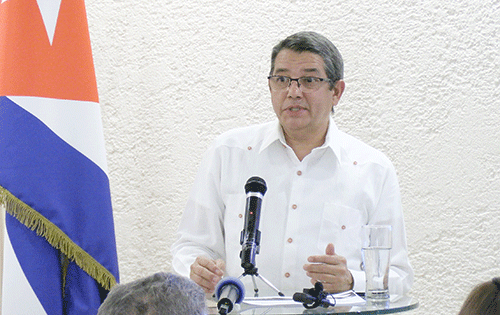
Speaking in Windhoek yesterday, the Cuban Ambassador to Namibia, Sergio Vigoa de la Uz, condemned the blockade as “illegal and inhumane,” saying it continues to inflict deep and measurable economic pain on the island’s 11 million citizens. “The blockade is the silent genocide of the Cuban people,” he said, adding that even simple financial transactions come at exorbitant costs due to Cuba’s exclusion from global systems such as SWIFT, the international interbank messaging network.
“The mere fact that Cuba cannot access SWIFT penalises our country with millions of dollars just to find alternative routes to complete basic financial operations,” he explained.
Since its introduction in the early 1960s, the US blockade has systematically weakened Cuba’s economy, manufacturing capacity, and trade relations. Recently declassified US documents reveal that the original intent of the embargo was to “bring about hunger and despair” among Cubans to prompt an uprising against the island’s communist government.
More than sixty years later, the economic impact remains devastating. Cuba estimates that the blockade has cost its economy billions of dollars annually and trillions of dollars since it was illegally implemented. The blockade deprives Cuban citizens of critical goods and services ranging from food and medicine to public transport and renewable energy.
This year, the US administration under president Donald Trump has intensified restrictions, tightening Cuba’s access to foreign markets and financial institutions in what Cuban officials describe as “an effort to strangle the economy to death.”
The Cuban government has translated the cost of the blockade into stark, everyday comparisons that highlight its social toll. This includes four months of blockade losses (US$2.85 billion) equal the financing required to purchase all the buses needed for Cuba’s public transportation system; two months of losses (US$1.6 billion) could cover the fuel costs to meet the country’s regular power demand for a year; another two months could fund the annual delivery of the rationed family food basket for every Cuban household; the cost of just 16 days of blockade (US$339 million) equals the funding needed to supply all essential medicines for the national healthcare system; 14 days could finance the expansion of renewable energy sources from 24% to 26% of Cuba’s energy mix; six days of losses (US$129 million) could cover the annual importation of basic medical consumables, including syringes, sutures, catheters, and intra-venous equipment; and even two hours of blockade losses (US$1.4 million) equal the cost of life-saving medications for psychiatric, neurological, and heart conditions, as well as special foods for children with genetic deficiencies.
These comparisons underscore the extraordinary economic strain the embargo places on ordinary Cubans, which is a burden that affects everything from hospitals and schools to transportation and clean energy.
Despite decades of pressure, Cuba continues to receive strong international backing.
At this year’s UN General Assembly, President Netumbo Nandi-Ndaitwah reiterated government’s call for an end to the embargo and demanded that Cuba be removed from the US list of state sponsors of terrorism. “Cuba’s resilience in the face of economic aggression is an inspiration to developing nations,” she said.
Namibian parliamentarians have likewise voiced solidarity, urging the United States and its allies to end what they described as an unjust and outdated policy.
Locally, the Cuban Embassy in Windhoek is organising a solidarity caravan, starting from Agosto Neto Park near the Angolan Embassy, to demonstrate public support for Cuba’s struggle and the removal of the blockade.
While the political motivations behind the blockade remain entrenched, economists argue that its social and developmental consequences are undeniable. Restricted access to trade, technology, credit, and global finance has stunted Cuba’s growth, limited industrial output, and discouraged foreign investment.
The United Nations has, for decades, overwhelmingly voted in favour of resolutions condemning the embargo, yet the illegal policy remains in place. For Cuba, each additional day of blockade means another lost opportunity for growth and improved living standards.
As Ambassador De la Uz put it, “The main goal pursued by the US government has not changed, it is to suffocate our economy and provoke a social collapse. But Cuba has chosen dignity over submission”.
With the global community once again debating the future of the blockade, the question remains: how long can an island nation endure the world’s longest-running economic siege, and at what cost to its citizens?