


Uakutura Kambaekua
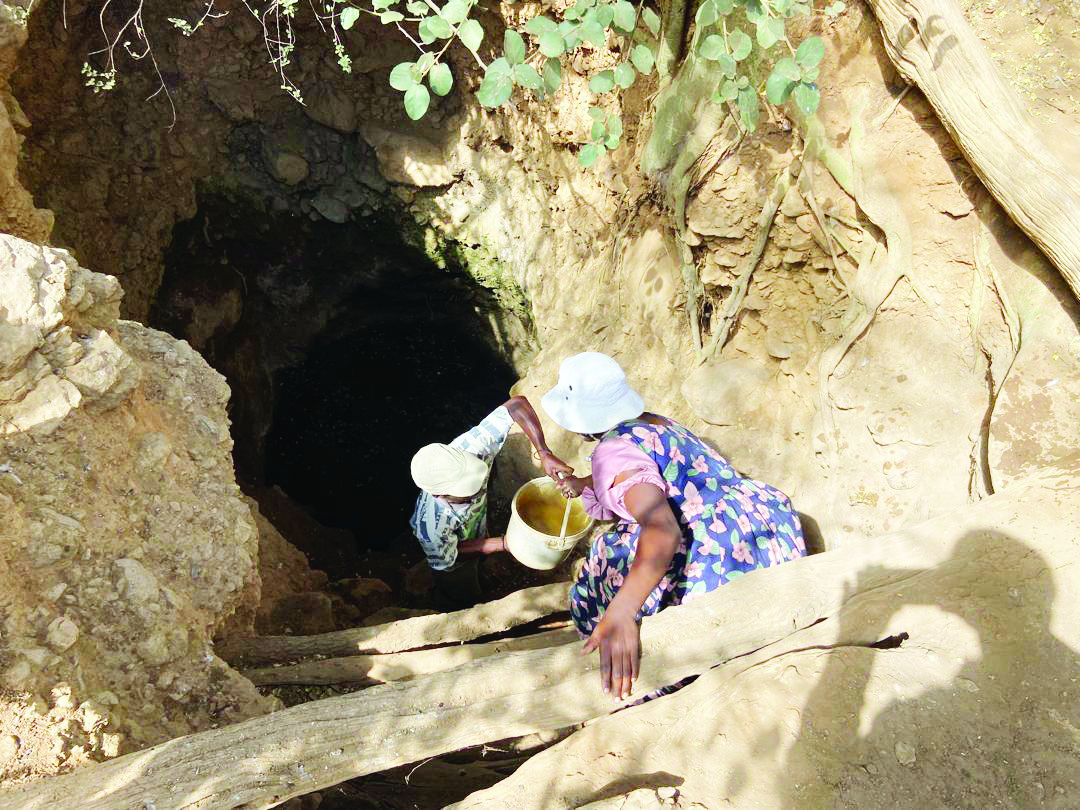
OPUWO – The escalating demand for quality water and persistent scarcity issues have become a significant challenge for residents of Opuwo.
They are calling for prompt and effective rectification.
For the past 34 years, the rocky town has been grappling with water challenges due to scarcity, lack of quality water, and loss of water.
The town’s aggrieved residents allege that population growth, urbanisation and poor management of water resources have aggravated the water crisis. The scarcity affects their socio-economic activities, food security (gardening) and health. It prompted the residents to complain to the Opuwo Town Council management for permanent solutions. They claim that the pre-paid water meter system was installed to swindle them.
Resident Mberimo Tjazapi decried the new water meter system by the council for effective debt- collection and safe water usage.
“Since the installation of these pre-paid water meters, our debt has been increasing. We thought the council would do their deductions of other services when we buy water, but this has not been the case,” she charged. A representative from Hengarihoff Corporation anonymously told this publication that the company was hired by the town council to install pre-paid water meters. The arrangement regarding deductions is between the client and the town council.
He noted that the pre-paid water meters function like a bank.
“If you don’t purchase water, the account continues to run. Without any deposits, the balance goes into the negative, resulting in increasing debts owed to the council,” added the representative. Over 500 households in Opuwo have so far had pre-paid water meters installed.
The installation process is still ongoing. Some residents moaned that they have been paying for “air”, as no water runs from their taps.
“We had no idea that air could be so costly. You open the tap, but nothing comes out – only to be billed later for air. This feels unjust,” remarked one resident. The council stated that Opuwo water has high levels of calcium and magnesium salts, which are the main minerals that cause scaling in pipes.
Council and NamWater have recently engaged with residents to discuss possible solutions.
They assured that by next year, the water crisis would be alleviated.
The discussions involved the Opuwo borehole, which is the town’s primary water source.
The borehole contains high levels of chloride, fluoride, sulphate, copper nitrate, iron and manganese.
These metals contribute to poor taste and health concerns. Scaling in pipes and meters as well as excessive soap consumption further complicate the situation, leading to digestive issues for sensitive individuals. Head of NamWater’s Business Unit in the North-West Hieronymus Goraseb said Opuwo’s water is classified as class B. This means that it is of ‘acceptable’ quality. “The reverse osmosis plant is designed to reduce or eliminate these detergents. However, the technology/process is not 100% effective, and at best produces class B water. The total hardness is a major cause for concern, as it causes scaling in pipes and meters, and excessive soap consumption,” he stressed.
He acknowledged that the water corporation still struggles to meet water demand, improve water quality, secure alternative water sources, replace the acid storage facility and rehabilitate the terminal reservoir. However, NamWater is working on the matter.
The corporation has drilled seven boreholes with a production capacity of 120 cubic metres per hour (1 020 litres). Output remains at 90 cubic metres per hour (900 litres), rationed between 21h00 and 05h00. The current supply is insufficient for Opuwo’s 36 000 residents, who require at least 2 030 litres daily. Goraseb noted that NamWater is busy with the refurbishment of the Opuwo Plant Structure, construction of a temporary fence, and brine conveying pipeline at a total cost of N$1.2 million.
The project is expected to be completed this month.
Other short-term interventions by NamWater include the replacement of existing membranes to improve water quality.
This includes the repair and replacement of dysfunctional components of the plant for N$1.1 million. All these projects are in line with the United Nations Sustainable Development Goal (SDG) 6, which aims to ensure sustainable access to clean water and sanitation by 2030.
However, assessing water scarcity remains a challenge as Opuwo’s population continues to grow.
NamWater has proposed further initiatives, including policies to protect water catchment areas and enhance clean water access.
As a medium-to-long-term solution, NamWater plans to drill 20 boreholes at Okovaeve village, expected to be completed in 22 months. “A major project to drill 20 new boreholes in the eastern well fields is underway. This includes 13 production boreholes and seven standby boreholes to meet Opuwo’s projected water demand of 3 040 cubic metres per day by the 2036 fiscal year,” Goraseb said.
Another notable long-term solution will be the Epalela-Okaluheke canal, which might take at least 10 years to be completed.
This would aid Opuwo in case the boreholes dry up.
Opuwo Town Council promised to address the ongoing water predicaments by coming up with short-term interventions.
Management committee chairperson Lucius Mupya said the council is “working around the clock” to ensure everyone has access to water. “The town council is trying its best to ensure that all residents have access to water. We are not just standing by, as we are affected by this too”.
He said the council has drilled two boreholes to help the existing ones that were drilled by NamWater to primarily cater for residents of the Orutjandja location.
Mupya urged the residents to pay their dues to fast-track the improvement of the ongoing water challenges. He said the council has set high standards for water quality, and intends to go to great lengths to ensure these standards are met.
-Nampa