


The contemporary challenges facing Africa and developing countries are huge. Unemployment, hunger, poverty and wars are all serious challenges. These are challenges making African countries inevitably perform at the negative end, and where events become too dramatic, relief actions from wealthier nations often have to respond to “African chaos.”
However, even relief action has become a problem, as seen recently with certain countries halting relief aid to needy countries. Therefore, the continent now needs technocrats, not necessarily talkers, to solve current challenges and realities. But how can African technocrats contribute to the betterment of their people’s socio-economic conditions?
The term “technocrats”, consists of two parts, “technocracy”, which means art and a technician who possesses a great deal of science and knowledge, and the affix “cracy” which means authority and rule, derived from the Greek language. It refers to the government of technicians, independent people who are specialised in a particular field like civil servants, business management administrators, doctors, engineers and the like. A technocrat is a doer and implementer of what he/she specialises in, and not necessarily a talker. Talking is reserved for politicians. Technocracy is considered a very important factor which can contribute to achieving goals that are in the interest of the country and institutions.
To inform solutions and solve challenges, technocrats advocate and believe in empiricism and data, not in unproven and hastily-developed solutions.
Technocrats uphold key basic and established principles which govern relationships and phenomena. To be a technocrat is to be highly self-disciplined, selfless and a patriot. It is perhaps here that current technocrats are getting it wrong. The commitment to serve using one’s specialised skill and knowledge is paramount, and should not be rooted in self-will, self-love and demagoguery.
A technocrat should talk less and meditate more, should have wisdom – not the wisdom of this world, but secret wisdom from elsewhere, to solve riddles and complex challenges.
Do we have technocrats in Africa? Yes, but since good technocrats are doers and not talkers, they need to be discovered. What then are the essential characteristics of a typical 21st- century African technocrat?
Fervent focus on, and love for, humanity
Technocracy is serving others, using one’s specialised skills and knowledge. It presupposes that technocrats should have a great deal of love for others. The 21st century institutions demand the appointment of competent people with unquestionable integrity through transparent, contextualised but robust processes. Organisational members in 21st century institutions should be able to work with different cultures, comfortable with mixed cultures, and accustomed to seeing the world as integrated value systems.
One can develop sophisticated systems, processes and procedures. But in the final analysis, it is exceedingly all about the technocrat in power and at the helm of the institution.
The 21st century technocrats are rooted in leading and managing from the heart, and can entrench the culture of functioning in a community of humans. 21st century technocrats entrench effective and responsive interpersonal relationships.
Excessively arrogant and abusive technocrats belong to the “old” era, not to a 21st century institution. Personal interests placed above organisational interests and pervasive self-will and self-love are no-go areas in 21st century technocrats.
Instead, selflessness, patriotism and “love of neighbour” underpin the thought processes of a 21st century technocrat.
Effective stakeholder relations’ management
Invariably, institutions consist of different stakeholders, with different competing interests. Therefore, effective stakeholder management is foremost to 21st century technocrats. Especially considering the era of social media, in which everything is “live”, effective stakeholder relations’ management is critical for the success of a modern technocrat.
Resilience and managerial patience
Through the turbulent economic, social and environmental contexts of the 21st century, disruptions and discontinuities are likely to be experienced.
Covid-19 and even the never-ending wars in the eastern parts of the Democratic Republic of Congo, food shortages and hyperinflations are current experiences in point. Given the potentially devastating implications of disruptions such as these, the concepts of resilience and managerial patience are key to the success of 21st-century technocrats. In a nutshell, the concept of resilience refers to the perseverance and toughness to emerge from devastating calamities and circumstances without losing hope. On the other hand, managerial patience refers to a greater understanding and awareness of one’s unique operating circumstances and context, especially the major adverse conditions and obstacles in the environment, which should be incorporated into the institution’s management architecture.
Africa’s last hope to gain its rightful standing in the world is on her technocrats who manage key institutions. This is where meaningful impact to mitigate the citizenry’s poor socio-economic conditions should come from. The liberation struggle has long been won, but now the struggle is about socio-economic transformation, a struggle which should be fought by technocrats, not politicians. Now, hard work!
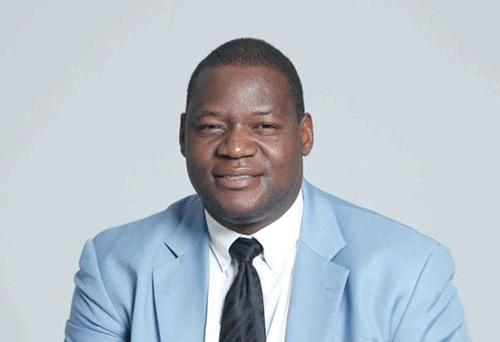
* Matthias Ngwangwama is the Managing Director of Namibia Wildlife Resorts (NWR).