

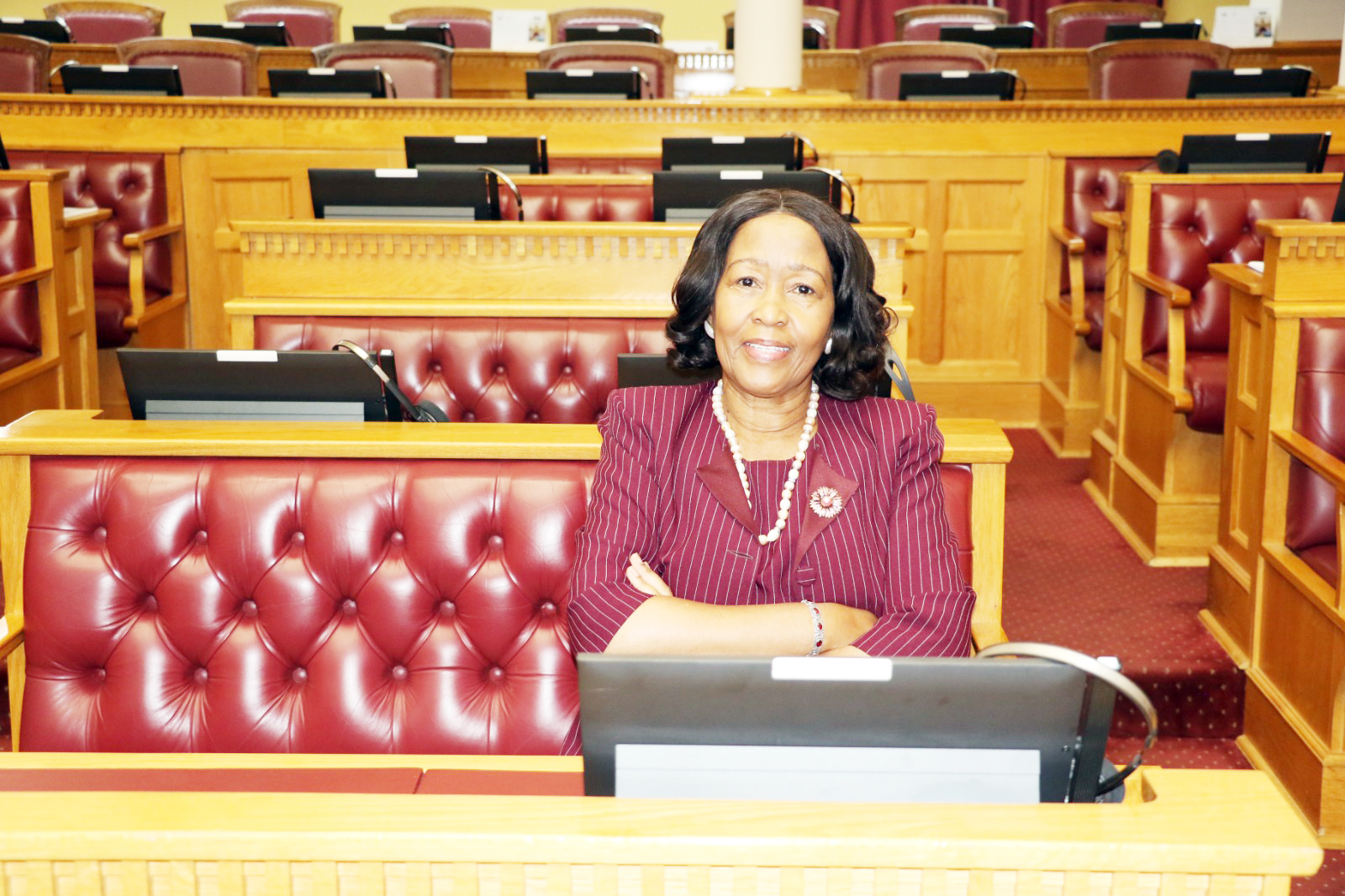

Lahja Nashuuta
A significant portion of the Ministry of Agriculture, Water, Fisheries and Land Reform budget has been directed towards crucial development projects focused on land reform and improving access to water and sanitation.
The total budget for the ministry is N$2.57 billion, minister Inge Zaamwani submitted in the National Assembly last week.
Of this amount, N$1.5 billion has been allocated to agricultural development while N$323 million is for the land reform and resettlement programme. N$956 million is for the water and marine resources’ division.
This allocation is aimed at expanding access to land, supporting the national resettlement programme, and enhancing water and sanitation infrastructure across the country.
Zaamwani said a major focus of the development budget is redressing historical land ownership disparities.
She said during the last financial year, eight farms covering a combined 30 097.64 hectares were acquired for resettlement, at a total cost of N$87 million. Of these, two farms totalling 11 026.81 hectares were purchased for N$28 million, specifically to resettle generational farmworkers.
Another farm near the Neckartal Dam, measuring 166.05 hectares, was acquired for about N$128 000 for the development of an irrigation scheme.
Zaamwani further said two commercial farms in the Khomas region were purchased at a combined N$33.9 million, and were converted into communal land.
“On 9 December 2024, these farms, totalling 8 132.95 hectares, were officially handed over to the Khomanin Traditional Authority. It will be used for allocating land and grazing rights, establishing livestock commonage, enabling food production and income generation, and preserving cultural practices,” Zaamwani revealed.
To further improve access to land and alleviate pressure on existing communal grazing areas, She said the ministry acquired additional farms totalling 31 056.12 hectares at N$67 million.
These included 15 160 hectares in Otjimbingwe, 9 128.32 hectares in Ovitoto and 6 767.61 hectares in Aminuis. She added that six beneficiaries were officially resettled during the reporting period, while 7 396 communal land rights were ratified by Communal Land Boards across the country. Zaamwani also applauded the ministry of finance for allocating an additional N$100 million for the acquisition of land specifically for landless farmers living in farm corridors.
She reaffirmed her ministry’s commitment to the implementation of the 176 resolutions adopted at the 2018 Second National Land Conference, and noted that 25 of these had been fully implemented, while 134 are work in progress. However, she cautioned that full implementation depends on the passing of the long-awaited Land Bill.
Fisheries
Furthermore, Zaamwani said of the N$956 million allocated to the water and marine resources division, N$598 million (63%) will be used for development projects, and N$358 million (37%) will cover operational expenses.
More so, N$471 million is allocated to water supply and sanitation, and N$300 million for water supply security programme. This programme includes the extension of purification plants in Oshakati and Rundu and the construction of a new desalination plant in the Erongo region.
Zaamwani emphasised that the goal is to ensure Namibia achieves social equity, economic efficiency, and environmental sustainability in water use.
Additional planned activities include transboundary water management, geo-hydrological investigations and the upgrading of the National Water Analysis Laboratory, all within the framework of Integrated Water Resources’ Management.
She highlighted that in the previous financial year, the ministry invested N$311 million to enhance rural water infrastructure, which resulted in the drilling of 249 boreholes and the equipping of 147.