

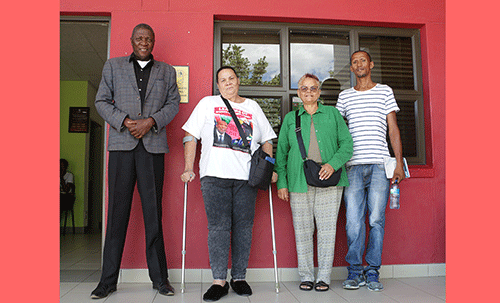

With national elections approaching, Constituency Development Committee (CDC) members from the Khomasdal constituency are urging lawmakers and the City of Windhoek to prioritise grassroots concerns.
They warned that if their cries fall on deaf ears, communities may lose faith in the democratic process.
The CDC members have expressed deep frustration over persistent neglect by local authorities and national leaders, calling for urgent legislative intervention ahead of the upcoming national elections in November.
They warn that constituency-level development will remain stagnant without financial empowerment.
At a recent dialogue with New Era, CDC representatives laid bare a catalogue of longstanding issues affecting residents.
These matters include high crime rates, collapsing infrastructure and lack of sanitation and electricity in informal settlements.
In addition, they are concerned about insufficient employment opportunities and unresponsive municipal systems.
CDC members expressed frustration over the challenges faced by the councillor and committee in delivering basic services.
They argue that despite being close to the community and aware of its pressing needs, they remain powerless to act due to the lack of a direct development budget.
Fazila Marta Bok-Kakombo, a CDC member representing Khomasdal, was vocal about the deteriorating conditions in the area.
She described a constituency riddled with unemployment, ageing infrastructure and rising criminal activity, particularly around the Khomasdal soccer field, where homelessness and theft have become rampant.
She said many senior citizens are suffering.
Their houses are old and falling apart, but they cannot afford to fix them because they only receive a small pension.
In addition, their children are unemployed.
Bok-Kakombo pointed out that despite many reports to the city about broken pipes and sewage, nothing has been done.
She added that residents live in fear because housebreaking has been on the rise.
Bok-Kakombo said even though the police and City officials are part of CDC meetings, they often claim they have no cars or fuel to respond to crime.
She suggested that the Namibian Defence Force should be roped in to help combat crime since the country is not at war, and the soldiers are available.
Another CDC member, Sina Rautenbach from the Yokohama informal settlement said her area has no electricity, water or toilets.
She stated that residents have been waiting for years for promised development, but all they hear are promises without action. Some people received land certificates years ago, but those are now seen as useless because they were never followed up with proper service delivery.
Rautenbach added that officials in charge of human settlements do not respond to phone calls or community concerns.
She said it feels like the city is ignoring the needs of the poor.
The CDC members said they are doing their best to help the community, but they feel unsupported.
They want to be recognised and supported by the government to fast-track development within their constituency.
“We cry for toilets and water, but we are ignored. We need the city and lawmakers to act – not just talk,” Rautenbach said.
Many CDC members are unemployed, hence they struggle with taxi money to attend meetings.
The committee suggested that once a constituency development fund is implemented, it will help them with transport money to attend the meetings.
Rautenbach lamented the lack of electricity, title deeds and basic services. “We’ve been promised development since 2020. Still, no electricity, no land certificates and no change. It’s just meetings and promises,” she said.
Another CDC member, Willem Seibeb highlighted the need to formalise and upgrade existing informal settlements, particularly in Otjomuise. He proposed the establishment of new townships to alleviate congestion in areas like the YC informal settlement, bordered by Kitchener, Nakasaki, Aukureyri and San Diego streets.
Seibeb called for the provision of basic services, such as water, toilets and electricity, as well as land ownership opportunities for the community to access affordable housing through the City of Windhoek or the National Housing Enterprise (NHE).
“The City of Windhoek, as the custodian of land, must come on board for land delivery. We also need a constituency development fund to address these issues effectively,” he said.
Photo: Heather Erdmann