

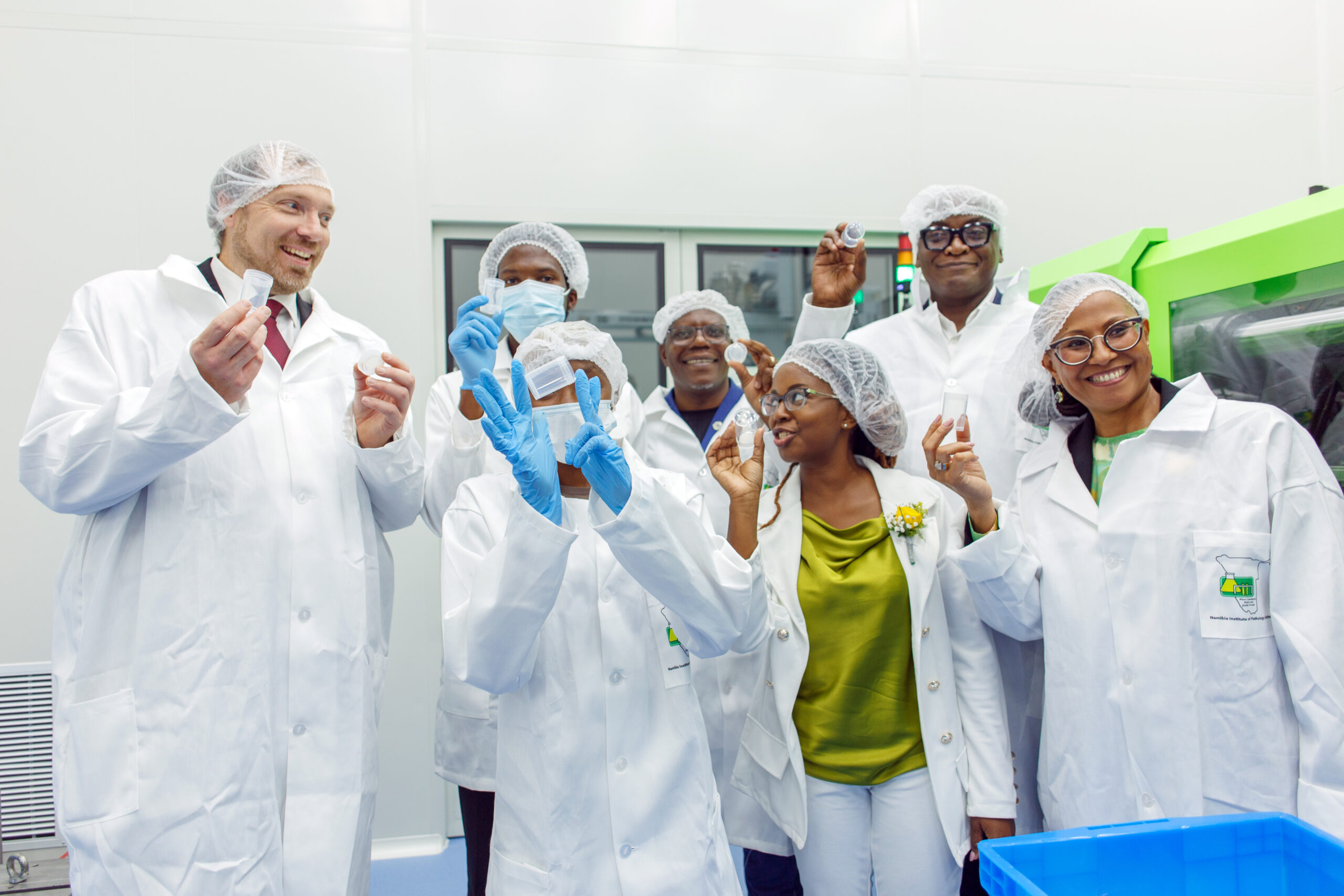

In a landmark event this week, the Namibia Institute of Pathology Limited (NIP) unveiled a state-of-the-art innovation hub for laboratory consumables in Swakopmund’s New Industrial Area. This development marks a transformative leap toward Namibia’s healthcare self-reliance and industrial innovation.
The facility, inaugurated by Dr Vaino Shivute, NIP board deputy chairperson, positions Namibia as a regional leader in medical manufacturing while addressing critical gaps exposed during the Covid-19 pandemic.
The NIP Innovation Hub, backed by a N$15 million investment for the year to-date, including approximately a N$3 million (EUR 155 000) grant from the European Union and Germany, will produce essential laboratory consumables, including virus specimen tubes and urine/stool cups.
Through the leadership of NIP CEO Kapena Tjombonde, the institute committed close to N$11 million thus far to the facility. This major step forward in advancing regional economic integration and industrial development has been further achieved together with the SADC Secretariat.
Phase One aims to manufacture 2.7 million units in 2025, scaling to 5.5 million by 2028. Phase Two will expand into advanced products like serum separators and regional exports, targeting SADC’s 300 million population by 2030.
In his keynote address, Shivute emphasised the project’s alignment with national agendas: “This facility is not just a factory—it is a declaration of Namibia’s resolve to dismantle dependency on imports. By producing locally, we safeguard our health sovereignty and ignite economic resilience under Vision 2030 and the Harambee Prosperity Plan II.”
The Erongo region, hailed as a nexus of trade and innovation, hosts the hub strategically near NamPort for seamless logistics. Erongo governor Neville Andre, highlighted the regional impact: “From eight direct jobs today to over 20 in Phase Two, this hub uplifts families, nurtures skills, and catalyses SMEs in logistics, packaging, and recycling. Erongo’s evolution from a logistical gateway to an innovation beacon is unstoppable.”
Partnerships with academia, including the Namibia University of Science and Technology (NUST), will foster youth innovation.
“Through NUST’s FabLab, we’re moulding futures—training engineers and creating a circular economy. This is how nations leap forward,” said Tjombonde.
International allies, including the SADC Secretariat, the European Union, the German Government, the Deutsche Gesellschaft für Internationale Zusammenarbeit (GIZ), and PEPFAR, were acknowledged for their technical and financial support.
At the launch, a guided tour of the facility and video demonstration showcased the hub’s cutting-edge injection moulding technology, while Dr Iyaloo Konstantinus, NIP Head: Research & Development emphasised the facility’s role in job creation and regional trade.
The NIP Manufacturing Hub sets the stage for Namibia to produce test tubes and medical consumables and has the potential to produce further pharmaceutical products. This will potentially reduce the country’s reliance on imports by 40% by 2030. With plans to certify products through the Namibia Standards Institute (NSI) and Namibia Medicines Regulatory Council (NMRC), to penetrate SADC markets, the project exemplifies the power of unity. As Tjombonde concluded: “A single bracelet does not jingle. Together, we ring loud with progress.”