


John Muyamba
Paulus Shiku
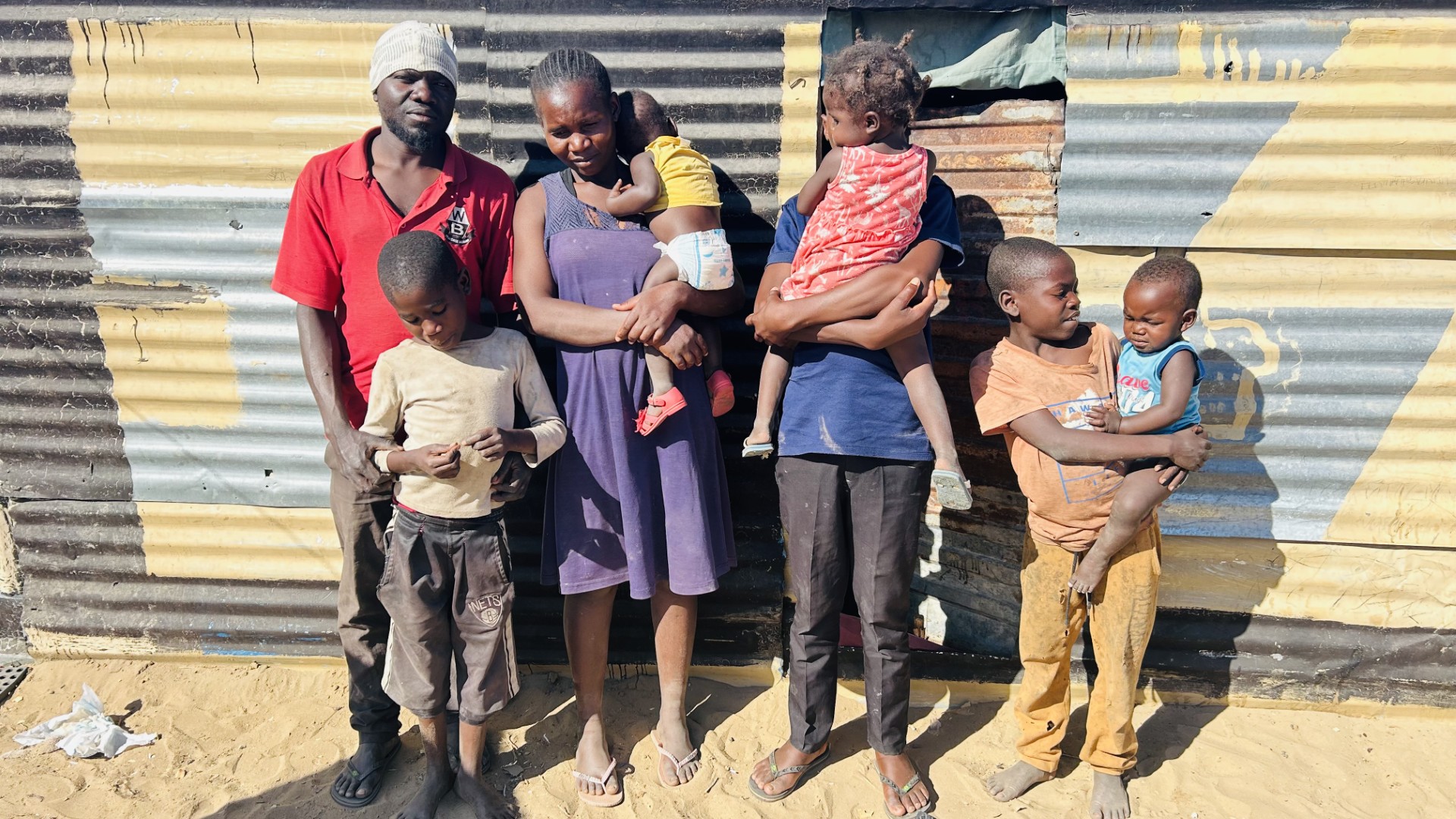
RUNDU – Cecilia Kamwanga (30) from Rundu’s Sikanduko informal settlement has been relying on leftovers to feed her six children for years.
What is more, her health does not allow her to do domestic work.
She has had caesarean sections for the births of all her six children, including two sets of twins.
“When I was operated on, the doctor told me not to do heavy work, as it is not recommended in my situation. Now, looking at my life, I’m now struggling,” she narrated.
Health professionals at the Rundu Intermediate Hospital, where she gave birth to all her children, recommended her for grants beneficiation.
However, she does not receive any grant.
Kamwanga’s firstborn is in grade 9, and the second-born – a set of twins – are in grade 2.
The other three are not yet of school-going age.
“My children resorted to picking food from rubbish bins. One of the boys has started stealing, which is bad. All they do is collect bottles to sell,’’ she narrated her life struggles.
“My children are suffering: no food, no soap and no clothes. We don’t have blankets. We just survive by God’s grace,’’ she cried while showing New Era the poor state of the makeshift structure they call home.
Kwamwanga’s partner, Moses Pinto (36), narrated his family’s ordeal.
He said he has no luck with jobs.
“Life is harsh for me and my family. Sometimes I collect firewood to sell. I have attended school only up to grade 10. I didn’t have money to upgrade after failing grade 10, as I’m from a poor background. If someone can offer me a job, I will be grateful – any job,’’ Pinto said.
After several enquiries regarding the status of Kamwanga’s application, stemming from last year, gender ministry spokesperson Lukas Haufiku yesterday acknowledged that the application was submitted to the ministry in 2023.
He was, however, quick to note that there is a backlog of applications for vulnerable children under the ministry.
He said the ministry is overwhelmed by such cases.
Haufiku said although they are doing their best to support every child, the available funds are not enough.
“Generally, this is one of 50 000 cases that we are dealing with in, let’s say, one financial year. So, you can understand how long it will take to complete and allocate a grant. It can take up to five years,” he said.
He said that due to the financial challenge and overwhelming number of vulnerable children who require assistance, the ministry sometimes waits for beneficiaries to turn 18 to get out of the system.
This gives them a chance to add new beneficiaries below the age of 18.
“When 10 000 beneficiaries’ benefits expire due to their age, they are removed from the payroll, and 10 000 new ones are added,” he clarified. The spokesperson said 30 000 applications were approved and allocated during the tenure of late president Hage Geingob.
The ministry is now working on allocating applications on the budget from the current administration of President Netumbo Nandi-Ndaitwah.
Haufiku said there is an exception for emergency cases, where children in danger of dying can be recommended after a thorough assessment, for instance in the case of malnutrition.
He highlighted the challenge in the utilisation of such funds, saying the money sometimes does not reach the beneficiaries, as the parents and guardians sometimes use it for their own benefits.
“Some parents call it ‘my salary from gender,” Haufiku said.
This year, finance minister Ericah Shafudah proposed an allocation of N$7.2 billion towards social grants for the 2025-2026 financial year.
In addition, N$877 million was allocated to vulnerable grants, N$36.9 million to foster care grants, N$417 million to maintenance grants, N$955 million to disability grants for adults, and N$152 million for disability grants for minors.
-pshiku@nepc.com.na