

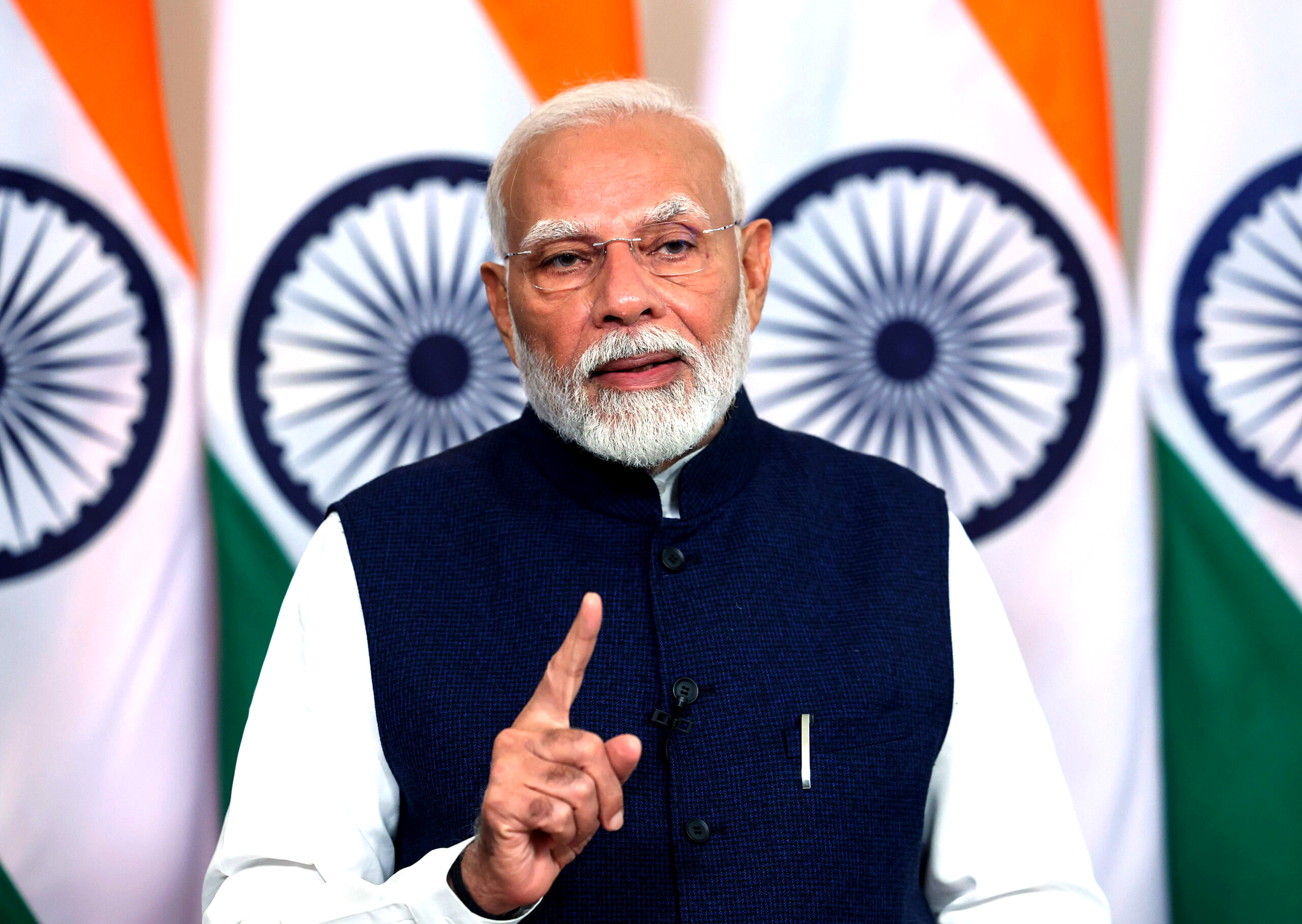

In less than 48 hours, on Wednesday to be exact, India’s prime minister Narendra Modi will land in Namibia.
It will be the last country he visits as part of his five-nation tour to strengthen strategic connections throughout Africa and Latin America and gain traction.
Modi embarked on an eight-day trip last week, starting in Accra, Ghana; Trinidad and Tobago; Argentina; Brazil; and now Namibia.
The trip to Namibia will be centred around strengthening defence ties, boosting trade and deepening India’s partnership with the south-west African nation.
“It will be a privilege to also address the joint session of Namibian Parliament as we celebrate our enduring solidarity and shared commitment to freedom and development,” said Modi.
The spokesperson of India’s ministry of external affairs, Dammu Ravi, said this will be Modi’s first visit to Namibia.
It will however be the third visit to Namibia by an Indian prime minister.
“During his visit, the prime minister will hold bilateral talks with President (Netumbo) Nandi-Ndaitwah. He will also pay homage to the founding father and first president of Namibia, the late Sam Nujoma. The visit of the prime minister is a reiteration of India’s multifaceted and deep-rooted historical ties with Namibia,” said Ravi.
He added the visit is important to renew the relationship and, at the same time, deepen India’s economic engagement with Namibia.
Several high-ranking Indian officials have visited Namibia since its independence in 1990, among them prime minister Vishwanath Pratap Singh, former prime minister Rajiv Gandhi and other high-ranking politicians were in Namibia for its Independence Day celebrations in 1990. President Shankar Dayal Sharma visited Namibia in 1995, and prime minister Atal Bihari Vajpayee in 1998.
“The visit is happening very early, as President Nandi-Ndaitwah just assumed office in March 2025. This is to renew the relationship and at the same time deepen our economic engagement with Namibia,” said Ravi during a press briefing recently.
He noted that the bond between the two countries dates to India recognising Namibia before its independence.
Modi agenda
Modi has 25 years of experience in governance, first as chief minister of the state of Gujarat from 2001 to 2014 and then as Prime Minister from 2014 to date. He is a rare world leader with such uninterrupted and extensive experience. In his third term, Modi remains massively popular. He is one of the few leaders who has won a third term to lead the nation. The year 2024 was an exceptionally bad year for incumbent governments in elections worldwide.
Under him, India has managed friendships with different countries as well as different groups of countries despite their contradictions. He is also the driving force behind improving India’s relations with the Gulf countries.
Analysts praise Modi for being a moderniser and building a new India by building infrastructure at an unprecedented pace and changing the face of India with his focus on sunrise sectors like semiconductors, space, and start-ups.
India
After surviving near bankruptcy in the early 90s when the treasury could not honour its financial obligations, more than 30 years later, the Indian economy has grown from strength to strength.
India reclaimed the fifth position as the world’s most preferred destination for global CEOs. India is also the fifth largest economy and fastest growing economy in the world.
What is more, 86% of India’s CEOs agree that its economy will record further growth over the next 24 months, according to PwC’s 27th Annual Global CEO Survey, which polled 4 702 CEOs in 105 countries and territories, including 79 from India.
There is a general convergence between India’s economic growth and its political leadership, many experts and politicians say.
Last year, India’s foremost diplomat, external affairs minister Subrahmanyam Jaishankar was also in agreement with the narrative being propelled by many.
“The reason for this phenomenal growth is the consumption boom brought about by our population [and] good governance and a well-coordinated approach [which] have moved us to where we are now,” Jaishankar told African journalists while on their familiarisation visit.
His sentiments also reverberated through a panel consisting of several experts from the University of Hyderabad when the journalists visited the institution.
“Democracy has worked well. The political leadership has allowed people to think freely. The political leadership has been sensitive to the needs of the people. On the political, social, and economic level, India believes in the philosophy of ‘one family, one world’, which forms the basis of partnership, whether domestic, regional, or international,” one of the panellists said.
With a population of 1.4 billion, India is well on course to overtake Japan and Germany to become the world’s third-largest economy in the world by 2027.
Just between 2011 and 2015, close to 100 million people in India were unchained from the yoke of abject poverty, thanks in part to robust economic growth and a social safety net catering for 800 million people that have improved the overall living standards.
The Indian economy is primarily driven by its world-class pharmaceutical industry, as well as billions derived from car sales, motorcycles, tools, tractors, machinery and forged steel.
India is also the world’s largest producer of fruit and is a major exporter of information technology services, outsourcing services, and software workers.
The country’s digital strategy over the past decade is also said to have eased doing business and the delivery of public goods and services at an industrial scale.