

Namibia is one of Africa’s most resource-rich countries in terms of both people and minerals. Namibia’s position, in my opinion, can be improved by changing the people’s mindset, which is characterized by a high level of dependency, as well as the leadership at various levels, which is dominated by a diverse group of people who are financially motivated rather than developmental.
A ticking time bomb for the country is the rising levels of inequality and lack of economic opportunity, especially among young people. The high unemployment rate is caused by a number of serious factors, such as the inadequate implementation of the Harambee Prosperity Plans and the failure to adequately implement all of the goals of the National Development Plans (NDPs).
It hurts to hear that Namibia has been downgraded from an upper-middle-income to a lower-middle-income country in the World Bank’s most recent income classification update. This could have a negative effect on the planned launch of National Development Program Six (NDP 6), as it should be in line with the country’s classification update, which requires some serious creative thinking.
It is critical to keep in mind that economic growth has been stalling, investment has been limited, employment is falling in comparison to the population’s growth, and poverty and inequality have thus persisted. Therefore, having excellent intentions is good, but it will be difficult if the policymakers lack the evidence, don’t grasp the macro-economic factors, and don’t have a model-based modus operandi to uphold.
With real GDP growth rates of 2.7% in 2021 and 4.6% in 2022, Namibia has maintained a stable performance. Notwithstanding the growth rate for 2023 being previously revised downwards to 4.2% and 3.7% in 2023 and 2024, respectively. In the first quarter of 2025, the economy grew 2.7%, which was slower than the 4.8% growth observed during the same time in 2024.
By the end of March 2025, the government owed N$166.7 billion, an increase of 8.3% from the previous year. Thus, the country’s debt today stands at 66.3% of GDP, exceeding the SADC-targeted regional standard of 60%. In 2023, the Namibia’s unemployment rate increased to 36.9%, according to new figures from the Namibia Statistics Agency (NSA).
In general, Namibia’s growth was ascribed to weak agricultural and diamond mining performance, which counterbalanced improvements in other areas. In particular, operational difficulties and the 4.0% decline in diamond mining owing to pressure from global demand, low agricultural productivity, and low manufacturing investment are to blame for the slowed growth. Namibia has been downgraded from upper-middle-income to lower-middle-income country due to frequent growth slowdowns and the failure to implement national development initiatives. If these issues are not addressed, Namibia may become stuck in what is known as the middle-income category.
Furthermore, unemployment leads to an array of social problems, including dishonesty, immorality, alcoholism, gambling, robbery, and gender violence. It produces social disruption in society, forcing the government to spend a lot of money on law enforcement and social assistance services. It is vital to remember that unemployment leads to mental health issues such as low self-esteem, feelings of worthlessness, sadness, and hopelessness. Therefore, most individuals will not find much of an economic rebound if it does not result in new jobs.
It is positive and gives optimism for Namibia’s agricultural future. At the Ondonga Traditional Authority at Okashana Agri-nest, which is situated in the Omuthiya Constituency, a substantial commercial potato harvest began for the first time. Over 100 farmers from the community were given units ranging from 50 to 100 hectares, and it is rather remarkable to observe that they were expected to plant within at least three years. Watermelons, potatoes, carrots, tomatoes, and maize were grown by the farmers. Additionally, over 100 individuals now have jobs, thanks to the effort.
Going forward, diverse policies and methods have been implemented at the government, business industry, and civil society levels to help address the issue of unemployment. Jobs for young people can be created in large part by the commercial sector and civil society. Promoting investment activities requires coordinated and intentional efforts because doing so will grow the economy and create jobs through a cascade of benefits.
The education system needs to be refocused to better meet the demands of the labor market. There is a need for a more streamlined strategy when developing government policies to avoid duplication of work and interference with existing policy implementation activities. The government must recognize that capitalism prioritizes its own interests over people, resulting in poor governance and accountability.
Furthermore, the government should encourage entrepreneurship and provide start-up funding to the unemployed. It should implement mandatory training and mentorship programmes for new businesses. We also need a transformation in agriculture, mining, and hospitality, which requires young people to take up and lead.
Entrepreneurship can provide young men and women influence over their future success. However, successful young entrepreneurship requires equitable economic institutions and a business-friendly environment.
In conclusion, when effectively executed, National Development Plans constitute a crucial tool to fostering employment, reducing inequality, and ending the cycle of poverty. Maintaining accountability and periodically monitoring the plan’s execution are crucial.
-This article has been shortened.
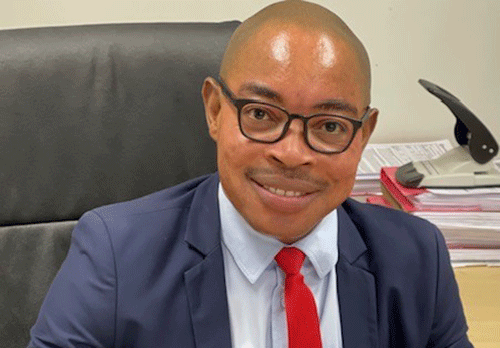
* Josef Kefas Sheehama is an independent economic and business researcher.