


The demise of mother tongue refers to the gradual decline or loss of native languages and cultural identities, traditions and knowledge systems tied to them.
While many languages are endangered, others are being revitalised, as the latter keep on borrowing and creating new words to fit their environment.
It requires intentional action from individuals, communities and governments to protect the languages, which seem to be becoming extinct. At its core, preserving mother tongues is about valuing human diversity and ensuring that the wisdom of the past is preserved. In the traditional African society, mother tongue is also used for the profound sayings of the elders, words that are witty and pregnant with meaning.
Such words of elders are words of wisdom and find expression in proverbs, idiomatic expressions, riddles, incantations or oracular and witty sayings.
Of course, the words of African elderly people are full of wisdom and find expression in idiomatic expressions, proverbs, incantations (charm) or in oracular or prophetic sayings.
The young Africans are usually expected to treat these sayings with deep respect because they are words of the departed and ancestral spirits in some African quarters.
Above that, such words of wisdom are filled and pregnant with complexity and ambiguity that only the elders can unravel. A few examples of witty sayings can be found among many communities today.
After a decade of consultations and numerous research assignments, Chata, Fenyeho, Lilemba, and Mwanawina came up with a Chifwe-English dictionary in a rare attempt to preserve the remaining words in Sifwe. It was a tedious and saturative exercise, which saw the group coming up with a dictionary of 105 pages. Of course, it was the first task of its own and such a great achievement as some Chifwe speakers have acclaimed.
The project took off, but amid the exercise, those who saw light started wishing the group well and expressed support. After the publication of the dictionary a few months ago, there were some mixed feelings among some people, while others raised eyebrows for their reasons.
It was important for the group to come up with a dictionary for many reasons. The first and most important reason is that the Fwe group, a composition of the Mafwe large group, who speak a Bantu language called Chifwe, and their language is gradually dying.
Fwe is a part of the Bantu language family, which is part of the Niger-Congo phylum, Africa’s largest language family (Gunnink, 2018).
De Luna (2010) places the Fwe in a subgroup called Bantu Botatwe, which consists of two branches.
The eastern branch consists of Toka, Leya, Ila, Tonga, Sala, Lenje, Lundwe and Soli, while the western branch consists of Shanjo, Fwe, Mbalangwe, Subiya and Totela.
But other sources claim that the concept of Mbalangwe seems to be used in a derogatory manner, as the term implies a people without a language. The fact that many words were being lost prompted the researchers to embark on extensive research and consultations in efforts to find the disappearing words, phrases, idiomatic expressions and proverbs.
There are many causes of mother tongue loss, of which a few examples can be cited, such as globalisation and dominant languages such as English, Mandarin, Spanish, French and a few other global languages. These languages dominate business, academia and technology. As a result, native speakers of less widely spoken languages may shift to dominant ones for economic or social mobility. In some countries, where nationalism is strongly advocated, education policies and systems may prioritise national or colonial languages.
Indigenous or minority languages are often not taught or used in schools, leading younger generations to grow up without fluency in their mother tongue.
This is the situation in Namibia, where English is regarded as the official language at the expense of the mother tongue, despite the policy indicating that children should be taught in their mother tongue at an early age.
But in some areas, the definition of mother tongue might be ambiguous, as a language which is not their mother tongue is taught at an early age. Another factor which leads to the demise of the mother tongue is migration and urbanisation. Children from different linguistic backgrounds interact in schools and are, therefore, forced to use the dominant language, such as English and other colonial media of instruction and communication.
This leads to a situation where, in cities, native languages may be seen as impractical or even inferior. In some homes, children are taught in a foreign language. In the process, they lose the vocabulary of their mother tongue.
In today’s world, the media and technology, such as TV, internet and literature, are usually in dominant languages, leaving speakers of native languages with little access to content in their mother tongue.
It should be noted that loss of mother tongue can mean losing a sense of self and community. Equally, the erosion of oral traditions, knowledge and indigenous languages, which often carry traditional knowledge about medicine, agriculture, ecology and cosmology, can mean the disappearance of irreplaceable knowledge. Psychological impact may force individuals from minority linguistic backgrounds to face identity crises or feel culturally alienated, especially if their heritage is undervalued.
The demise of mother tongue can be minimised by community-led initiatives, in which movements should promote native languages through schools, literature and storytelling.
In some countries, bilingual education is supported through the media. Through cultural celebrations such as poetry, music and theatre, mother tongue can be salvaged.
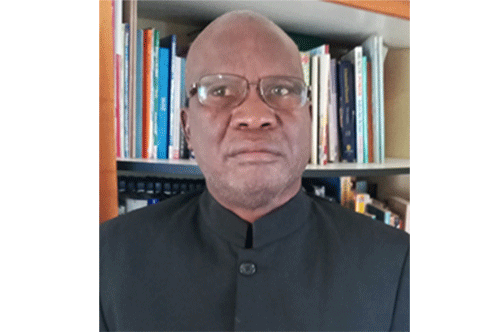
*Prof. Makala Lilemba is an academician, researcher and scholar.