


Rauna Kalola
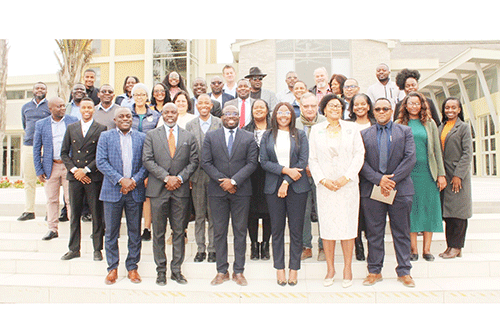
The Ministry of Information and Communication Technology (MICT), recently hosted a major stakeholder consultation in Erongo, spotlighting the region’s central role as Namibia’s ICT connectivity hub.
The session brought together regional leaders and key ICT stakeholders to discuss network coverage, digital literacy, access to information, and broadcast infrastructure.
Erongo’s coastal location makes it uniquely suited to serve as the country’s digital entry point. ICT minister Emma Theofelus noted that the region is home to two critical undersea links: the older West Africa cable and the newer Equiano cable that landed near Swakopmund in 2022.
These cables form the backbone of Namibia’s international connectivity, enabling high‑speed data services and access to global networks.
Theofelus observed that disruptions — due to marine activity, submarine interference, or undersea volcanic shifts — underscore the significance of protecting these vital cables. Without them, national connectivity would be compromised.
Theofelus further argued that infrastructure and interconnectivity are foundational to all ambitions — from providing tablets for schoolchildren to ensuring phones and broadcast services reach every corner of the country.
She acknowledged the logistical and financial hurdles of expanding network coverage — constructing a single tower can cost around N$2–3 million depending on height, power requirements, and terrain.
While the rolling out of infrastructure remains costly — especially in remote settlements where solar power is needed and regulatory compliance is complex — the minister affirmed that the long-term benefits justify the expenses.
“It is a lot of money, but the potential of what technology can do for our people is much greater,” said Theofelus.
The engagement also deliberated on other persistent operational challenges affecting telecommunications operators and, in the process, affecting service delivery to the people. These include delays in land approvals, land ownership disputes, vandalism, and cable theft, as well as difficulties in accessing infrastructure sites.
Still, Theofelus emphasised government’s determination to continue investing, and highlighted a new infrastructure-sharing policy to avoid redundant deployments by operators like Telecom Namibia and MTC.
She also reaffirmed the ministry’s commitment to inclusive services, noting that 26 rural ICT centres are in operation to bridge gaps in digital access.
The engagement served as a critical step in harmonising Erongo’s unique geographic advantage with the ministry’s strategic plan, ensuring digital infrastructure efforts merge with national development objectives and regional priorities.
As Namibia advances its ICT agenda—including commitments from the N$40 million Universal Service and Access Fund, the rollout of a National Digital Literacy Framework, cybersecurity initiatives, and development of innovation ecosystems—Erongo stands at the centre of that vision: a literal gateway through which Namibia connects to the world.