

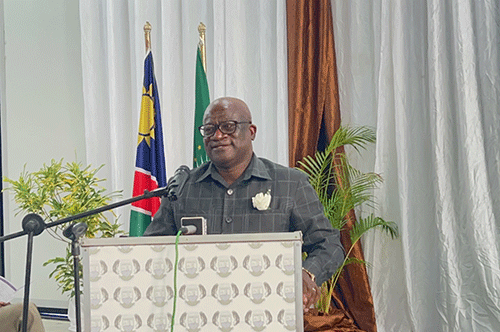

RUNDU – Kavango East governor Hamunyera Hambyuka, highlighted the region’s push for food production, in his maiden state of the region address for the fiscal year 2024/25 last Thursday.
He said the region had invested in supplying farmers with inputs and training to boost production.
“In the area of food production, our emphasis on supporting farmers through training, technical assistance, and market access has been the cornerstone for sustainable agricultural growth and regional economic development.
To boost food production, subsistence farmers were supported with subsidised inputs such as fertilisers, improved seeds, pesticides, and mechanised agricultural services such as tillage, ripping, planting, and weeding services,’’ he said in his Sora delivered at the regional council auditorium at Rundu on Thursday.
The governor said under the Dry Land Crop Production Programme (DCPP) and Cereal Value Chain, at least 3 403 farmers had benefitted from subsidised seeds, while 1 044 farmers with a combined landmass of 2 656 hectares benefitted from ripping and ploughing services, 93 farmers were subsidised for weeding and 18 farmers for machinery. He said the region is striving for the full operationalisation of the green scheme projects to intensify food production and promote agro-processing initiatives at these projects, which may result in sustainable agriculture, employment creation and improved food security.
“This is evident in the performance of the Uvhungu-Vhungu green scheme, in which 147 ha of maize were planted with an average yield of 8 tonnes per hectare, while a total of 97 hectares of wheat were planted with an average yield of 5.01 tonnes. It is also important to inform the residents that the Ndonga Linena green scheme project has planted 88 hectares of maize and 22 hectares of wheat, which yielded 440 tonnes. This has been increased to a total of 350 hectares, with 110 hectares of maize and wheat planted, in which 2 600 tonnes are expected to be harvested,’’ he said.
According to the governor, the region has allocated N$751 145 to the Horticultural Support Programme, which benefits 80 farmers.
“These farmers are now making a positive impact on the social lives of many residents,’’ he stated.
In the area of Small Stock Development and Distribution in the Communal areas, the scheme provided a quality core breeding flock of suitable local goats to selected vulnerable farmers to gain a sustainable means of income generation and increased food security.
“Through this scheme, 420 goats were distributed to all rural constituencies in the region, in which 20 farmers benefitted with 21 goats each under the supervision and mentorship of the Ministry of Agriculture, Water, Fisheries and Land Reform. This is a revolving programme in which new beneficiaries are expected to be selected to also benefit from the scheme,’’ he
said.
A total of 54 poultry farmers were also reported to have been supported in monetary terms to the tune of N$417 194.
To ensure that sustainable farming practices are implemented, a total of 6 539 farmers, of which 3 120 were male and 3 419 were female, received training and information on various agricultural topics and techniques, and it is expected that these farmers will cascade the knowledge further to fellow farmers in their communities.