

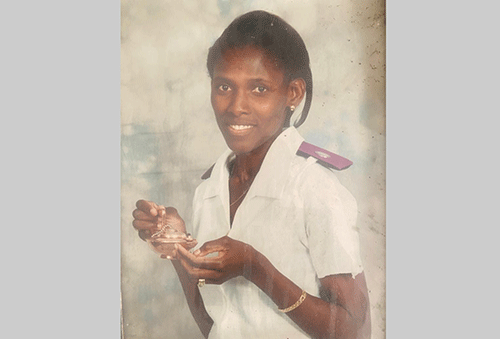

Lahja Nashuuta
Magdalena Didalelwa is a trained nurse serving under the Ministry of Health and Social Services with more than two decades of experience in the mental health sector in Namibia.
She holds a basic nursing diploma, which included foundational modules on mental health. But her passion for the field led her to pursue further education, completing a postgraduate specialisation in mental health nursing.
“I’ve worked in a mental health institution for almost 20 years, 19 years and four months, to be exact,” she says with remarkable precision, a testament to her deep connection with the work she does.
Her professional journey began in 1998 after completing her general nursing training. Didalelwa started off as many nurses do, working in various departments. But by January 2000, a new chapter began when she joined the Ministry of Health and Social Services’ mental health unit.
“There, I found myself on the frontlines, providing care and support to patients in psychiatric wards, often the most neglected area of public health, she narrates.
With hard work and a growing interest in the systemic challenges affecting mental health, Didalelwa steadily rose through the ranks.
After her postgraduate specialisation, she transitioned from clinical care to national policy work.
She now serves as the senior health programme officer for mental health at the ministry’s head office.
“My main responsibilities are administrative, but they cover a very wide scope,” Didalelwa explains. “These include strategic planning, policy development, the coordination of mental health services across the country, and contributing to legislation and regulatory frameworks,” she narrates.
But her work doesn’t stop at the desk. Didalelwa frequently visits regional hospitals and clinics, offering technical support to healthcare workers who often lack adequate mental health training. “Since most regions in Namibia do not have dedicated psychiatric facilities, general hospitals are expected to handle patients suffering from mental health disorders,” she reveals.
She also conducts needs assessments, oversees data collection and reporting, and facilitates awareness campaigns to reduce stigma and inform the public about mental health.
According to Didalelwa, her work seeks not only to improve care systems but also to promote understanding, acceptance, and early intervention.
A calling discovered by chance
Despite her experience and clear passion for mental health, Didalelwa admits it was never part of her original plan.
“It wasn’t my dream to work in mental health. I ended up there by chance. It was the only available placement at the time,” Didalelwa recalls. Yet, what seemed accidental turned out to be transformative. Looking back, Didalelwa sees that her gentle, empathetic and nurturing nature made her ideally suited for a role that demands patience and compassion.
“As a child, I always loved helping people. I enjoyed talking to them, comforting them, even singing to lift their spirits,” she says with a warm smile. “So even though it wasn’t part of my original plan, it felt like a calling fulfilled. Helping others is part of who I am. It gives me purpose,” she maintained.
But her passion is often tested by a system struggling to cope.
“One of the biggest challenges is that mental health remains severely under-resourced,” she says. “For a long time, I was the only person in the entire ministry overseeing mental health at the national level,” she reveals.
Only recently has she gained some support from a colleague whose focus is on integrating mental health services with HIV and TB care. Still, the primary mental health portfolio remains her sole responsibility, an enormous task for one individual.
This understaffing is made worse by the rising number of people seeking help.
“Mental health conditions are increasing, driven by factors like poverty, unemployment, drug and alcohol abuse, family breakdown and relationship struggles,” Didalelwa explains.
“People are in distress, and we are seeing it more and more. But with limited staff and resources, the system is under pressure. We simply can’t meet the growing demand,” she said.
She also points to a major skills gap in the health system. “Most of our frontline healthcare workers receive only minimal mental health training during their studies,” she says. It’s not enough to meet the complex needs that are becoming more common. As a result, many patients are referred to distant facilities, often having to travel long distances just to access proper care, she narrates.
Despite these challenges, Didalelwa remains steadfast, a quiet but determined force pushing for reform in a neglected field. Her years of service, her tireless advocacy and her deep empathy make her a pillar of Namibia’s mental health efforts.
She acknowledges that progress is slow. Mental health is still sidelined in many national conversations, and funding remains limited. However, she maintained that her work, whether in policy meetings or field visits, continues to make a difference.
On her wishlist, Didalelwa expresses a strong commitment and determination to serve in government until she reaches retirement.