

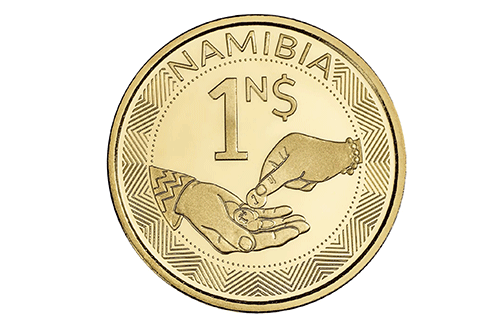

In response to growing backlash from certain sections of society regarding the recently introduced N$1 coin, the central bank issued a statement emphasising that the new currency actually represents trade and interaction between communities.
“The N$1 was designed to honour Namibia’s retail sector, a cornerstone of the national economy that empowers local businesses, sustains households, and fosters entrepreneurship. The motif of two hands exchanging coins symbolises the act of trade, a mutual, everyday interaction that connects people and communities. It is a celebration of resilience, agency and economic inclusion,” the Bank of Namibia (BoN) stated.
In an official statement, BoN noted the ongoing public discussion surrounding the new N$1 coin, particularly the interpretations that have emerged on social media around its design and public perception.
BoN added it is aware the coin has, in certain circles, come to be colloquially referred to as the “Outere dollar,” a phrase rooted in Khoekhoegowab that loosely translates to “give me”. This interpretation, while not the bank’s original messaging, has gained traction online. In response, the bank acknowledged the phrase in its public awareness efforts, not to endorse or promote it as an official name, but rather to reframe and debunk the perception that the coin depicts begging or dependency.
“Our aim was to shift the conversation toward what the coin truly represents: dignified exchange, vibrant commerce, and shared economic progress. There was no intention to use it as a slur or cultural slight. The Bank of Namibia recognises and celebrates the country’s cultural and linguistic diversity and would never intentionally promote exclusion or division. The interpretation that this was a tribalist insult misconstrues both the intention and the message,” the central bank stated.
Some sections of society remain adamant that the term “Outere dollar” is derogatory. Critics argued the word is often used in a mocking way to target speakers of the language, stripping it of cultural value and reinforcing negative stereotypes.
However, the central bank never called the new currency this name and merely responded to social media where the term was coined. The new coin is part of a currency series that aims to showcase Namibia’s cultural diversity. However, the backlash over the term “Outere” has raised questions about the consultation process and whether all communities were properly represented during the coin’s development.
On social media platforms, users expressed concern, saying the Bank of Namibia should have considered the historical and social weight of the word before including it on the national currency. Some have accused the central bank of being insensitive to linguistic and ethnic diversity in the country.
“I write to you as a concerned Namibian citizen regarding the recently introduced coin referred to as “Outere”. While I acknowledge the bank’s role in preserving and promoting indigenous languages and cultures, I respectfully wish to express my concern that the chosen name, although seemingly innocuous on the surface, carries an unfortunate and offensive connotation within certain communities, particularly among the Khoe-Khoe Gowab (Damara/Nama) speaking people,” Brigitte Luiperth wrote on Facebook.
Others echoed similar sentiments, “The Bank of Namibia, through some of its new coin designs, is not celebrating unity, it is promoting tribalism and showing disunity. National symbol must reflect inclusiveness, not deepen division,” Matthew Gowaseb said on X. -pmukokobi@nepc.com.na