

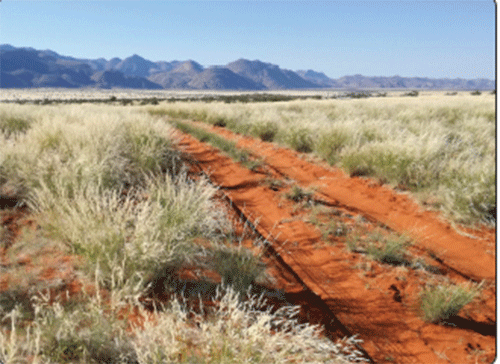

Rangeland is defined as land with natural forage that livestock and wild animals use.
Its productivity relies on rainfall and how it is used.
Plants in rangelands need good environmental conditions and protection to establish, spread and stay resilient in agroecosystems or on farmland.
Key features to assess rangeland productivity in grazing areas include grass vigour, density, species mix and richness.
These features reflect the ability of the grass to regrow after dormancy and grazing, the yield per area and the types and dominance of grass species.
They serve as indicators of grazing value across different rangelands, influenced by climate and use, and vary over space and time.
Rangeland is the primary and most affordable source of feed for livestock.
Additionally, humans obtain many useful resources from it, like medicinal plants, edible products and household items such as timber, poles, droppers and thatching grass.
Thus, rangeland resources support all life forms. This leads to competition for these resources between animals and humans.
As a result, many rangelands are under pressure, risking their productive capacity and leading to degradation.
In Namibia, rangeland degradation is visible across various landscapes and scales, manifesting as deforestation, desertification, soil erosion and bush encroachment.
Factors like the growing human population, development activities, climate change and increased demand for livestock and their products exert additional pressure.
Deforestation is common, especially in rural or farming areas, caused by construction, mining, timber harvesting and land clearing for farming.
These activities lead to the loss of valuable plants, local extinction of native species and reduced biodiversity.
Moreover, deforestation, combined with overgrazing, causes desertification, making soils barren and exposed to extreme conditions, such as high temperatures, where only a few or no plants can survive.
Exposed soils become unstable without plant cover, making them vulnerable to erosion and trampling.
Wind and water then remove topsoil, seeds and organic matter.
Erosion also leads to surface runoff, increased evaporation and soil dehydration.
Livestock farming in many parts of Namibia has become costly due to degraded rangelands.
Degradation has lowered farm productivity and earnings, forcing farmers to spend more on rangeland repair and livestock feed, which depletes their financial resources.
To promote sustainable livestock farming, farmers should adopt practices like controlled grazing, controlling bush encroachment, preventing soil erosion, rebuilding soil organic matter, restoring vegetation and conserving water.
Any change in rangeland conditions will directly impact the farmer’s livelihood.
*Erastus Ngaruka is Agribank’s technical advisor on livestock and rangeland.