

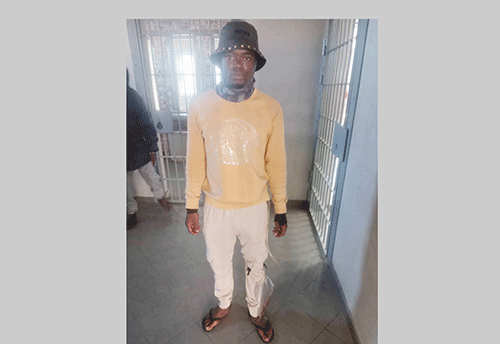

WALVIS BAY – Police brutality and the use of excessive force in holding cells are once again under scrutiny after a trial-awaiting inmate was allegedly assaulted by officers during a routine cell search.
He was allegedly denied urgent medical attention after the attack.
Michael Awaseb, who also made a court appearance on a murder charge last week, claims his basic human rights were violated during the attack.
A limping Awaseb made another court appearance last Thursday in the Walvis Bay Magistrate’s Court with a catheter visibly hanging from his trousers.
A catheter is a thin, flexible tube inserted into the bladder to help drain urine into a bag, often used when someone cannot urinate on their own due to injury or medical reasons.
His sister, Sara Awases*, told New Era that her brother is in constant pain, urinates blood, and has a broken finger. She also expressed concern about his overall wellbeing and safety while being in police custody.
“We are scared for my brother’s safety and wellbeing,” she said while showing a series of WhatsApp messages Awaseb sent her while he was hospitalised.
In the messages, Awaseb alleges that he was attacked on 10 April 2025 during a search at the Walvis Bay police station.
He said that during the search, he asked to stand by a broken window due to his asthma, but was told to wait. As the corridor became crowded, he began struggling to breathe.
“When I asked to go back into the cell to get my asthma pump, an officer pushed me. I pushed back and tried to walk, but all the officers grabbed me,” he said in the conversation with his sister.
According to him, officers pepper-sprayed inmates who tried to intervene, broke his finger while forcing handcuffs on him, and dragged him to an area with no cameras where they beat him.
“One stepped on my head. I was in pain, but they told me to go back to the cell when I asked to go to the hospital,” he narrated the ordeal.
The next day, Awaseb was allegedly transferred to Swakopmund Correctional Facility, even though a court order directed that he remains at Tutaleni Police Station. There, he said, he was denied a phone call and only received ointment, painkillers and antibiotics.
“I was urinating blood and in so much pain. I kept asking to see a doctor, but no one helped,” he said.
He claims he was informed later that he was being charged with assaulting a police officer. However, he was not allowed to lay a charge of his own.
“I asked to open a case against the police, but they refused,” he wrote.
Awaseb said he remained at Swakopmund for nearly a month and was only taken to the hospital after being returned to Walvis Bay on 13 May 2025 for a scheduled court appearance. He was admitted for three days and had a catheter inserted, as he could not relieve himself.
Court documents indicate the State was informed that Awaseb had threatened police officers. The charge sheet reflects that he told the court that he was assaulted and tortured by three officers, one identified as “Ngorime, Constable Amutenya”, and a certain “Sergeant Easy”.
Erongo police spokesperson, Commissioner Nickolas Kupembona, when contacted about the incident, said that he was not aware of it.
“It was never brought under my attention, but we will look into the matter,” he told New Era earlier this week.
Investigation
Meanwhile, the chief investigating officer from the Ombudsman’s office for Erongo, Hermina Apollus, confirmed investigating the matter after receiving a complaint from Awaseb.
According to the Ombudsman, Awaseb informed them that he was assaulted on 10 April at Walvis Bay (Bravo) station, but that no further assault occurred following his transfer to Tutaleni in May.
Their investigation found that Awaseb was attended to at Swakopmund Correctional Facility the day after the alleged incident, despite earlier allegations that he was initially uncooperative.
“The station commander confirmed to the Ombudsman’s office that the transfer from Tutaleni to Swakopmund was for security reasons and was communicated to the magistrate,” she said in her response.
Although Awaseb told New Era that police officers feared he would inform his family and therefore delayed medical care, Apollus said no such claim was made to their office during their visit on 16 April.
“However, denying a person medical care is a violation of their right to dignity and healthcare under Articles 8 and 95 of the Constitution. That is why we act immediately once a complaint is received,” she said.
She also confirmed that Awaseb was using a catheter during their 30 July visit and that his medical passport shows several hospital visits. The appearance of blood in his urine was recorded from 17 July, but Apollus said they had not yet confirmed with the attending doctor whether it resulted from the alleged assault.
“While the use of force will be left for the court to determine, we emphasised that officers are required to de-escalate situations before continuing with cell searches. We have since referred the matter for criminal investigation,” the officer stated.
According to her, they were told that Awaseb did not indicate a desire to open a case. However, after meeting with him in April, they referred the matter to the Internal Investigation Department, and a case has since been registered.