

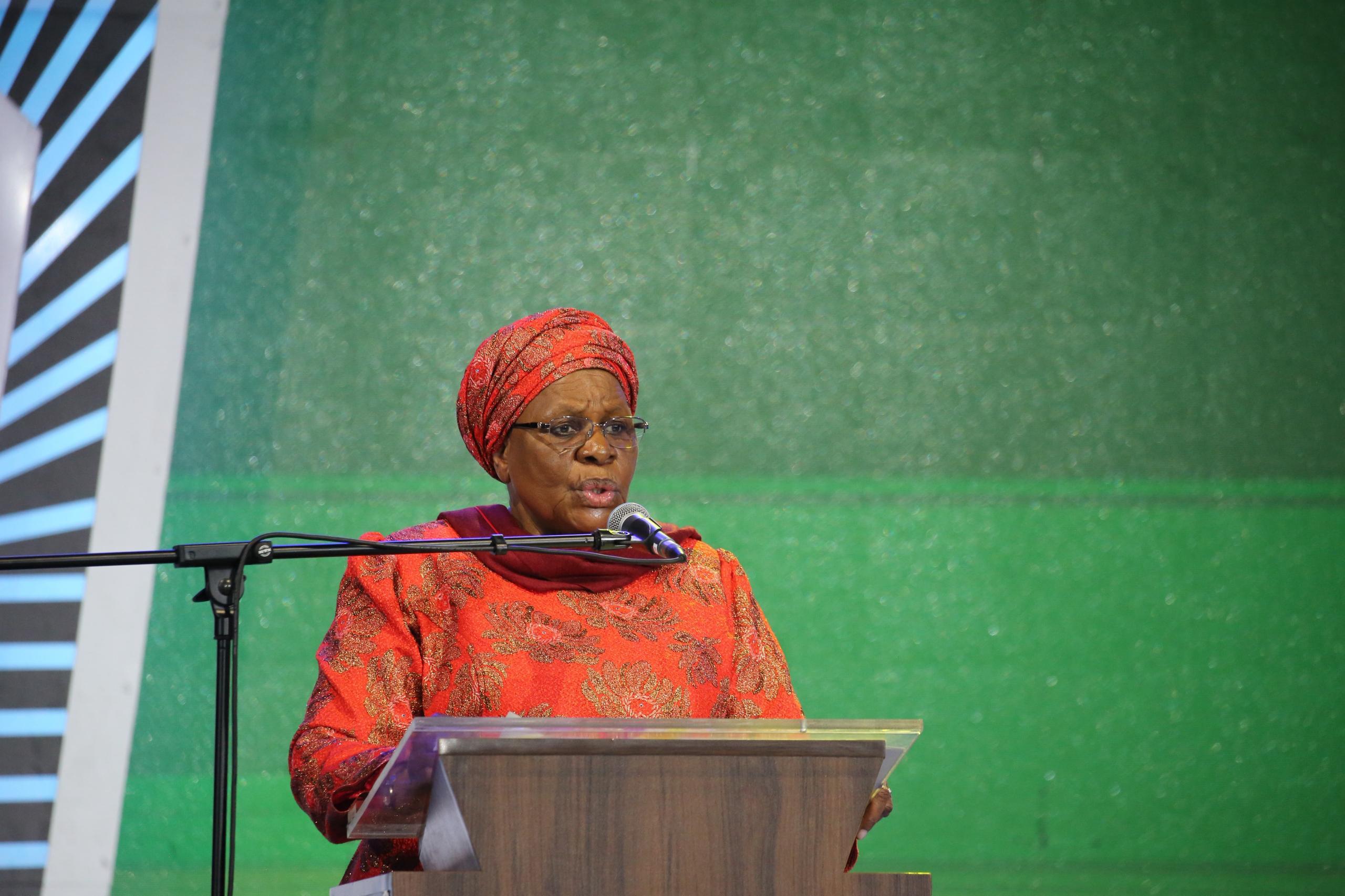

ANTANANARIVO – President Netumbo Nandi-Ndaitwah, in her first address to the 45th Southern African Development Community (SADC) Summit as Namibia’s Head of State, has called for greater cooperation and urgency to ensure food security is not just a goal on paper but a reality in every home across the region.
The summit, which brought together Heads of State and government from the 16-member bloc, featured maiden speeches by Nandi-Ndaitwah, Botswana’s Duma Boko and Navinchandra Ramgoolam, Prime Minister of Mauritius.
Their messages, though from different perspectives, converged on a single point: SADC must move from rhetoric to practical steps that transform lives.
In a firm speech, President Nandi-Ndaitwah tied her maiden appearance to both history and the pressing needs of today.
She paid tribute to Namibia’s Founding Father, the late Sam Nujoma, promising to carry forward his legacy of unity and development.
She positioned food security and youth empowerment as urgent priorities.
“We must empower the youth with skills, enabling them to compete with their peers worldwide, particularly in creative industries, information and communication technology and digital innovation,” Nandi-Ndaitwah urged. On industrialisation, she called for stronger regional value chains and local beneficiation of minerals. “There is a compelling need to enhance value addition to our critical raw minerals before they are exported. By doing so, we will strengthen our economies, create jobs and retain more benefits from our natural resources,” she said.
Nandi-Ndaitwah reminded delegates that peace and stability remain the bedrock of development. Expressing concern about insecurity in the eastern Democratic Republic of Congo (DRC), she praised SADC troops for their sacrifice. “Their courage and sacrifice remind us of the cost of peace and inspire us to keep working for a better tomorrow. Without peace, there is no progress, hope for our children and growth for our economies,” she stated. The Namibian President stated that hunger and other pertinent issues on the continent cannot be ignored.
“The objectives of the SADC Vision 2050 cannot be realised when our people are confronted by hunger, high youth unemployment and other socio-economic challenges,” she said. Her words captured the stark reality: despite the region’s natural wealth, millions struggle with poverty and food insecurity.
Nandi-Ndaitwah called on member states to urgently translate commitments into action.
“We must work together with urgency and compassion to ensure food security in our region is not just a goal on paper but a reality in every home across the region,” she added.
Peace and security also featured strongly in her remarks. She warned that instability in the eastern DRC threatened to derail regional progress. Praising SADC forces deployed in the DRC, she said “their courage and sacrifice remind us of the cost of peace and inspire us to keep working for a better tomorrow. Without peace, there is no progress, no hope for our children and no growth for our economies”.
Nandi-Ndaitwah’s address struck a balance between empathy and urgency, underlining that SADC must be both compassionate and bold to meet its people’s needs.
Nearly 70% of Southern Africa’s population depends on agriculture for survival, yet millions still go hungry. This urgent reality set the tone at the SADC Summit in Antananarivo, where leaders spoke with one voice on the need for food security, industrialisation and youth empowerment. SADC executive secretary Elias Magosi has warned that food insecurity remains one of the region’s biggest challenges, with an estimated 60 million people – about 17% of the population affected in 2024.
She said agriculture, which contributes around 33% of SADC’s gross domestic product and supports the livelihoods of more than 62% of the population, must undergo urgent transformation. “We will intensify efforts to transform the agriculture sector,” he said, stressing that adequate investment and modernisation were essential to unlock its full potential.
He said agricultural transformation is not only critical for food security but also for creating decent jobs and stimulating economic growth.
He said the interventions would be guided by the theme of the 45th SADC Summit, which emphasises industrialisation, agricultural transformation and energy transition for a resilient region.
Botswana
Botswana’s new president Duma Boko took to the stage with a different but equally powerful message. He said the survival of the continent depends on democracy and intra-African trade.
He recalled Botswana’s 2024 general election, in which his opposition party defeated the ruling party, which had been in power for 58 years.
He said the peaceful transfer of power was proof that African democracies could pass even the hardest tests. “Let Botswana be your guiding star,” Boko declared. “These are words we would like to hear uttered in similar circumstances across the breadth of the continent,” he added.
But Boko’s focus quickly shifted to economics. He warned that Africa’s over-reliance on global powers had left the continent vulnerable, and that the solution lay in trading with each other. “We have come to that point in our history where we must recognise that we need each other desperately as Africans,” he said.
“Let us hold each other by the hand as we strengthen deeper intra-African trade. That is our only means of survival,” he said.
Boko criticised decades of political rhetoric that had failed to produce results.
He said the time had come for action that directly addressed poverty and unemployment.
“Africa is in distress. It is calling out to each and every one of us. That cry of distress is a call to the rescue. We must rise here and now to respond,” he urged.
Boko argued that this dependency was worsened by Africans’ reluctance to trade with each other. “We have refused. We have been reluctant to see and recognise each other’s worth. We must reach out across barriers and find each other, and hold each other by the hand as we strengthen deeper intra-African trade. That is our only means of survival,” he said. His words reflected a broader frustration shared by many African leaders – that while the continent is rich in resources, its people remain poor because of limited industrialisation and weak regional trade.
Mauritius
The Prime Minister of Mauritius used his maiden speech to align with the summit’s theme, ‘Advancing Industrialisation, Agricultural Transformation and Energy Transition for a Resilient SADC’.
He placed special emphasis on preparing young people for the future economy.
“We must promote youth and gender empowerment through quality education, vocational training and digital upskilling,” he said.
The Mauritian leader stressed that economic progress must go hand in hand with environmental sustainability. “We must build climate resilience with innovative policies and regional partnerships to adapt to environmental challenges,” he said.
He highlighted the African Continental Free Trade Area (AfCFTA) as a platform for deepening integration and reducing trade barriers. “Together, let us move forward hand in hand for a peaceful, integrated and resilient society,” he said. His address resonated particularly with island nations and climate-vulnerable states, where the effects of global warming are already disrupting livelihoods. By linking industrialisation with sustainability, Mauritius positioned itself as a voice for balancing economic ambition with environmental responsibility. Outgoing SADC chair president Emmerson Mnangagwa of Zimbabwe reflected on his one-year tenure as he handed over the chairmanship.
His speech acknowledged both progress and challenges facing the bloc.
He praised the bloc’s achievements in industrialisation and regional infrastructure but warned that the lack of financing remained a major obstacle. “The SADC Regional Development Fund is a low-hanging fruit which, when operationalised, will provide alternative financing for critical infrastructure projects,” Mnangagwa said. He highlighted agriculture as an area requiring urgent attention, especially in the face of worsening climate shocks.
“Our prosperity is inevitably tied to the success of our neighbours and to that of our region as a whole,” he told delegates.
He applauded efforts to build agro-based value chains but admitted results had been mixed. “We should not deter agencies from investing in innovative strategies for climate change adaptation, mitigation and resilience,” Mnangagwa said. On peace and security, he commended African-led mediation efforts in the DRC and other hotspots.
“We welcome the outcome of African-led peace processes, which reinforced our philosophy of African solutions to African problems,” he said.
Action
Across the summit, the maiden speeches of Namibia’s Nandi-Ndaitwah, Botswana’s Boko and Mauritius’ Prime Minister converged with the reflections of Zimbabwe’s Mnangagwa on a single theme – the need to act decisively.
The leaders stressed that the region cannot continue exporting raw materials and importing finished goods while its youth remain unemployed and families go hungry, nor can it remain at the mercy of external powers for trade and investment.
Instead, they urged SADC to deepen its integration, invest in its people and harness its vast natural wealth for local development.
The event saw a peaceful handover of the SADC chair from Zimbabwe to Madagascar.