


Lahja Nashuuta
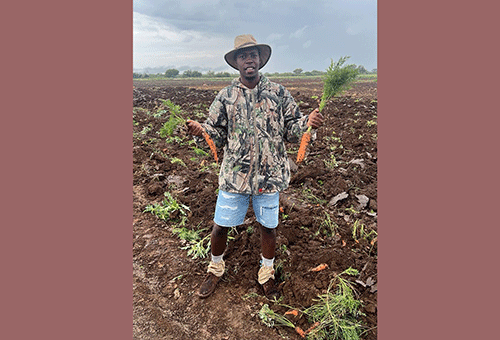
At just 25 years of age, young farmer Viarinao Evra Usurua is proving that farming is not only for the elderly but also a viable and modern career path for Namibia’s youth.
Usurua is the manager and face behind Orusuuo Farming, a family farming business situated some 40km southeast of Witvlei in the Omaheke region.
The farm engages in wood and charcoal production, Brahman stud farming, Meatmaster sheep, game hunting and horticulture.
“We believe in not putting all our eggs in one basket. Farming in Namibia is unpredictable, so diversity keeps us afloat,” he says.
His love for farming even extends to wildlife or game farming. “I developed a passion for hunting, and I’m currently pursuing my professional hunting license under the Namibian Professional Hunting Association (NAPHA),” he reveals.
“My life has revolved around farming from as far as I can remember. It is embedded in my DNA,” he said proudly.
Born and raised in Windhoek, he spent much of his childhood alongside his father on the farm, hardly keeping up with township youth trends. “While my friends were chasing the latest fashions and gadgets, I was chasing cattle and fixing fences,” he recalls with a laugh. For Usurua, farming was never a choice but inevitable. “Growing up in an extensive farming family, it was clear I would become a third-generation farmer. I was inspired not just by tradition but by the passion, discipline, and resilience that farming demands,” he explained.
He revealed that his father, Colin Usurua, who runs Agrifutura, has been a mentor and guide throughout his journey.
“My father is the backbone of my farming career. He mentors me daily, guides my decisions, and instils the discipline needed to succeed in this tough industry,” he says.
His mother, Theofilia Usurua, also contributes significantly to the family’s operations, particularly in the horticulture operations.
“She’s the driving force behind our vegetable production, which we supply to both mainstream and street markets in Gobabis and Witvlei. Her guidance ensures our crops meet quality standards and reach reliable markets,” he shared.
Humble beginning
Usurua completed his secondary education at Delta High School and enrolled at the University of Namibia’s Ogongo Campus to study animal production.
After a year, he moved to the Namibia University of Science and Technology (NUST), where he is pursuing a degree in Agricultural Sciences. He was recently elected chairperson of the NUST Agricultural Society, which has now grown to 85 active members.
“Our mission is to enhance agricultural practices, foster innovation, ensure food security, and support farmers and rural communities. We also aim to encourage young people to see agriculture not as a last resort but as a smart, innovative career choice,” he added.
Overcoming challenges
Farming in Namibia comes with its unique set of challenges, the young farmer admitted. “Our work is always at the mercy of the weather. You must plan breeding and planting around unpredictable rain patterns.”
He emphasised that Namibia’s arid and semi-arid conditions, high temperatures, and low humidity require farmers to be strategic and adaptable. Market dependency is also another hurdle.
“Namibia relies heavily on South Africa for weaner exports. When South Africa experiences disruptions, it directly affects our income. The recent foot-and-mouth disease outbreak at Karan Beef caused significant trade disruptions, and our prices dropped,” he says.
He further indicated that conflict with wildlife and bush encroachment are other challenges farmers are faced with.
“Wild animals can destroy crops, attack livestock, and sometimes even endanger human life. These losses affect our income and our approach to conservation while bush encroachment further reduces grazing land. Horticulture struggles with penetrating mainstream markets. Sometimes I’m forced to sell my produce cheaply just to avoid wastage,” he admits.
Despite these obstacles, Usurua remains optimistic. “These challenges are part of the learning curve. With experience, exposure, and the right strategies, they can be managed and even turned into opportunities,” he said.
Support and opportunities
Government support has been instrumental in helping him and other farmers navigate difficult seasons. “The drought relief programme has been a lifeline for me and my workers,” he says.
He said subsidies from the Namibian Agronomic Board also helped with recovering from the drought, through the supply of seeds, fertilizers, and tractors.
As chairperson of the NUST Agricultural Society, Usurua is passionate about youth engagement in agriculture. Namibia’s national unemployment rate currently stands at 37%, with 45% being youth, and that means alternative pathways like farming are increasingly becoming important.
“There’s this ‘degree disease’ where people think success only comes from a four-year degree. But agriculture, renewable energy, and technology are where the jobs and opportunities are. Don’t wait for government jobs. Create your own opportunities. Farming is not just ploughing fields; it’s agribusiness, innovation, and food security. Agriculture is the way to go,” he urged fellow young farmers.
“My vision is to make farming a respected, profitable, and sustainable career choice for young Namibians. We need more youth to see the potential in agriculture, not just as farmers, but as innovators, entrepreneurs, and leaders.”
-lnashuuta@nepc.com.na