

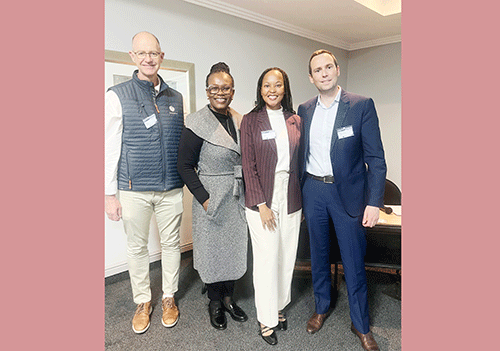

A high-level gathering of tourism investors, developers and ESG leaders has sparked critical debate about the relevance of global sustainability standards in the Southern African context.
It raised pressing questions about whether widely used Environmental, Social and Governance (ESG) frameworks are fit for purpose in emerging markets.
Hosted by the Southern African Development Community Tourism Alliance, the closed-door think tank marked a regional convening to bring hospitality operators and sustainability experts into a candid conversation with developers and private equity.
It was titled ‘Profit, Planet, People: How Global Hospitality is Scaling in Southern Africa Responsibly’
What emerged was clear: while ESG remains a vital entry point for funding and operating sustainably, its current implementation often misjudges local impact, over-emphasising environmental compliance at the expense of transformative social outcomes.
“We should stop treating ESG as a certificate on the wall,” said Olivier PerillatPiratoine, managing director for Club Med South Africa.
“In our business, it has to be the operating system – the way we design, source and develop people,” he added.
Club Med’s coastal safari resort in northern KwaZulu-Natal offers a case in point.
Set to open in 2026, the development has already created 800 direct jobs, over 1 600 in the value chain, and contributed to a 60% drop in local crime.
However, most of these achievements will not appear in a standard ESG scorecard.
“Globally, the centre of gravity is the ‘E’,” said Lopang Rapodile, ESG manager at Kasada.
“Here, the ‘S’ – jobs, skills, women in leadership and township inclusion – is often the licence to operate. If we don’t elevate that, we miss what sustains hospitality in this region,” he said.
Simon Stobbs, managing director South Africa at Wilderness, backed the call for a more context-sensitive approach.
“You can count diesel consumption. You can’t count the pride of a parent with a stable job or the resilience a community builds when its farms supply a lodge yearround. Those intangibles are the foundation for everything else,” he said.
Panellists agreed that current ESG compliance systems – born in more developed markets – often create barriers for Southern African businesses.
Small and township-based suppliers, particularly those led by women, are disproportionately locked out of procurement opportunities due to documentation and capacity expectations that fail to consider local market realities.
“The scale bias is real,” said Rapodile.
“We want to localise procurement, but consistency and volume expectations lock out smaller vendors. That’s solvable – with aggregated orders, practical QA support and faster payments – but it requires design choices, not just intent,” he added.
The think tank concluded with a call for ESG reform, not to lower the bar, but to recalibrate what is measured and valued.
This reform includes recognising contextually relevant social indicators, such as job creation, small and medium enterprise participation and skills development.
In addition, it includes adjusting procurement systems to enable small supplier inclusion, balancing global environmental standards with local economic realities, and shifting ESG reporting from template-based compliance toward performance-based impact.
Natalia Rosa, tourism project lead for the SADC Tourism Alliance, said “conversations like this show why the Alliance exists. Our role is to connect the tourism eco-system across 16 member states so that global frameworks translate into regional realities. ESG in Southern Africa cannot be a tick-box exercise. It must recognise the value of jobs, skills and inclusive growth alongside environmental priorities.
“By convening the sector, we ensure that the issues that matter most to our region are heard, debated, and translated into solutions that strengthen both our tourism industry and the communities it supports”.
The SADC Tourism Alliance’s formation and activities are supported by the Joint Action NaturAfrica/Climate Resilience and Natural Resource Management (C-NRM) Programme, co-funded by the European Union (EU) and the German Government and implemented by Deutsche Gesellschaft für Internationale Zusammenarbeit (GIZ) GmbH.