


Venezuela is one of the Latin American states in South America, situated just above Brazil. Its state capital is Caracas, and it has a population of about 28 million people. Despite that, only about 30% of the country’s population resides in the rural areas. Venezuela attained its independence and freedom from Spain on 5 July 1811. Henceforth, the first republic was established.
From 1811 to 1992, Venezuela experienced a series of circumstantial transitions and turmoil. Nonetheless, the revolutionary spirit of the Venezuelans never wavered amidst these occurrences. Venezuela is one of the Latin American countries that has witnessed a series of crises, including authoritarian governance of the country, but the Venezuelan people never give up on their country, an exemplary revolutionary spirit worth emulating in the modern world. The second, most notable figure, still celebrated countrywide is the Commander in Chief Hugo Chavez, who established and formed a political movement called Movimiento Bolivariano Revolucionario (MBR) on 17 December 1982. President Chavez assumed power in 1998, and in 1999, he changed the constitution.
The new name of the country was adopted as the Bolivarian Republic of Venezuela to incorporate a direct reference to the independence hero, Simón Bolívar, and his moral values of liberty, justice and peace. He is a notable revolutionary in the transformation, establishing a solid economy and political stability.
Venezuelan Government and society in what he has termed a Bolivarian revolution. Based on Chávez’s interpretation of the thinking of Venezuelan founding fathers Bolívar and Simón Rodríguez, this revolution brings together a set of ideas that justifies a populist and sometimes authoritarian approach to government, the integration of the military into domestic politics, and a focus on using the state’s resources to serve the poor the president’s main constituency. The people of Venezuela vow to defend the country’s sovereignty and resist Western influence, having adopted a socialist approach to politics, economy, and democracy. The people of Venezuela oppose globalisation and neoliberal economic policies. Hence, they endure the economic sanctions that have been placed on Venezuela by the United States of America and other Western countries. President Chavez, together with his successor, and the current president of Venezuela, Nicolás Maduro, have invested a great deal of time and cooperation in building relations with Socialist and Communist nations of the world.
The late president Chavez once said, “The only way to save the world is through socialism, but socialism that exists within a democracy it’s not dictatorship”.
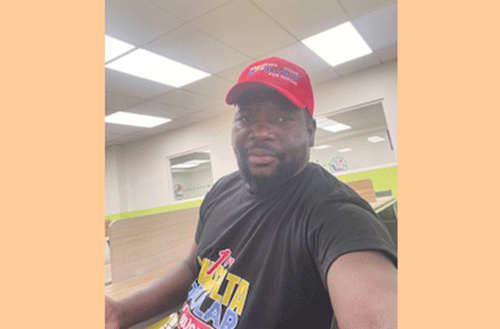
*Martin-Olembe Antindi is a scholar, educator and youth leader. He recently obtained an International Diploma of leadership in Communal Management from Antonio Jose De Sucre International School, Venezuela.