

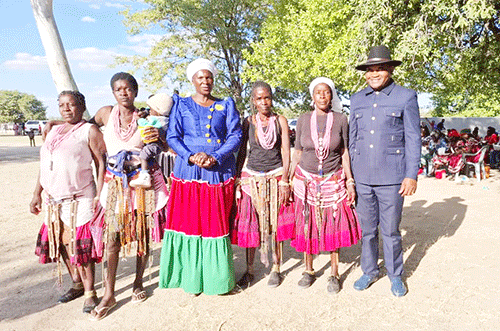

Lahja Nashuuta
As Namibia celebrates Heroes’ Day tomorrow, Fransina Ndateelela Kahungu, Secretary of the Swapo Party Women’s Council, said Namibian women’s dedication to the country’s liberation struggle was unquestionable.
“They were on par with men, and in some respects, exceeded men’s commitment,” Kahungu told New Era.
She explained that during Namibia’s fight for independence, women were a crucial force both inside and outside the country. Women in Swapo’s military camps abroad carried out important tasks needed for the movement’s success, while those who stayed inside Namibia, especially in the north, secretly provided PLAN fighters with food, shelter, and information.
Women also held various positions within PLAN, including medical and communications officers, political commissars, and members of the military council, Kahungu maintained.
She emphasized that although men often fought on the frontlines, women played equally heroic roles at home. During the liberation struggle, women would light the fire in a hut as a symbol of protection for everyone wandering in the forests of Namibia.
In the same hut, food was stored and reserved for the soldiers and fighters. This meant that sometimes even those staying in the house went to bed on an empty stomach, yet special food was kept for ‘aayendanandjila’ (people en route to serve their communities or the nation),” Kahungu explained.
“The food I refer to includes traditional cabbage and other staples, regarded as sacred and best served to people engaged in heroic work with the goal of elevating the family and the nation. For example, when a boy went into the forest looking for food to support the family or fighting for his country, it was the women in the house who made sure there was food waiting when he returned.”
Kahungu highlighted the broader roles of women in Namibian society.
In many African cultures, women are seen as advisors. In our community, we say ‘Eumbo omukulukavi’ (a house is only complete when a woman is present). “Women offer clarity, protection, and wisdom both at home and in the wider community,” she said. She added that women pass on knowledge and values to children, shaping the next generation to contribute meaningfully to society.
Reflecting on past challenges, Kahungu highlighted women’s roles during the contract-labour period under the Southwest Africa Native Labour Association (SWANLA). Many men were away for months working in mines, farms, and other industries, leaving women and children to handle households, farms, and community needs.
“It required courage, perseverance, and focus to provide for families and even strangers during those times,” she said. She also emphasized women’s role in promoting education and literacy in rural areas.
“While men were away, women ensured children went to school and encouraged learning so they could become doctors, engineers, and leaders once Namibia achieved independence. These contributions laid the foundation for our nation’s future,” she maintained.
Kahungu urged the youth to continue these legacies.
“The next struggle is economic emancipation. Education is your path to freedom of the mind. Use it to innovate, create, and uplift our nation. Be heroes in your own right. Heroes existed before, they exist now, and they shall continue to exist,” she encouraged.