


Keetmanshoop residents in the //Kharas region, have urged the government to ensure the petroleum industry delivers tangible benefits to ordinary Namibians, especially women, youth and small businesses.
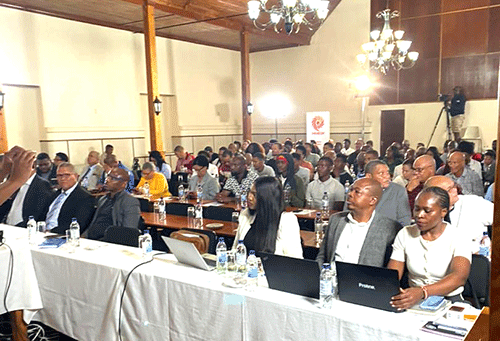
The residents who included entrepreneurs, traditional leaders, the elderly and youth shared their perspectives at a national consultation meeting of the Upstream Petroleum Unit in the Presidency, on how the petroleum industry can deliver tangible benefits to the region.
Chairperson of the regional council, Joseph Isaacs, opened the meeting by stressing that local content should directly address inequalities.
“We must consider those who were previously disadvantaged. True transformation will only be achieved if the petroleum sector becomes a vehicle for empowerment and shared prosperity across all sectors of society,” he said.
Residents agreed with Isaacs and also raised concerns about limited access to capital for small businesses, lack of skills, and fears of unfairness in the awarding of opportunities.
The Presidency noted that the consultation at Keetmanshoop was marked by strong calls for the government and industry to pay closer attention to the unique challenges facing local people.
Participants highlighted issues such as the shortage of vocational skills, the need for transparent processes, and financing barriers faced by small enterprises.
“Without transparent systems, only the well-connected will benefit.
We want fairness so that even young people from our town can take part,” one resident remarked.
The demands echo the principles of the draft Local Content Policy, which commits government to maximising training, upskilling and employment opportunities for Namibians, while reserving supply and delivery services for local businesses, especially those owned by previously disadvantaged people.
“The Government of Namibia is committed to unlocking the full potential of its citizens by maximising employment opportunities in the petroleum sector across all skill levels,” the draft policy states.
It further pledges to create financing avenues for small and medium enterprises and to guarantee fair and transparent licensing and contracting processes.
“All things considered, this policy mandates that supply and delivery services be exclusively reserved for Namibian businesses, particularly those owned by previously disadvantaged persons,” it reads.
Suggestions
Residents called for more vocational training centres, funding schemes for small and medium enterprises, and monitoring systems to ensure promises of local participation are kept.
Carlo McLeod, the deputy head of the Upstream Petroleum Unit, assured the people their voices would influence the final policy.
“The ultimate goal is to create a framework that not only unlocks opportunities in the petroleum sector but also responds to the needs of ordinary Namibians,” he said.
The draft policy, seen by New Era, places emphasis on what it terms “Namibianisation.”
It requires companies in the oil and gas value chain to employ locals, transfer skills, and form partnerships with Namibian firms. It also warns against “fronting,” where disadvantaged Namibians are used as window-dressing without real benefits.
At the Keetmanshoop meeting, participants welcomed these safeguards but called for strict enforcement.
“It is not enough to write these things in a policy. We need watchdogs to make sure they happen,” said a local entrepreneur.
The government’s consultation process began on 1 September and will run until 17 September, covering all 14 regions. The next stop is Mariental, in the Hardap region today.