


Every Namibian has seen it. You buy bread, school uniforms, or a packet of tinned fish, and the label says “imported.” Yet the maize, the wheat, the fish, the stone all come from our own land and waters. We export it raw, then pay more to buy it back processed.
That gap is not just statistics. It explains why jobs are scarce, why skills go unused, and why national wealth keeps leaking away.
The sixth National Development Plan, NDP6, gives us a map. It calls for manufacturing to rise from about 10.6% of GDP today to 18% by 2030. Jobs in the sector must expand from just over 53 000 to 80 000. Manufactured goods must grow from 42% of exports to 60%. These are not abstract percentages. They are livelihoods. They are classrooms built, homes roofed, children fed. They are the difference between a fisherman in Walvis Bay selling frozen hake by the tonne and selling branded Namibian portions in regional supermarkets.
This path demands connection. A farmer cannot succeed if their harvest rots before reaching a mill. A factory cannot survive if power cuts halt production. An exporter cannot compete if issuing certificates take months. A sponsor cannot help if their project is detached from our plan. Everything depends on the pieces working together farmer to factory, regulator to buyer, port to corridor, investor to framework. When they connect, Namibia moves. When they don’t, we stand still.
NDP6 tells us where to start. We cannot industrialise everything at once. But we can build on what we already do well. Agro-processing can take northern harvests and turn them into fortified cereals and tomato paste for schools and hospitals. Fisheries can shift from bulk frozen blocks to retailer-ready products that pass EU and SADC standards. Construction materials gypsum into boards, stone into tiles, timber into frames can supply housing and public works first, then export into the region. These are quick wins if inputs, utilities, and standards are aligned.
Progress is already visible. New fish lines on the coast are climbing the value chain. Packaging SMEs now supply processors that once depended on imports. Agro-processors in the north are supplying national school meals. These are not isolated wins. They prove that when the system connects, Namibia delivers.
The risks are real, but they are not excuses. Power outages and tariff uncertainty can turn an investment into a stranded asset, which is why industrial parks need dedicated feeders and predictable rates. Water shortages can quietly kill a factory, which is why siting and reuse must be disciplined. Standards delays can close markets, which is why laboratories must be resourced with the same urgency as factories. Logistics bottlenecks can wipe out competitiveness, which is why ports and corridors must function as reliably as the production lines they serve.
This is also a continental story. Under the African Continental Free Trade Area, tariff-free access depends on value added at home. Agenda 2063 calls for beneficiation and industrialisation as Africa’s path to prosperity. Namibia’s corridors and ports give us an advantage, but only if we ship certified, reliable products. Partnerships with China, the EU, and others are real, but they must serve Namibia’s plan, not overwrite it.
And this is a citizen’s story. For the market woman in Katima Mulilo, it means goods that cost less when more is produced at home. For the student in Keetmanshoop, it means courses that match real jobs in factories and labs. For the entrepreneur in Oshakati, it means building a business that plugs into existing value chains instead of scattering energy. For the banker in Windhoek, it means lending into deals that are standards-ready and buyer-led. For the sponsor abroad, it means aligning funds with NDP6 priorities and being welcomed into a system that works.
Hope alone is not a strategy. Numbers, plans, and discipline are. The recent assessments remind us that drifting will not deliver Vision 2030. NDP6 reminds us that alignment can. The question is not whether Namibia can industrialise. The question is whether we are willing to connect the parts we already hold.
If the market woman in Katima Mulilo, the fisherman in Walvis Bay, the governor in the South, the student in Keetmanshoop, the banker in Windhoek, and the partner abroad all move in the same direction, then manufacturing and value addition will no longer be jargon. They will be pay slips, factory lights, and national pride. They will be the heartbeat of a Namibia that captures its own wealth, proud, productive, and prepared for the future.
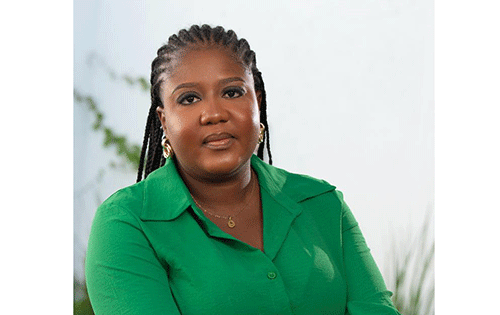
*Dr Penny T Uukunde is a regional development economist and Africa China Expert.