

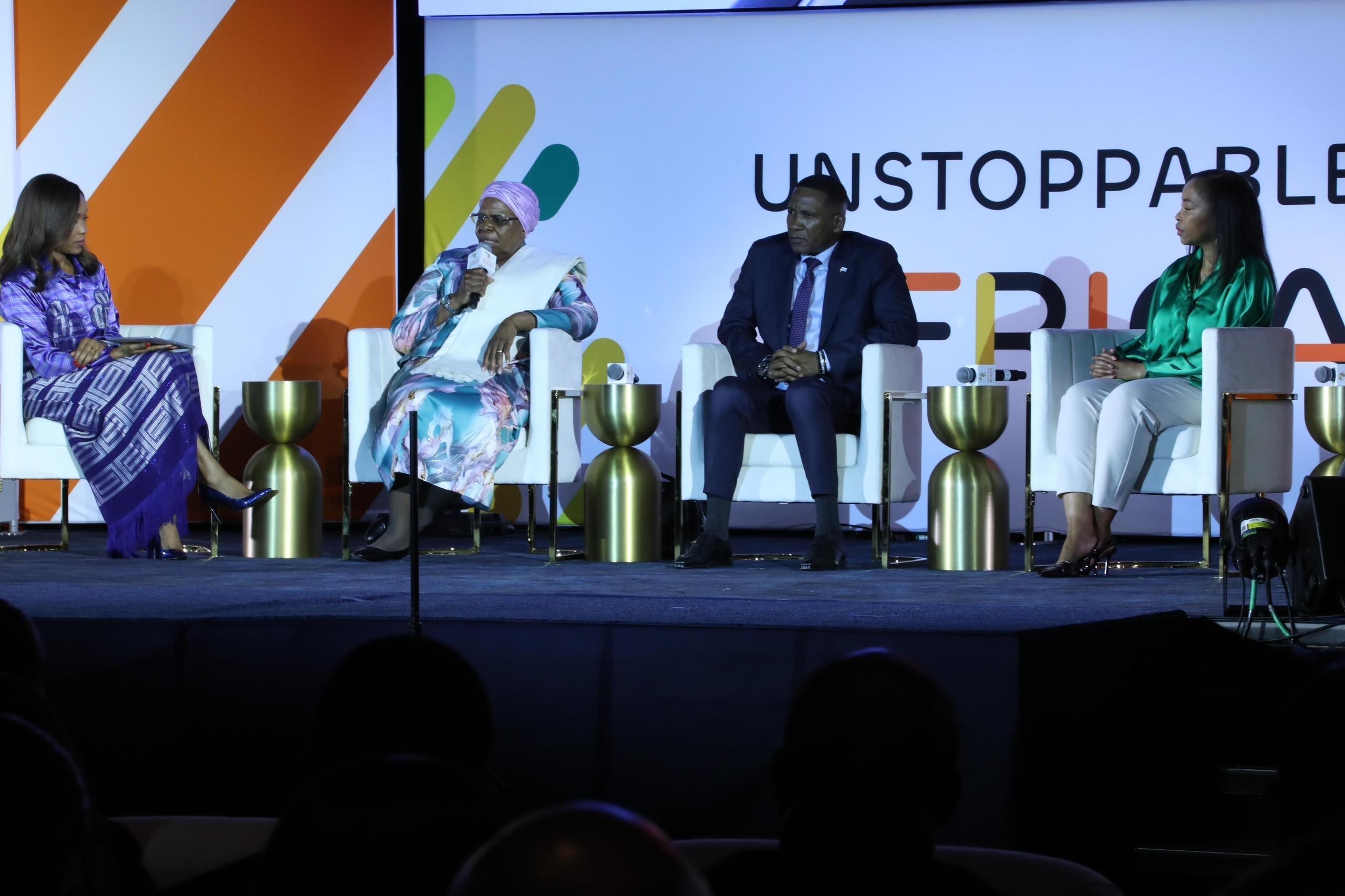

NEW YORK – A high-level panel discussion featuring Namibian President Netumbo Nandi-Ndaitwah, Botswana’s leaders and other speakers has called on Africa to take ownership of its resources and clean energy future instead of remaining dependent on outside markets.
At the Unstoppable Africa 2025 high-level opening panel in New York, President Nandi-Ndaitwah joined Duma Boko, President of Botswana, Phuthi Mahanyele-Dabengwa, CEO of Naspers South Africa and Sultan Ahmed Bin Sulayem, Group Chairman & CEO of DP World to underline Africa’s pivotal role in shaping global markets.
President Nandi-Ndaitwah said Africa must position itself as both a producer and a market, stressing that the African Continental Free Trade Area (AfCFTA) was already creating opportunities for a united African market.
“Africa has already done something, and Africa is just in the process of implementing what has been decided. When Africa agreed on the value chain within the continent, it was positioning itself to become the hub for goods and service production,” she said.
The Namibian leader emphasised that the continent holds some of the world’s most critical minerals, particularly those needed in technology and communications.
She warned that Africa should no longer allow its resources to be exported raw without value addition. “If Africa works together on critical minerals and their value chains, then it will be an attraction for the world to relocate operations to Africa. Our resources should not continue to leave the continent unprocessed,” Nandi-Ndaitwah said.
Clean energy
Turning to the issue of energy, President Nandi-Ndaitwah said Africa has vast potential to become a leader in renewable energy because of its natural conditions.
“Africa is blessed with sunshine and – in some parts, very good wind,” she noted.
“These are the resources we can use to generate clean energy. But we also need a fair transition, because our economies still depend on conventional energy to develop,” she added.
She explained that hydrogen has been in the market for years, but much of it was produced using traditional energy sources.
The current challenge is to ensure hydrogen is produced through solar and wind, making it genuinely clean.
“Clean hydrogen is part of the package of development we are looking for on the continent,” the President said.
Botswana’s president echoed her call, stressing that Africa must create an enabling environment for investment in green industries while ensuring local benefits.
The discussion touched on the role of education in Africa’s transition. A panellist asked how higher education institutions could prepare the next generation for leadership in clean energy and innovation.
Experts stressed that universities should align their training with Africa’s new development agenda.
“Capital must find its way into Africa because it faces the best prospects of improving the lives of real people and also getting returns on investment,” one speaker said.
They argued that Africa’s young population, combined with its resource base, gives the continent an unmatched opportunity to shape the global economy if it invests in education, research and innovation.
Nandi-Ndaitwah said Africa was not just a market “to receive” but must be a market “to produce”.
She added: “If we shape our markets and industries, then we will become a world-class market continent”.