

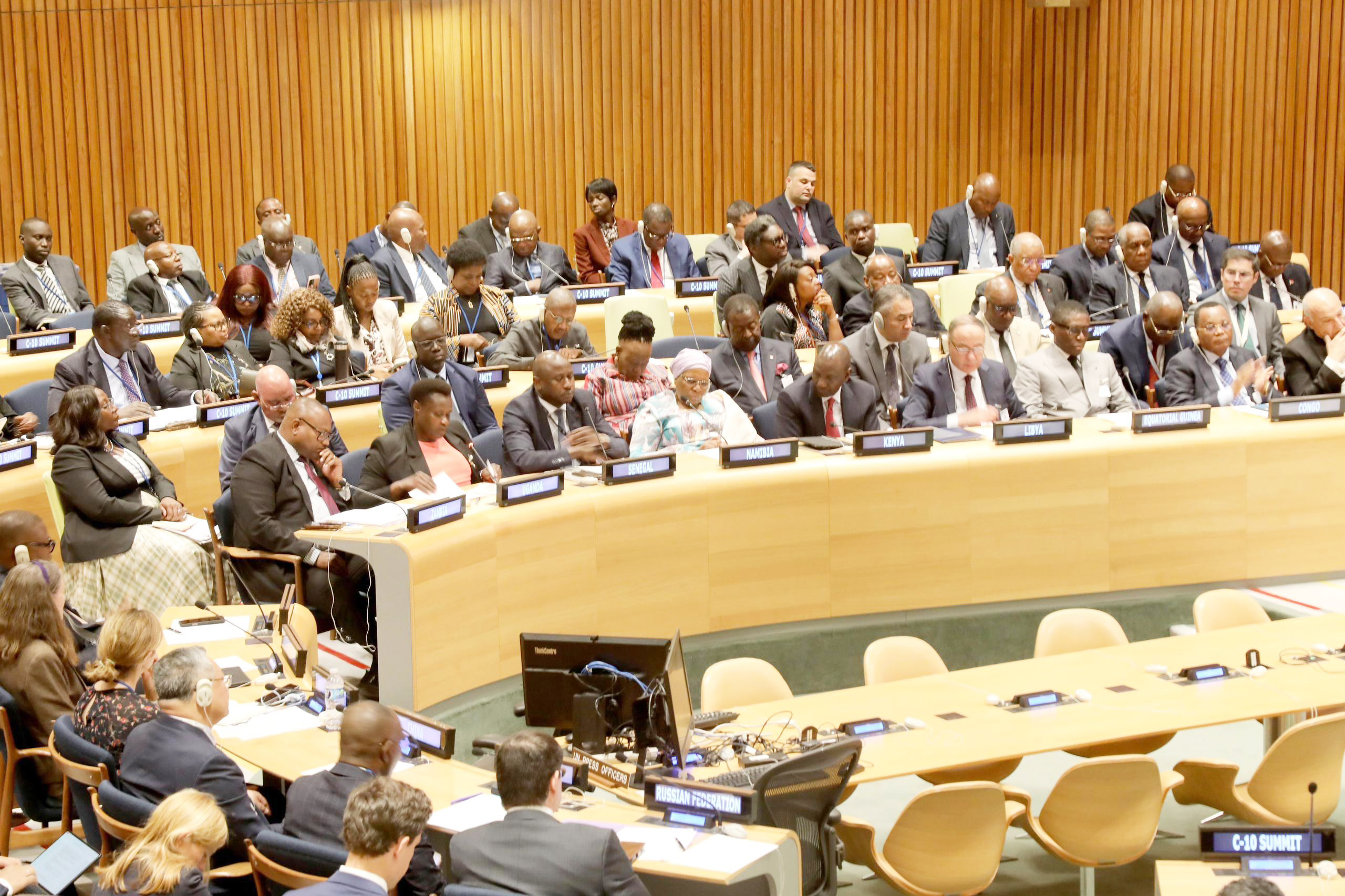

NEW YORK- Africa spoke with one voice during the 7th C-10 Summit, held on the sidelines of the United Nations General Assembly on Sunday, demanding that Africa must no longer be treated as an afterthought in global decision-making.
The mood was both reflective and urgent as the leaders marked the 20th anniversary of the Ezulwini Consensus, demanding their rightful place.
The strongest call came from Namibian President Netumbo Nandi-Ndaitwah, who insisted that Africa is not asking for favours but demanding its rightful place at the world’s most powerful table.
“Africa is not asking for hand-outs. We are demanding our rightful place in a council that is tasked with maintaining international peace and security,” Nandi-Ndaitwah declared, stressing that future generations deserve a more just and inclusive global order.
For two decades, African nations have stood behind the Ezulwini Consensus and the Sirte Declaration, which call for at least two permanent seats and five non-permanent seats for Africa on the United Nations Security Council. Yet despite broad international sympathy, little has changed. As one leader after another reminded the gathering, the injustice of Africa’s exclusion is no longer tolerable.
She reminded the assembly that Africa accounts for more than a billion people and one-third of the UN General Assembly, yet remains voiceless where the most consequential decisions are made. This, she warned, is a contradiction that undermines both the credibility of the UN and the hope of building sustainable peace.
In her statement, Nandi-Ndaitwah reflected on the journey since African leaders agreed in 2005 to push for UN reform through the Ezulwini Consensus and Sirte Declaration.
She stressed that the 80th anniversary of the United Nations is the right moment to fix historic injustice.
She reminded delegates that Africa accounts for one-third of UN member states and over 1.2 billion people, yet has no permanent representation on the UNSC — the body that makes binding decisions on peace and security, often about Africa itself.
“Future generations must inherit a fairer world,” she said, calling on the five current permanent members to “stand on the right side of history.”
Tying the reform debate to broader struggles for equality, she also highlighted the importance of women’s participation in peace and security matters, noting that 2025 marks the anniversaries of both the Beijing Conference on Women and UN Resolution 1325.
“As Africa strives for equal representation in the world’s premier peace and security body, women must equally be at the decision-making table,” she said.
African Union
The Chairperson of the African Union, President João Manuel Gonçalves Lourenço of Angola, carried the same theme forward, but with sharper emphasis on history and demographics.
Speaking with the weight of the AU behind him, Lourenço argued that Africa’s demand is not symbolic, nor excessive, but an expression of a legitimate right.
He pointed out that Africa is the continent most often debated at the Security Council, yet the one most absent from its permanent membership.
“A Security Council that treats Africa unequally cannot be credible,” he said, adding that the current arrangement denies the continent both dignity and justice.
Lourenço underlined that Africa’s demand is neither excessive nor symbolic.
He said it is a legitimate right, grounded in demographics, geography, and the fact that Africa is most often the subject of UNSC debates but least represented.
“A Security Council that treats Africa unequally cannot be credible,” Lourenço stated, pressing for at least two permanent seats with veto powers for Africa and five additional non-permanent seats.
He reminded the world that Africa is not only a continent of ancient civilisations but also a continent of youth, with almost half of its people under the age of 20. That youthful energy, he said, is already driving innovation and resilience, yet Africa’s voice remains muted in international governance. To exclude such a continent from permanent decision-making power, he argued, is to undermine the legitimacy of global governance. “Our unity remains firm and unbreakable,” Lourenço said, urging African nations to remain cohesive, put aside divisions, and persist until they are seated as equal decision-makers.
The summit was steered by Sierra Leone’s president Julius Maada Bio, who serves as coordinator of the Committee of Ten (C-10). Opening the Seventh C-10 Summit at UN Headquarters in New York, president Bio described the meeting as a historic moment, coinciding with the 20th anniversary of the Ezulwini Consensus and Sirte Declaration of 2005. These documents form Africa’s Common Position, calling for at least two permanent seats with full veto powers and two additional non-permanent seats on the Security Council.
President Bio reminded delegates that when the UN was founded in 1945, Africa had no voice, and today remains the only continent without permanent representation, even though African issues dominate the Council’s agenda. “This was not a plea for favour. It was, and remains, a demand for justice to correct a historic wrong,” Bio said.
The summit brought together the 10 C-10 member states, Algeria, Republic of Congo, Equatorial Guinea, Kenya, Libya, Namibia, Senegal, Sierra Leone, Uganda and Zambia. High-level participants included Lourenço, Mahamoud Ali Youssouf, Chairperson of the African Union Commission, Kenyan president William Ruto. President Bio praised Africa’s unity, noting that no country has broken ranks in two decades of advocacy. “Despite our diversity, Africa has remained steadfastly aligned behind a single, principled position. That unity is our strength. No reform can succeed without a united Africa,” he said.
He highlighted recent milestones, including the Freetown Retreat and Lusaka Ministerial Meeting, which produced the African Union Reform Model, a blueprint for structured negotiations.
Calling for action, Bio urged permanent members to match their recognition of Africa’s claim with political will and pressed negotiators to move beyond entrenched positions. “Africa’s demand is legitimate, non-negotiable, and just,” he declared. “Equal representation for Africa is not only an African imperative, it is a global necessity,” he concluded
Kenya
Although not a formal C-10 member, Kenya’s Ruto added his voice in New York, stressing that UNSC reform is part of a wider need for fairer global systems. He linked the agenda to conflict hotspots like Sudan, Somalia, and the DRC, as well as to issues of development finance and climate action. His intervention highlighted that without inclusion, Africa cannot shape the solutions to crises that most affect it. For all the speeches, the atmosphere was not one of pleading but of rising confidence. Gone are the days when Africa’s leaders couched their demands in cautious tones. Instead, they spoke of entitlement, dignity, and justice.