

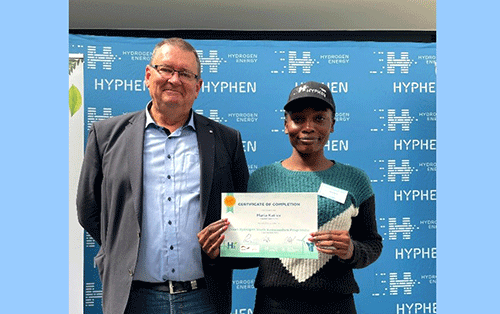

“I still remember racing the sunset, balancing a bucket of water on my head, and clutching a bundle of firewood.
In my village, light meant candles, warmth meant firewood, and study time ended when the flames burned out,” recalled Maria Kativa, a young woman from Kavango East.
Those daily struggles pushed her to pursue a career in electrical engineering.
Now, she is one of 28 young leaders selected from all 14 regions of Namibia to participate in the first-ever Green Hydrogen Youth Ambassadors Programme (GH2 YAP), which was held in Windhoek from 1-5 September 2025.
The programme was organised by the GIZ Energy Partnership in collaboration with Hyphen Hydrogen Energy and the Namibia Green Hydrogen Programme. Its goal was to equip young Namibians with the knowledge and tools to understand green hydrogen and explain it to their communities.
Green hydrogen is a clean energy source that could help Namibia reduce pollution and create jobs.
However, for it to succeed, people need to understand what it is and how it works.
That’s where the youth ambassadors come in.
“As ambassadors, we must raise awareness and answer questions. We must make sure our communities understand both the opportunities and challenges of this new industry,” said Kativa.
Participants were trained in hydrogen science, communication and community engagement.
She stated that, before the training, “hydrogen” felt like a distant buzzword.
But when Detlof von Oertzen, CEO of VO Consulting, drew two dots for hydrogen, one for oxygen and then showed them how electricity splits water apart, it suddenly became real.
This is what green hydrogen is using: Namibia’s sun and wind to split water into hydrogen and oxygen through the process called electrolysis to create a clean fuel with no carbon emissions.
Unlike grey hydrogen made from coal, which is highly polluting, green hydrogen is 100% clean.
The beauty is in what comes next.
This hydrogen can be turned into fertilisers for farmers, synthetic fuels for ships and planes or even stored to generate electricity later when needed.
“This process is called Power-to-X – but to her, it felt like Power-to-Possibility by turning clean hydrogen into other useful products to drive industries and improve lives. For Namibia, this could mean more food security, cleaner transport and stronger energy independence, which ultimately could boost our economy,” Kativa said.
“One of the most eye-opening lessons was realising how uniquely positioned Namibia is. With some of the best solar and wind resources in the world, we can produce green hydrogen cheaper than most countries. The scale of investment in GH2 projects is also massive. For example, the Hyphen project alone is valued at US$10 billion, about the same as Namibia’s entire gross domestic product,” she added.
Green hydrogen is expected to create 15 000 construction jobs and 3 000 permanent jobs.
Even more powerful, this project could supply excess electricity to the grid, lower energy costs and support farmers with affordable fertiliser.
“To me, that number was more than an economic fact. It felt like we were building a new Namibia alongside the one we already know. For the first time, I realised that our deserts are not empty but fields of energy waiting to be unlocked,” Kativa said.
The training highlighted an important fact that technology alone is not enough.
Skills development, transparency, community buy-in and inclusion will determine whether this industry succeeds.
She noted that one of the most powerful tools is the ongoing National Skills Census by Hyphen Hydrogen Energy Project, which is helping Namibia identify the training needed to prepare young people for hydrogen jobs.
As highlighted during training, Namibia needs reliable data to understand what skills exist and what training is required to ensure young people are ready to take up new opportunities in this transition.
“I did not return home with just a certificate to frame, but with a mission. As a youth ambassador, I will raise awareness in my community in plain and relatable language. I will advocate for local training opportunities, so our youth are part of the journey, not just observers. Most importantly, I will listen to community concerns to ensure they are shared with the national network of ambassadors,” Kativa noted.
-pmukokobi@nepc.com.na