


Rudolf Geiseb
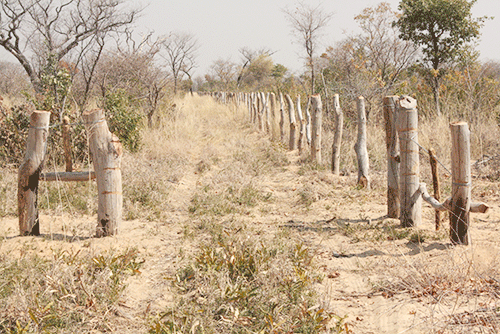
Fencing of communal land will be something of the past, if the land bill before Parliament is passed in its current form.
This will be a drastic move from current legislations that permits fencing on certain grounds.
The 18-year-old draft Land Bill is a consolidation of the Agricultural (Commercial) Land Reform Act and the Communal Land Reform Act, along with related legislation.
The different acts were consolidated into a single, coherent legal framework in order to enhance clarity, improve administrative efficiency, and strengthen the legal foundation for equitable land reform.
Agriculture, Fisheries, Water and Land Reform minister Inge Zaamwani tabled the comprehensive Land Bill in parliament on Tuesday.
The Bill restricts fencing on communal land areas, while existing fences will not be retained after a period set by the minister.
Currently, fencing on Namibia’s communal land is strictly regulated by the Communal Land Reform Act (2003), prohibiting new fences and requiring authorization for existing ones unless they are around homesteads, crop fields, or animal pens.
Erecting a fence without permission is an offense with penalties including fines or imprisonment, and the Communal Land Board can order removal of illegal fences.
Fencing of communal land has been a big thorn in the flesh of both governmnet and farmers. In some cases, farmers were ionvolved in physical confrontations over the fencing of some portions of communal land.
In recent years however, government efforts and community support have aimed to combat illegal fencing through awareness campaigns, audits, and the removal of unauthorized fences.
The clause was shot down by Swapo lawmaker Modestus Amutse, who said the Bill is good but has areas that need amendment.
“The law does not distinguish which areas; there are areas fenced off by residents to protect crops from wildlife or for livestock keeping and grazing. If we pass such a law, we are leaving people in a dire situation,” he told New Era at Parliament on Wednesday.
Amutse said even if the individual who wants to erect a fence on any portion of land within a communal land area applies for authorisation from the relevant board, as the Bill suggests, “it will still be a very long and unnecessary process.”
At the same time, Amutse is of the view that the prohibition of integrated crop-livestock systems on commonage in communal areas is not beneficial to residents.
The common practice, north of the cordon fence, where residents divide a portion of the land in two, where one side is used for crop production and the other for livestock, should not be stopped now, he said.
He said if a person is resettled in commercial land and loses the right to occupy the portion of land they had in the communal area, it diminishes the benefits that that person has already been enjoying.
“The law must not diminish the benefits that people have been enjoying. Laws must always advance to improve on how people have been living,” he added.
The draft Bill provides customary land rights, rights of leasehold, and occupational land rights; and any other form of communal land right that may be prescribed may be obtained.
Communal land boards will be established to control the allocation and the cancellation of customary land rights by chiefs or traditional authorities.
The board will receive applications for rights of leasehold and occupational land rights and make recommendations to the minister and, where applicable, grant rights of such.
It will resolve land disputes or refer them to appropriate authorities.
Furthermore, the power to allocate or cancel any customary land right in the communal area of a traditional community vests in the chief of that traditional community, after consulting the traditional authority of the relevant traditional community.
“Where the chief of that traditional community and the relevant traditional authority have so agreed, in the traditional authority of that traditional community… subject to ratification by the relevant communal land board,” it reads.
Commercial agricultural land
Essentially, the bill prohibits the ownership and leasing of communal land by foreign nationals.The ownership of commercial agricultural land by foreign nationals is also prohibited, but it allows for lease under certain conditions.
Foreigners will only lease amid hefty regulations, with written approval of the minister given on the recommendation of the land reform advisory commission.
The Bill radically asserts the minister will acquire commercial agricultural land for purposes of land reform and other related purposes. The state has the preferential right to be the first buyer whenever any owner of the land intends to alienate the land.
Political commentator Ndumba Kamwanya asserted that the ‘Willing Buyer and Willing Seller Policy’ did not yield tangible outcomes for land issues over the years.
“It became more of an obstacle because of a lot of disadvantages,” he said, such as hefty selling prices, slagging delivery, and low equitable distribution. The new Land Bill is trying to avoid this. To make sure that the selling and the buying of land works, because it gives the power to the state,” he said.
Kamwanya also noted land distribution to communities is important, but providing them with means such as tools, knowledge and skills is equally important.
The bill adjudicates that a lease may be for a renewable period or fixed term, renewable given the total occupation period does not exceed the prescribed period.
Kamwanya cautioned that the ban on foreign ownership and heavy regulation may discourage foreign investors, particularly in agriculture and tourism.
He also believes that if traditional authorities are not held accountable, there’s a risk for land allocation to favour elites or those politically connected.
Tabling the bill, Zaamwani said the land question remains a complex and emotive matter, but it remains central to the national discourse of redressing historical injustices of brutal dispossession.