

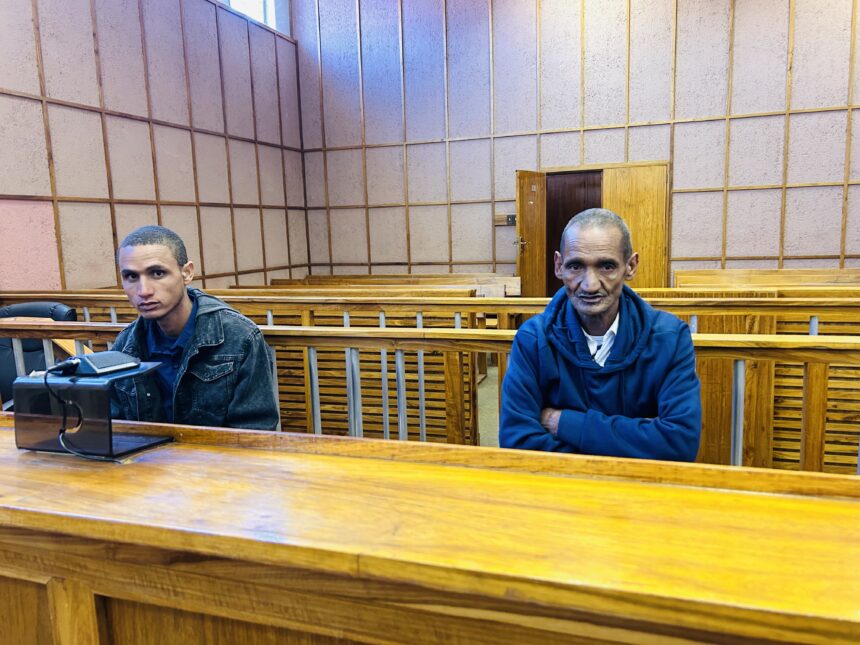

Iuze Mukube
A man was heard by neighbours instructing his eldest son to beat his youngest son on his arms and legs, stating that ‘the devil’s power’ resided in those limbs.
Hendrik Le Roux (61), who was convicted last Friday for the murder his youngest son, Carlos Le Roux (24), was also reported to have threatened that he would beat the deceased ‘half-dead’.
Windhoek High Court Judge Philanda Christiaan also found Le Roux’s son, Borris Le Roux (31), guilty of murdering his younger brother, after he had complied with his father’s instructions to beat the deceased.
In addition, Borris was seen fetching water from a well after his father instructed him to do so in order to pour it on the deceased. He was further heard taunting his younger brother.
Although, Borris denied participating in the fatal assault on 9 April 2021, and that his role was limited to minor tasks, such as fetching water, which he did at the direction of his father, the judge ruled that he acted in common purpose with his father to assault the deceased, with him executing and his father directing.
Christiaan also found that his fear of his father and obeying him out of respect and authority, did not meet the requirement of an individual being forced and acting out of necessity to commit the offence.
Hendrik Le Roux admitted he disciplined the deceased with a piece hosepipe and, on occasion, with firewood, but said this was in response to the deceased’s abnormal behaviour, including breaking windows and slaughtering a chicken.
He, however, denied intending to kill the deceased or striking him on the head.
He further denied that he admitted to the police that “we killed Carlos” and submitted his words were misunderstood for meant to say the “deceased had died because no assistance had been given by the authorities despite his abnormal conduct.”
He also denied issuing instructions to Borris to beat or pour water on the deceased.
The two faced charges of murder and assault with intent to do grievous bodily harm, read with the Combating of Domestic Violence Act 4 of 2003.
The charges are in relation to that on 9 April 2021, the two fatally assaulted the deceased, a household member, with piece hosepipes and sticks.
Christiaan found that for the count of murder, the requirement for common purpose was met.
She stated that Le Roux initiated and directed the assault through verbal instructions and threats, while his eldest son associated himself by complying with those instructions, fetching water, and taunting the deceased.
“Their joint conduct demonstrates active association in the execution of the common design. Each is therefore liable for the acts of the other, and both are guilty of murder,” she ruled.
For the second count of assault, Christiaan found that the State’s evidence was based on uncollaborated circumstantial assertion, hence, did not meet its burden of proof, so, she found them not guilty and acquitted them on this count.
She expressed that this case arose from a “night of violence within the confines of a family home, where the bonds of kinship, which ought to protect and nurture, instead became the setting of cruelty and death.”
On the accused’s private defence, the judge ruled that the deceased posed no imminent threat when the assault happened, as he was restrained on his arms and legs, was mentally and entirely incapable of mounting an attack.
Hence, the violence afflicted on the deceased, was not necessarily to avert danger.
The two were guilty of murder with dolus eventualis but were found not guilty and acquitted on the count of assault.
The case was postponed to 30 October for pre-sentencing submissions.