


Lahja Nashuuta
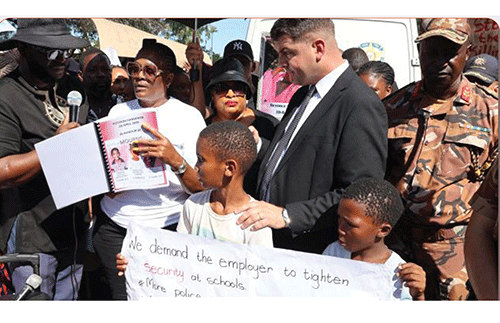
The killer/s of five-year-old Ingrid Maasdorp and her classmate Roslin Fabian remain at large as the police await the release of crucial DNA results from the laboratory.
Five-year-old Maasdorp was murdered in Okahandja on 20 March.
Her body was discovered the next day in a tunnel near a bridge in the Veddersdal area of Okahandja.
A post-mortem confirmed that she had been raped and strangled before her body was dumped beneath the bridge.
Minister of Home Affairs, Immigration, Safety and Security (MHISS) Lucia Ipumbu confirmed that nine witness statements have been obtained and filed in the case docket so far.
Ipumbu assured the nation that the investigation remains ongoing and is overseen by the Head of the Crime Investigations Division in the Otjozondjupa region.
“The investigation is ongoing. The police are following all possible leads while awaiting the outstanding forensic results,” Ipumbu said.
The minister recently made these remarks in the National Assembly while responding to questions from the Landless People’s Movement (LPM) legislature Utara Mootu.
She pressed the minister to clarify what specific actions the ministry has taken to conduct a thorough and timely investigation into the rape and murder of Maasdorp, amid rising frustration from the victim’s family and the public over what they see as police inaction.
Mootu questioned the ministry’s dedication to transparency and providing public updates on the case.
In response, Ipumbu said the Namibian Police Force remains committed to maintaining public confidence through transparent communication.
“We ensure that complainants receive direct feedback through the Pol 713 Feedback Form. However, the release of information is always managed carefully so that it does not compromise ongoing investigations. Where no new leads are available, the police continue to appeal to the public for information that could assist the investigation,” explained the minister.
On the broader issue of child safety, Ipumbu said the police continue to implement preventative strategies in partnership with other stakeholders.
“Police officers regularly visit schools to raise awareness about child abuse, substance abuse and personal safety. We encourage learners to avoid talking to strangers or walking alone in unsafe areas such as riverbeds or bushes, especially at night,” she said.
The minister further noted that they are working closely with the education ministry in rolling out the National Safe Schools Framework, which equips Life Skills teachers to educate learners on personal safety and protection.
When asked whether the ministry has established protocols for handling testimonies from child witnesses and if those were followed in the Maasdorp case, Ipumbu confirmed that strict legal and procedural guidelines were adhered to.
“The process of obtaining testimony from a child witness is conducted in line with the Criminal Procedure Act and the Child Care and Protection Act. Children are regarded as vulnerable witnesses, and their well-being is always prioritised,” Ipumbu explained.
She stated that, in the cases of Maasdorp and Fabian, the child witnesses were interviewed in the presence of their guardian (grandmother) and provided clear and understandable testimony.
“The child was not intimidated and confidently shared what she had seen,” Ipumbu stated.
She explained that, when a child experiences trauma or witnesses a crime, social workers are often called in to offer psychosocial support and perform forensic interviews.
However, Ipumbu clarified that this intervention was not necessary in this case, as the witness only confirmed seeing Maasdorp at the school premises after classes had ended.
-lnashuuta@nepc.com.na