


Every year, around this time, the same story plays out across northern Namibia: dry taps, long queues at communal water points, and frustrated families wondering why the most basic necessity of life – water – remains so hard to come by.
NamWater issues its seasonal warning, urging citizens to use water sparingly because supplies are running low.
Then, silence.
And yet, we all know this is not new.
Namibia is, by definition, a dry country – one of the driest in sub-Saharan Africa.
But what is painful and unacceptable is that our leaders know this too, yet every year we are caught unprepared.
Every October to January, people in the ‘O fours’ – Oshana, Oshikoto, Ohangwena and Omusati – are forced to live without water.
It has become a routine national embarrassment that households can go for days without running water.
Schools are hit hardest: children sit in classrooms unable to concentrate because they are thirsty.
Toilets become unbearable, smelly and unhygienic.
Teachers are demoralised, learners distracted and communities angry.
Let us be honest – this is not just a seasonal inconvenience. It is a humanitarian failure
Namibia cannot continue to call itself an aspiring upper-middle-income country when people are living like this.
The government knows we are a dry country, yet it does not address water availability with the seriousness it deserves.
We plan for everything else – conferences, celebrations and social programme – but not for water security.
When the government can allocate millions of dollars for youth grants, business initiatives and high-level consultancies, why can it not prioritise water investment with equal energy?
Youth development is important, but what kind of youth development can thrive in a country where schools have no water and communities are thirsty?
Namibia receives good rainfall during the rainy season, yet most of that water goes to waste – flowing into rivers, disappearing into the ground or simply evaporating.
We have no adequate reservoirs in the northern regions to store and use that rainwater during dry months.
We have an aquifer beneath our feet, a massive underground water source that could sustain the north for decades, yet we treat it as an afterthought.
When I proposed in the 7th Parliament through a motion that the government should fully tap the Ohangwena II Aquifer and connect it to the national water supply grid, it was not just a political suggestion. It was a call for survival.
The aquifer can ease the pressure on NamWater’s surface sources and ensure that even in dry seasons, communities have reliable access to water.
It is painful to watch Namibia – a country blessed with both a sea and underground water reserves – suffer as if we are landlocked and helpless.
Desalination technology exists.
Aquifer systems exist.
Rainwater harvesting works.
What we lack is not water but political will and long-term planning.
Water is not just another government portfolio.
It is the foundation of every human right and every form of development.
Without water, there is no life, no health, no agriculture, no education and no economy.
The constant excuse of “low water levels” has to stop.
We need permanent solutions, and not temporary warnings.
We need to invest in regional reservoirs in the north and central regions, full operationalisation of the Ohangwena II Aquifer, rainwater harvesting at community and institutional level, desalination and pipeline expansion from the coast, and upgrading old and leaking canal systems that waste millions of litres every year.
Our leaders must stop treating water like a seasonal inconvenience.
They must treat it as the national emergency that it is.
We can no longer afford to wait for droughts and warnings before reacting.
The same energy and resources we pour into political programmes and conferences must now be directed into securing Namibia’s water future.
Namibia’s suffering is not inevitable.
It is man-made and it can be fixed.
We have the expertise and potential, and we have the natural endowments.
All we need is decisive leadership that cares more about clean running water in a village school than about another empty press release.
If government had listened earlier, if it had implemented the aquifer proposals and prioritised water harvesting, we would not be here today, watching our people, children and farmers suffer for something that should already have been solved.
Water is life. It is dignity. It is survival.
Until Namibia treats water with the same urgency and seriousness it treats politics, our people will continue to live in thirst while standing above abundance.
The time for promises is over. The time for action is now.
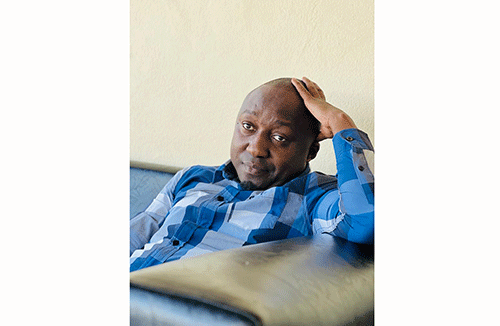
*Hidipo Hamata is a former member of the 7th Parliament. These words are my personal opinions. They are under no circumstances affiliated with any political party.