

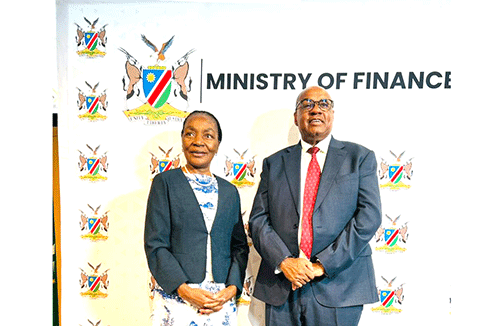

Finance minister Ericah Shafudah yesterday announced the successful redemption of Namibia’s second Eurobond.
This redemption, valued at US$750 million (over N$13 billion), represents the most considerable single debt maturity in Namibia’s history.
The finance minister noted that Namibia issued its first Eurobond in 2011 for US$500 million (approximately N$7.5 billion), which was secured at an interest rate of 5.5%.
Those funds were used to support key projects, including housing development.
That first Eurobond was fully paid off in November 2021.
By supporting initiatives such as expanding road networks and energy infrastructure, along with investing in education and healthcare, the second Eurobond helped lay the foundation for a more connected, productive and equitable Namibia.
In 2015, Namibia borrowed again by issuing a US$750 million bond at a slightly lower interest rate of 5.25%.
This bond has now been fully repaid.
Shafudah explained that ‘redeeming’ a bond means repaying borrowed money raised from investors on the international market.
“This redemption marks a proud moment for Namibia. It shows that our nation honours its financial commitments and manages its debt responsibly,” she said.
She added that the government has implemented the Sovereign Debt Management Strategy (SDMS) of 2005 alongside the Namibia Financial Sector Strategy from 2011 to 2021.
These two strategic frameworks recommend that approximately 80% of the government’s funding requirements be raised from the domestic market, with a target allocation of 20% from international markets.
“To bridge the remaining gap of US$306 million, we issued a request for proposal to local commercial banks. I am pleased to announce that the response was robust and competitive. The following institutions were awarded participation: Standard Bank, N$3 billion; First National Bank, N$1.5 billion; and Bank Windhoek (in partnership with ABSA), N$1.5 billion,” the minister said.
She added that while Namibia’s foreign reserves are projected to decline from N$63 billion as at the end of 2024 to N$47 billion by year-end of 2025, a moderate recovery is anticipated in 2026, supported by sound fiscal planning and continued economic resilience.
Following the redemption of the Eurobond, the overall government debt portfolio is expected to reflect 85:15 ratio, with domestic debt surpassing foreign debt.
“It is also important to note that approximately 90% of the foreign debt is denominated in ZAR. This strategic positioning contributes to an overall government debt portfolio that is 99% protected from exchange rate risks,” she said.
The Bank of Namibia’s (BoN)governor Johannes !Gawaxab yesterday said Namibia is not the only country to have issued a Eurobond. Eurobonds have been issued by many sovereign countries in emerging markets and developing economies.
“They have done it for key reasons such as the development agenda and supporting the budgets. Between 1997 and 2023, 19 African countries issued 91 Eurobonds,” !Gawaxab said.
The Eurobond can be thought of as the final instalment on a big home loan, except this is Namibia’s loan.
Through the Eurobond, the country borrowed money from international investors and promised to repay it, with interest, after 10 years. !Gawaxab said this shows Namibia’s strong financial discipline and commitment to meeting its obligations, a message that international investors will take positively.
Countries that repay their debts on time are seen as more trustworthy, which helps them borrow at lower costs in the future if needed. However, making such a large payment has certain consequences.
Namibia will draw on its foreign currency reserves, comprising a pool of United States dollars, euros and other currencies it holds, to pay for imports and stabilise the value of the Namibia dollar.
However, the BoN governor confirmed the country’s international reserves will remain at more than three months’ import cover, which is sufficient to maintain the one-to-one peg with the South African Rand.