

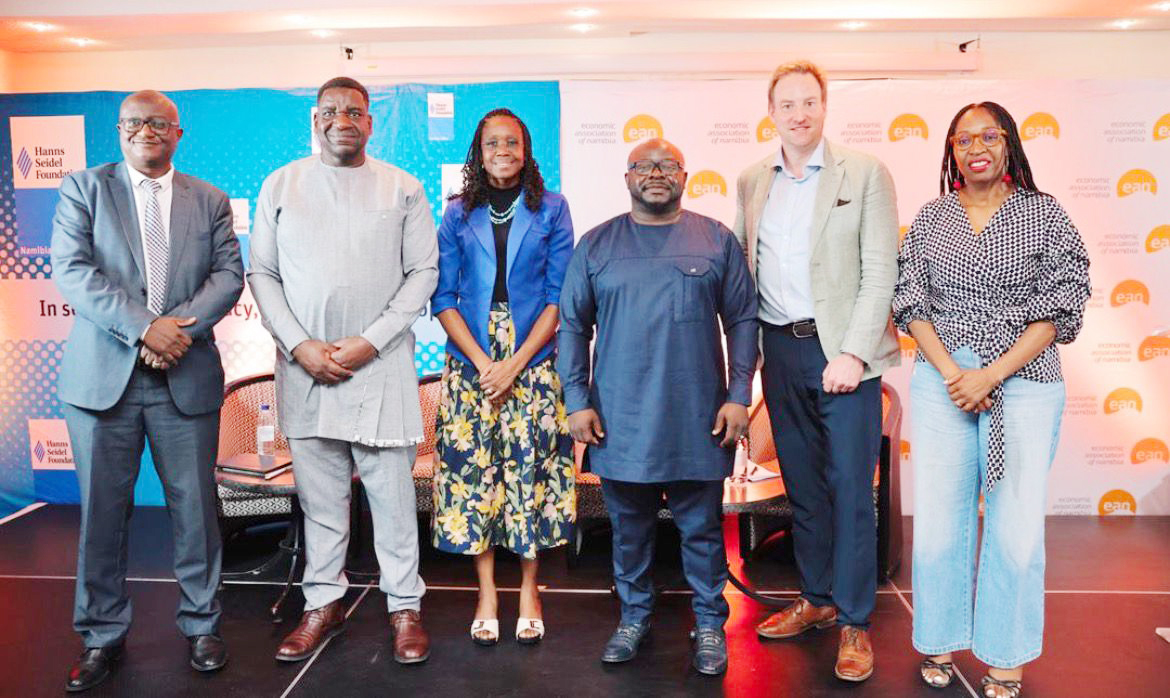

With Namibia’s unemployment rate standing at 36.9%, the Economic Association of Namibia (EAN) and the Hanns Seidel Foundation Namibia hosted a public discussion at Protea Hotel in Windhoek to talk about how the country can create more jobs.
The event was held under the theme ‘The Jobless Growth Puzzle: Can Namibia Unlock Inclusive Prosperity?’
It brought together economists, business leaders and students to talk about one of the country’s biggest challenges, namely economic growth without enough job creation.
Although Namibia has seen some economic growth in recent years, unemployment, especially among youth, remains very high.
This situation is often called ‘jobless growth’.
It raises questions about how the economy works and who benefits from it.
Speakers at the event discussed why growth has not led to more jobs in the market, which industries are doing better at creating employment, and what government policies could help make growth more inclusive and sustainable.
Grace Mohamed, a board member of the Economic Association of Namibia, said the event aimed to encourage open and critical discussion.
“This is the second last intervention for the year after the successful Oil and Gas Conference. We have invited thought leaders in their sectors to share insights and ideas for the country’s economic future,” she said.
Guest speaker Jealous Chirove, senior employment specialist for Eastern and Southern Africa at the International Labour Organisation (ILO), gave a presentation on jobless growth in Africa and its impact on Namibia.
“Africa is home to more than one billion people, and half will be under 25 years of age by 2050. The population is expected to double by 2050-2060. The challenge is not only about growth, but about creating decent and productive jobs,” he said.
Chirove highlighted Namibia’s Second National Employment Policy (NEP2), which aims to promote full and decent employment to reduce poverty and inequality.
He stressed the need for stronger support for small businesses, better skills training as well as construction and investment in industries that can create more jobs for Namibians.
The executive director at the finance ministry Michael Humavindu said government has put in place a clear strategic framework through the Swapo Manifesto Implementation Plan (SMIP) and the National Development Plan 6 (NDP6).
These strategic frameworks speak to a shift from growth for its own sake to growth that is linked to economic transformation supported by enhanced productive capacities, institutional capability-building, domestic value addition (value chains development and mineral beneficiation) and employment outcomes.
“We often speak of inclusive growth as a policy objective, but inclusive growth is an institutional outcome,” said Humavindu.
He noted that it must be mandatory to build and strengthen economic governance institutions, as well as collectively formulate and implement policies, strategies and economic initiatives and programmes.
He added that these programmes need to be evaluated with related processes and outcomes, and that government and financial institutions should collaboratively develop and implement financial instruments, targeting micro, small and medium enterprises (MSMEs) as well as small and medium enterprises (SMEs)’ informal enterprises.
Humavindu encouraged such platforms to be extended to create a workshop that looks at practical challenges in various sectors that will craft practical steps on how to create jobs.