

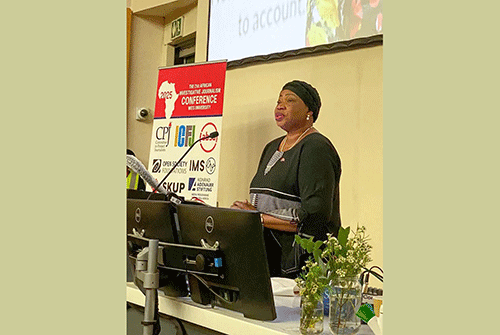

JOHANNESBURG – Africa must value the work of investigative journalists, as it is not ordinary or easy. It is work driven by courage, persistence and moral clarity.
This is according to Fatou Bensouda, the Gambian ambassador to South Africa, who addressed more than 400 investigative journalists and media experts at the opening of the 21st African Investigative Journalism Conference at the University of the Witwatersrand in Johannesburg.
The annual AIJC, hosted by the Wits Centre for Journalism, is the largest gathering of investigative journalists on the continent.
Journalists from across Africa and around the world come together to network, share ideas and stories, celebrate groundbreaking work, and learn from one another through lectures, workshops, and masterclasses.
Opening the three-day conference yesterday, Bensouda reminded the audience that investigative journalism stands at the intersection of truth and accountability.
“Journalists illuminate hidden corners, bring facts to light that would otherwise stay buried, and give voice to those silenced by fear or injustice. Across this continent, investigative reporters have confronted corruption, exposed human rights abuses, and challenged impunity at great personal risk,” she said.
Bensouda stressed that this work is not driven by praise or recognition, but by the belief that truth is the foundation of justice, and justice is the foundation of peace.
She said the narrative that shapes global perceptions of Africa is often built from afar, filtered through narrow lenses and selective headlines.
“Too often our stories are reduced to conflict, poverty, and disease. While fragments of truth may exist, such simplifications have the power to shape policy, influence investment, and define international relations for generations,” she noted.
In this context, she said the media does not only reflect events but also refracts them, clarifying or distorting depending on intention and perspective.
However, she urged African journalists to continue striving for richer and more balanced storytelling.
“It is only by fostering such a discourse that we can do justice to the continent’s remarkable diversity,” she said.
Bensouda said journalism becomes a form of public service, defending transparency and demanding integrity from leaders. It dismantles myths that restrict Africa’s image and helps the continent reclaim ownership of its story.
“This rigorous and principled journalism ensures that truth prevails over time. It forces the world to see Africa not through the narrow prism of despair or dependency, but through the broad lens of resilience, innovation and self-determination,” she said.
She reminded the audience that while the world often reduces Africa to crisis narratives, the continent holds millions of stories — of struggle and success, pain and hope, tradition and transformation.
“Only by embracing this complexity can Africa’s story be told with honesty and depth,” she added.
-edeklerk@nepc.com.na