

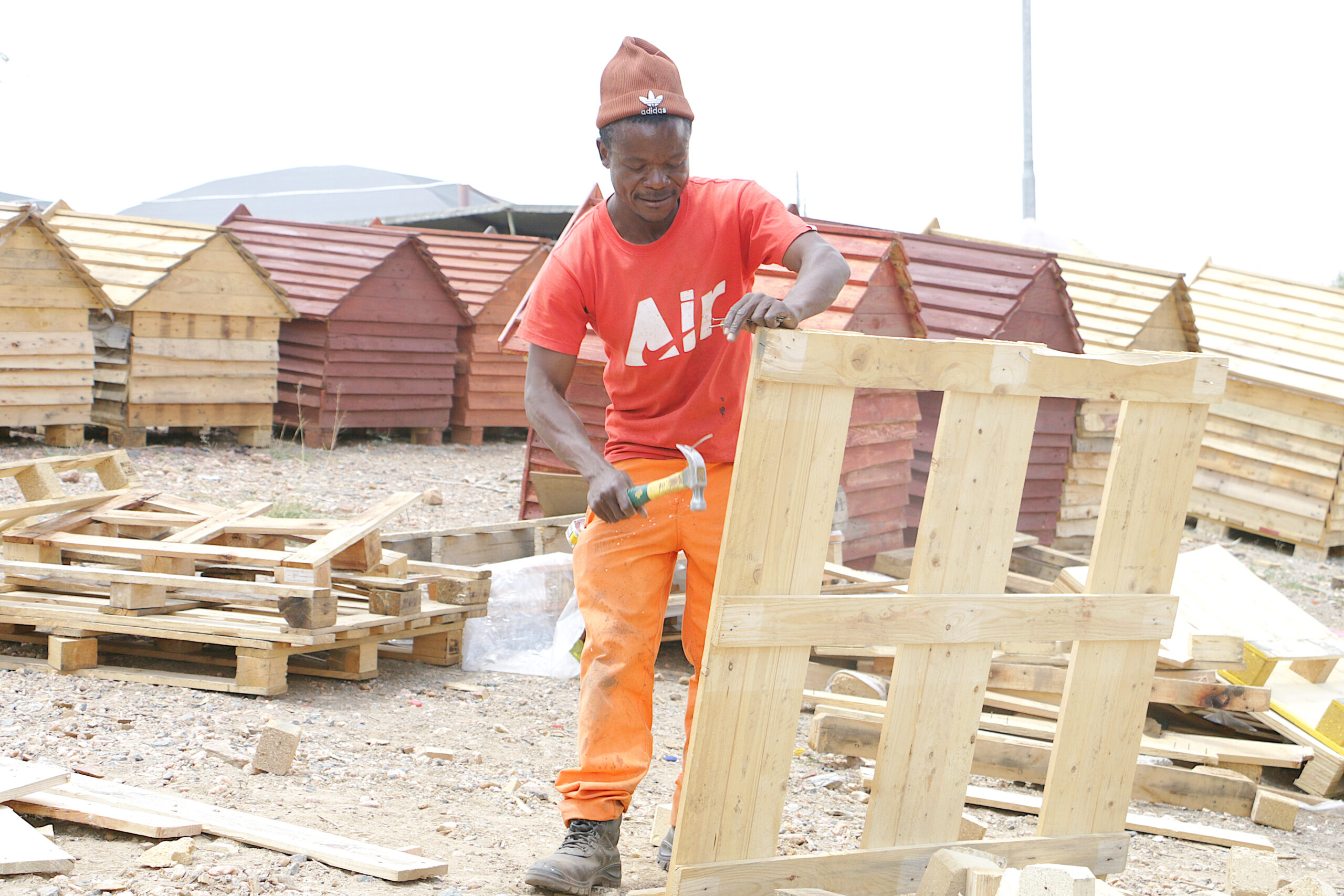

In the southern part of Windhoek, just next to Game Shopping Complex, a small group of wood carvers works quietly at their stalls. Calm and far from the busy city markets, the steady tap of chisels fills the air as artisans shape their pieces with patient, practiced hands.
Many of them have been carving for years, relying on the craft to make a living. “The money I make here is what I use to feed my household as well as pay my kids’ school fees,” said Edmore Makaha.
Most of the carvers say they never planned to become artisans. Makaha, who works at one of the workshops, explained that he turned to wood carving after losing his job, drawn to the craft because it required very little start-up capital and offered a quick way to earn money.
“The company I worked for used to throw away pallets. When I saw them, I started carving on my own. It required no start-up capital and was easier to manage. Back then, few
doghouses were made of wood, most were plastic and sold in bigger supermarkets,” he said.
Makaha sources the raw materials for doghouses, chairs, and beds mostly from larger companies that discard pallets after use. He said it takes a maximum of two days to finish a piece, depending on its size and quality.
“If it’s a big project, it can take me up to two days to finish. But most of the time, I complete a piece in a single day.
It also depends on the quality of the item I am making. Pallets have become more expensive, and it’s becoming harder for us,” he said.
While proud of their work, the carvers admit the craft comes with its own struggles, from slow sales to rising costs of materials.
“The market has become saturated compared to when we started. Now, hundreds of people do the same work, which makes business slow. One of the biggest challenges is finding the right place to sell our items. Our target market is wealthier customers, so we often have to go into town or affluent neighborhoods,” Makaha said.
Martin Chiwazi, who started selling his products in Rundu, shared similar concerns. He said business has been significantly affected since the outbreak of COVID-19 in 2019. “Business changed for a lot of people since the start of the corona virus. Sales have gone down compared to 10 years ago. Right now, it can take us three months to sell just 10 items,” he said.
Linyunga Immanuel, who has been carving in the same area for more than a decade, said he joined the trade after failing Grade 10.
“I have been working here for over 10 years. After failing Grade 10, I realised I needed to start something to support myself, and the only talent I had was carving, it’s something I learned at home from my late grandfather. Since then, I’ve been here, mostly selling to locals,” he said.
He added that one of their biggest challenges is the lack of a proper place to work from. “We are sometimes threatened by City Police to vacate the place. We were also promised by our leaders that they would find us a proper space where we can operate from, but we are still waiting,” he said.
Despite these challenges, the carvers remain committed to their craft, seeing it not just as a source of income but as a skill that provides independence and a sense of pride.
– mkambukwe@nepc.com.na
Photo: Heather Erdmann