

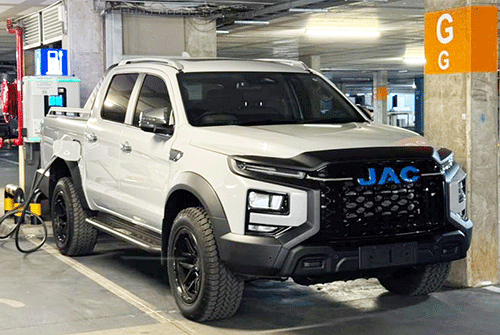

The highly anticipated JAC T9 Plug-in Hybrid Electric Vehicle (PHEV) is gearing up for its Namibian debut, and industry watchers expect it to transform how local motorists think about power, efficiency and capability on and off the road. The hybrid era isn’t approaching, it is here. It looks a lot like the JAC T9 PHEV, an extremely powerful and efficient double cab, is ready for Namibian roads.
Scheduled to go into full production at the beginning of 2026, the JAC T9 PHEV is anticipated to land in Namibian showrooms during the first quarter of next year, and demand is already building. Motoring enthusiasts, off-road adventurers, and everyday drivers tired of soaring fuel prices are eagerly lining up for what experts are calling the “sweet spot solution” for Africa’s unique long-distance driving conditions.
At a time when full electric vehicles (EVs) have captured global headlines but still fall short in countries with vast distances and inconsistent charging infrastructure, hybrid technology may be Namibia’s breakthrough. And the JAC T9 PHEV is stepping confidently into that gap.
With its dual power system—electric motor paired with a petrol engine—the T9 PHEV offers drivers the best of both worlds. For most daily commutes, the electric motor alone does the heavy lifting. Fully or even partially charged, the vehicle can glide through city traffic or cruise along highways at an operating cost shockingly lower than traditional fuel-powered engines.
To put that into perspective: a typical petrol-driven double cab costs roughly N$2 per kilometre to operate. The JAC T9 PHEV – A jaw-dropping 25 cents per kilometre for the first 100 kilometres when running on electric mode. That’s not just a reduction, it’s a revolution.
When longer trips call for more range, the petrol engine is waiting, ready to extend the journey without the anxiety of searching for a charger on the open road.
But make no mistake, this is no timid eco-friendly city runabout. The JAC T9 PHEV is built for domination. Combining the instant torque of electric power and the steady strength of petrol engineering, the double cab boasts a breathtaking 385kW of power and a towering 1000 Nm of torque, making it the most powerful production bakkie in Namibia. That is supercar territory packed into a rugged 4×4 built to climb dunes, defy gravel, tow loads and look good doing it.
Thanks to its electric motor, power delivery is instantaneous. Press the accelerator and it responds in real time with no lag, no hesitation, just raw force.
Supporting that muscle is a 32.4kW battery pack that delivers up to 100km of pure-electric range, which is enough to handle most urban driving without touching a drop of petrol.
Moreover, charging technology is advancing fast, and the T9 PHEV is already ahead of the curve. From 30% battery, a full charge takes just around 25 minutes, making it perfect for grabbing a coffee while topping up, and yes, home charging is included. The T9 HPEV comes with a 1.5kW home charger that plugs directly into a standard household electrical
outlet, transforming your garage into your own private fuel station.
In addition, the vehicle offers front and rear differential lock as well as multiple intelligent driving modes, including a 4×4 system ready to conquer riverbeds, wilderness trails, gravel expanses and construction sites. Whether it’s leisure, lifestyle, or livelihood, the T9 PHEV is engineered to thrive where lesser vehicles hesitate.
With three derivatives to choose from, the model range ensures a fit for every need; from luxury comfort to rugged utility.
Meanwhile, JAC Motors Namibia has opened pre-orders for the T9 PHEV and early signals suggest they may sell out before the first shipment arrives.
With the imminent arrival of the T9 hybrid Namibia’s motoring scene is bracing for a dramatic shake-up as the new beast on the horizon promises to be powerful, futuristic and unapologetically bold.