

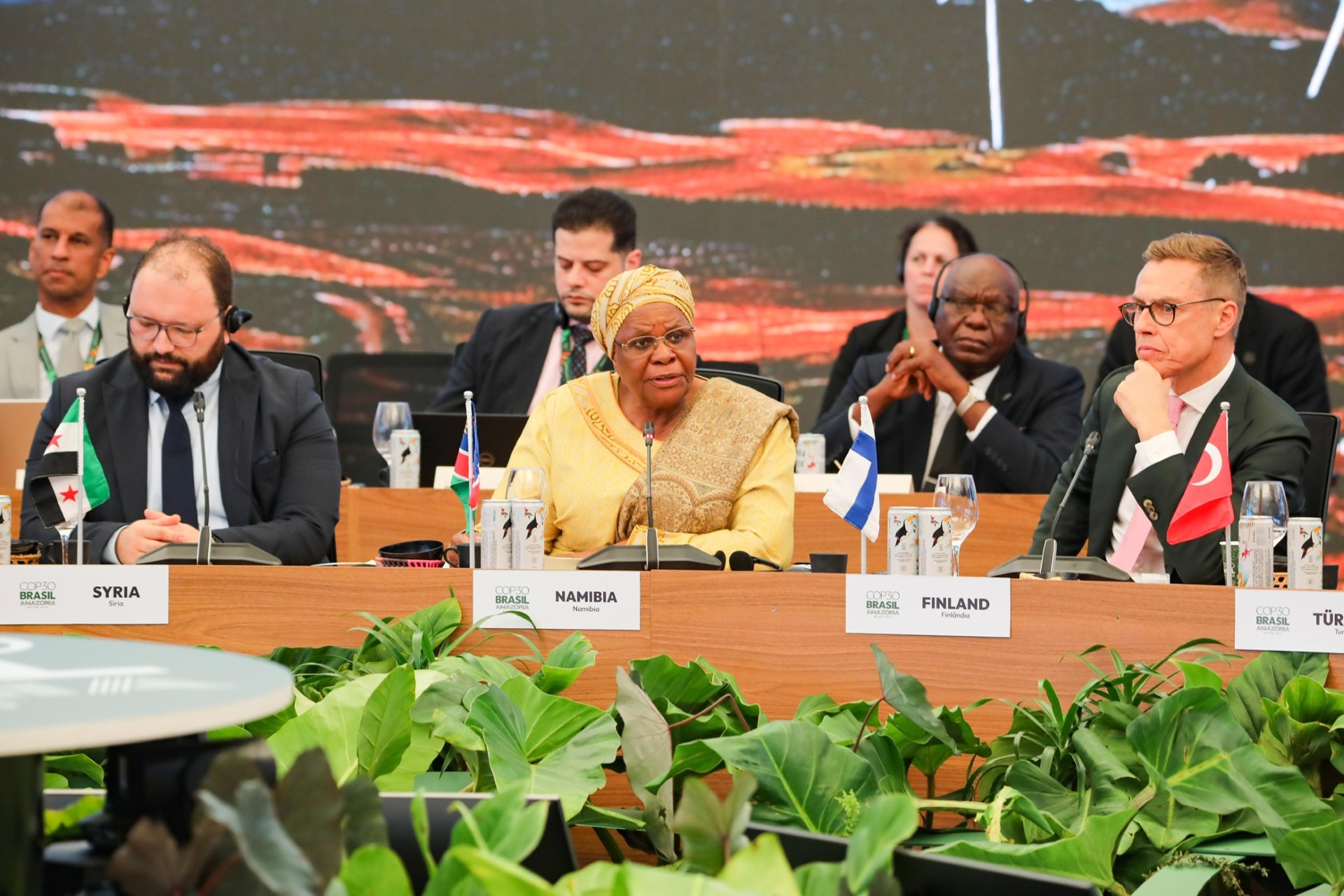

Namibia estimates to spend approximately N$285 billion, with around N$247 billion dependent on international support to cut emissions, adapt to the changing climate, and build a greener, more resilient future, said President Netumbo Nandi-Ndaitwah.
The head of State indicated that Namibia’s nationally determined contributions set out 17 mitigation measures and 34 adaptation actions across key sectors like energy, agriculture and transport.
“These efforts aim to reduce an estimated 11.9 million tonnes of CO₂, a bold target
for a nation that already absorbs more carbon than it emits. I call on developed nations and global institutions to scale up climate finance, strengthen technology transfer and ensure fair access to green investment,” said Nandi-Ndaitwah at the 30th Conference of the Parties in Belém, Brazil, recently.
She added that climate finance should move beyond pledges and be accessible directly to developing countries.
Held under the theme “From Agreement to Action: Accelerating the Implementation of Climate Solutions,” COP30 brings together world leaders and stakeholders to advance the global climate agenda, driving collective efforts toward a sustainable, inclusive and low-carbon future.
She noted that developing nations continue to carry the heaviest burden of a crisis they did not create, while facing high borrowing costs and slow access to funds. The President urged wealthy nations, development banks, and investors to reform global financial systems so that financing becomes predictable, equitable, and affordable.
Nandi-Ndaitwah said there is a need to combat desertification, land degradation and drought by collectively by implementing the Namib Declaration which was adopted during the Desertification COP 11 in Windhoek in 2013.
“In Namibia, over the past three decades, national mean temperatures have increased by more than twice the global average, while droughts have become more frequent and prolonged. More than eighty percent of Namibia’s landmass is classified as arid or semi-arid, and over seventy percent of the population depends directly on agriculture for food security and livelihoods,” she told the delegates.
She stated that these weather conditions place immense pressure on fragile water supplies, compromise agricultural production, and heighten the risk of disease outbreaks.
“The economic costs are profound, with recurrent droughts and floods eroding GDP growth, damaging infrastructure and reversing development gains. Hence, Namibia has been working tirelessly to address the effects of climate change, through adaptation and mitigation, as demonstrated through a record of action and transparency,” echoed Nandi-Ndaitwah.
The President noted that the country continues to take positive steps in the quest to meet commitments with interventions such as the launching of the Oshivela project, which is one of the world’s first industrial-scale green iron plants powered by green hydrogen, operating on a principle of zero emissions.
“The plant will avoid 27 000 tonnes of CO₂ from being emitted into the atmosphere. This is part of the transformative Green Hydrogen Strategy that will see the country take decisive steps towards cleaner and renewable energy sources,” she stated.
The European Union has praised Namibia for its enduring commitment to fighting climate change, promoting environmental protection and green industrialisation, adding that climate finance remains a decisive challenge.
“The ‘Baku to Belém Roadmap’ aims to increase support for developing countries to at least US$1.3 trillion annually by 2035,” said EU Ambassador to Namibia, Ana-Beatriz Martins.
She stressed that the EU and its member states remain the world’s largest providers of public climate finance, with N$634 billion delivered in 2024 and additional N$220 billion mobilised in private investment. “Strong partnerships are essential to a just transition. Namibia’s leadership in green hydrogen, critical raw materials and sustainable land management demonstrates how climate action can deliver jobs, industrial development, and opportunities for youth,” she mentioned.
Martins highlighted that Namibia’s lead in developing green economy sectors indicates Africa’s essential role in shaping a sustainable global future and that the EU stands ready to deepen cooperation with Namibia on green industrialisation, resilience, and inclusive growth.
In his opening speech, Brazilian head of state Luiz Inácio Lula da Silva reminded global leaders to implement their environmental and financial commitments to projects that combat climate change.
“COP30 will be the COP of truth. It is time to take the warning from science seriously. The time has come to face reality. Accelerating the energy transition and protecting nature are the two most effective ways to combat global warming,” he stated.
Da Silva said finance must be increased and fossil fuel subsidies must be done away with and energy to transitioned (for countries in the Global South that suffer most severely from the consequences of climate change) before temperatures rise.
“We must embrace a new model of development that is fairer, more resilient, and low-carbon. More than 250 000 people could die each year from causes related to climate change. This is not a distant threat: it is already happening in our communities. We live in a scenario of insecurity and mutual distrust, where immediate interests take precedence over our common future,” he highlighted. – psiririka@nepc.com.na