

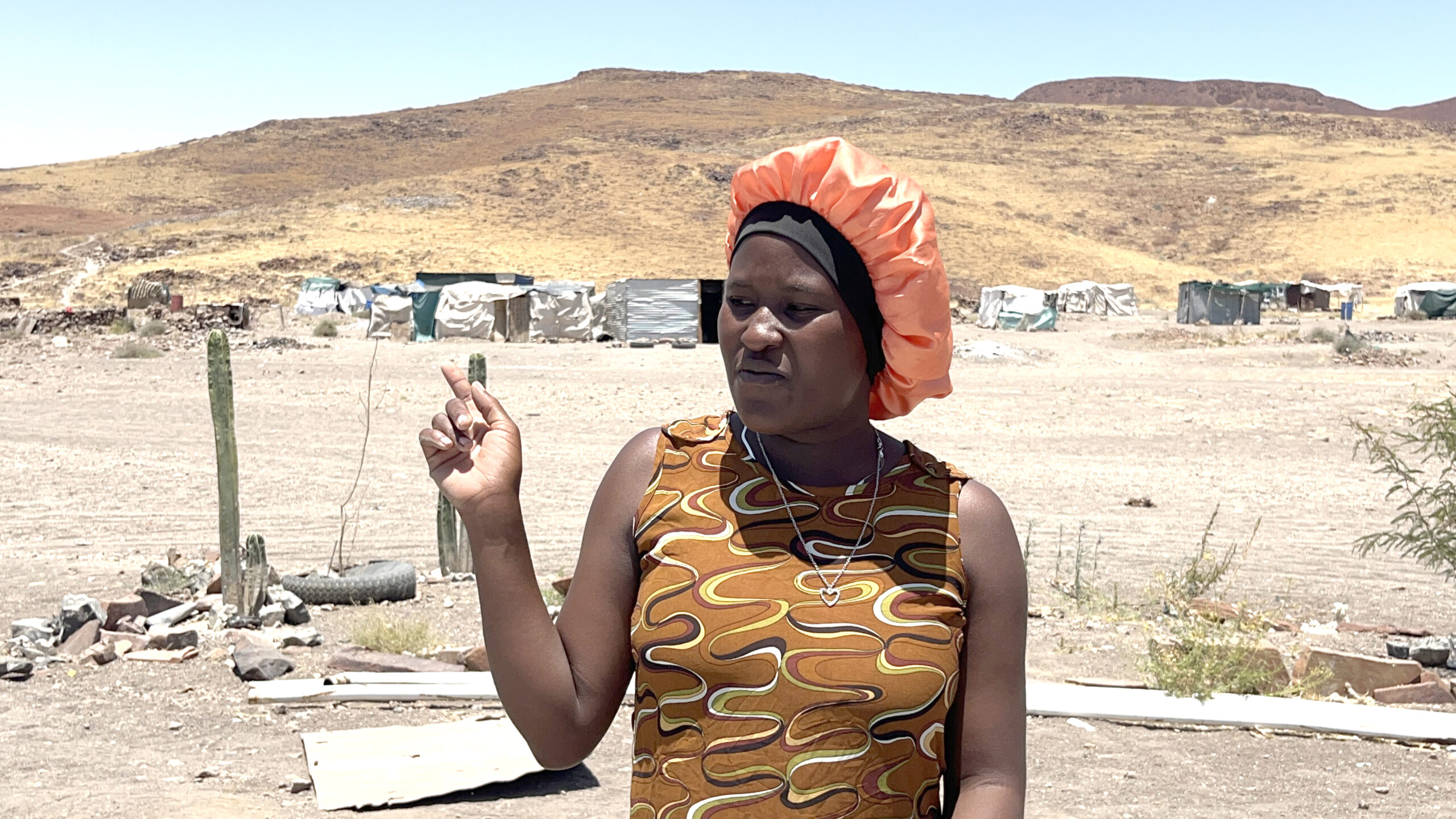

XOBOXOBOS – It may be a man’s world, but women at the Xoboxobos informal camp in Erongo are carving out a place in the male-dominated world of small-scale mining. These women stand their ground in this hard, manual labour that demands, just like for men, getting on their knees, crawling, and digging for hours to extract semi-precious stones that they later sell to potential buyers.
Among them is Ndahafa Shiteni, 27, who left her home in Uis to start a whole new journey in a sector she knew nothing about, but learns something new every day about the path she is crafting for herself.
Originally from the northern part of the country, Shiteni initially came to Uis to look for a job after failing grade 11. However, because Uis is a small town with hardly any income-generating opportunities, she began selling Oshikundu, kapana, and fat cakes to the miners at Xoboxobos. She soon noticed other young women mining semi-precious stones.
“I was intrigued when I saw other women doing it, and I decided to also try it. It was hard at first, but once you do it every day, it becomes easier,” she explained.
She says they normally start their day early in the morning, walking up to ten kilometres to their mining sites using manual tools. “I clean the site, then use a hammer, pickaxe, and shovel. It’s very hard for women. You can get hurt. But we must survive, and it feels good to support yourself instead of living on handouts,” she said.
Another miner also explained that they make a decent living from selling the semi-precious stones. According to her she always makes sure that the stones are well polished and then exhibit at their makeshift market.
“This allows us to charge or negotiate for better prices, but it also depends on the buyers. Some really wants to offer us low prices, despite the hard work we put in,” she said.
The miner added that amethyst stones are particularly popular among buyers, and a good-quality stone can sell for N$2 000. “A smoky quartz can sell for N$1 500 to N$2 000 per box of ten, or even N$6 000, if it’s big,” she explained.
No price regulation
Erongo governor, Natalia /Goagoses however says there is no price regulation, and many miners sell cheaply some of their stones out of desperation.
“We cannot give away our resources for peanuts. Prices must reflect the market, and our office will help. We need markets, including international ones, but they must be fair,” she said.
She is currently organising training that will allow them to market and sell their semi-precious stones for better prices.
Earlier, Tekla Mutero, president of the Emerging Miners Association of Namibia said the power and potential of small-scale miners in Namibia should not be underestimated.
“They have sustained communities, such as Uis, through economic hardship and now deserve to be fully empowered and integrated into the mainstream mining sector,” she said.
Threatened by EPLs
Small-scale miners say their existence in the industry is being threatened by Exclusive Prospecting Licenses (EPLs) issued by the ministry of mines and energy.
Their claims are frequently rejected in favour of EPL holders, particularly large companies, obstructing their ability to work on areas they have mined for years.
Regina Seibes, a long-time miner, expressed concern about the uncertain future of small-scale miners, saying EPLs have pushed them out of their traditional mining areas.
“You find an unregistered area and confirm with the ministry. But once you peg and try to register it, you’ll be told there’s an EPL,” she said.
There are close to 10 000 small-scale miners active across the country, with the majority based in the Erongo, Kunene, and /Kharas regions.
These miners predominantly extract semi-precious stones, industrial minerals, and dimension stone materials often overlooked by larger mining companies.
-edeklerk@nepc.com.na