


Fransina Ndateelela Kahungu
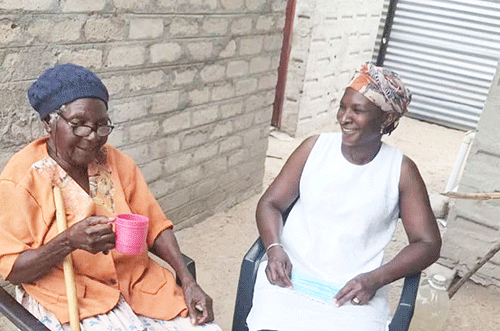
Meekulu Paulina ya Abisai (WaApi) was born on 14 June 1920 (one of the few people born before 1921) and had been a proud resident of Okalunga Kaatundu village since her childhood. In the early morning hours of Friday, 14 November 2025, the heartbreaking news spread that Meekulu WaApi had peacefully taken her last breath at the remarkable age of 105.
This news is both sorrowful and celebration. It is sorrowful because of the immense positive impact she made on countless individuals, institutions, and communities over more than ten decades, a legacy that will be deeply missed.
Yet, it is also a celebration of a well-lived life, a purposeful journey embraced to the fullest. As the saying goes, “Hano, a kuta omwenyo”—indeed, she has completed her life’s mission.
Meekulu’s exceptional skills in home economics were evident from a tender age. Her parents entrusted her with caring for her grandmother, which became the foundation for her mastery of domestic work.
In 1940, at just 20 years old, she joined others in building and developing Nakayale Missionary Centre, contributing to the construction of the hospital, church, and school. Her gifted hands and helpful spirit caught the attention of supervisors at Jongen Skool, managed by Finnish missionaries and local teachers.
In the early 1960s, Meekulu worked as a cook, earning the affectionate nickname “Woman” because of her caring nature. Her delicious meals nourished many students who later became respected professionals—a silent but powerful contribution to education and development.
When war disrupted Nakayale Jongen Skool, leading to the establishment of Yambalantu Secondary School, Meekulu lost her job. Yet her dedication did not go unnoticed; she was offered a position at Nakayale Hospital.
At a time when there were no milling machines for omahangu flour, Meekulu’s daily task was to pound mahangu manually to prepare meals for patients. She also brewed oshikundu, a traditional non-alcoholic drink, ensuring that the sick was well-fed with nutritious, locally sourced food.
Members of the Evangelical Lutheran Ovambo Kavango Kerk (ELOK), now the Evangelical Lutheran Church in Namibia (ELCIN), Nakayale Congregation, benefited immensely from Meekulu WaApi’s tireless dedication. Among her many responsibilities was preparing oshikundu for Elelo-ongalo (Congregation Board) meetings. Her oshikundu was unique, always sweet yet never made with sugar.
I vividly recall the early 1980s while staying at Meekulu’s homestead. The nights before a meeting were special and Meekulu would stay up through the night, patiently stirring a mixture of mahangu flour, water, and ongudo until it reached perfection. Her commitment was unmatched.
Another responsibility was cleaning the church every Saturday and decorating it on Sunday mornings. This meant spending Saturday afternoons at the church and waking up early to prepare the altar before service began. She carried out these tasks with joy and a smile, her tall and bold stature reflecting her strength and grace. Every action was deliberate and well-calculated.
Beyond her church duties, Meekulu’s fields were a source of abundance—beans, groundnuts, nuts, pumpkins, watermelons, and especially spinach (ombivi). She generously shared her harvest with the community. Hospitality was her nature and visitors never left her home without a meal, often served with chicken, or if time was short, she would offer a live chicken or something else from her home. Her hands were always open.
Permit me to honor ondjuwo ya Meekulu (Meekulu’s sleeping room)—a simple space with one bed for herself and a cowhide mat that I and one of her grandchildren used as a mattress. Meekulu was a prayer warrior, praying morning and evening for her family, the community, and the nation. She prayed specifically for me to succeed in my studies so I could help my siblings and family.
Today, I mourn my mother, God-grandmother, mentor, and prayer warrior, a woman who prayed for leaders and for peace. During my stay with her, she never hid sugar or locked food away. My parents entrusted me to her care because of their severe poverty, and now I say “Thank you, Meekulu wange, for everything!”
There is a popular Oshiwambo saying that “Kulupa nomeho, yo omayewo atu ku taasinine” (Age with eyes—even without teeth—we will help you chew.)
This reminds us of that wisdom and vision matters more than physical strength.
As we celebrate Meekulu’s 105 years, we reflect on her lessons. She was an avid reader who read with understanding. Even at 105, she read with the help of glasses and encouraged others to read Scripture. Before every prayer, a hymn from Ehangano or any God-centered song was sung. Her life affirms research linking reading to longevity, mental sharpness, and emotional well-being. Even in her final years, Meekulu never lost her memory—a true blessing.
In 2024, WaApi shared a visionary idea of organising a radio talk show about changing burial practices. She worried that traditional burials were consuming too much land and suggested cremation as a solution. Though she knew it would be controversial, she wanted people to discuss it openly. Her foresight challenges us to think about balancing land for the living and the dead.
May Meekulu’s spirit continue to live among us. Her life was a beacon of faith, service, and love—a legacy that will never fade.
* Fransina Ndatelela Kahungu is the Swapo Women’s Council secretary and former mayor of Windhoek. She writes in her personal capacity.