

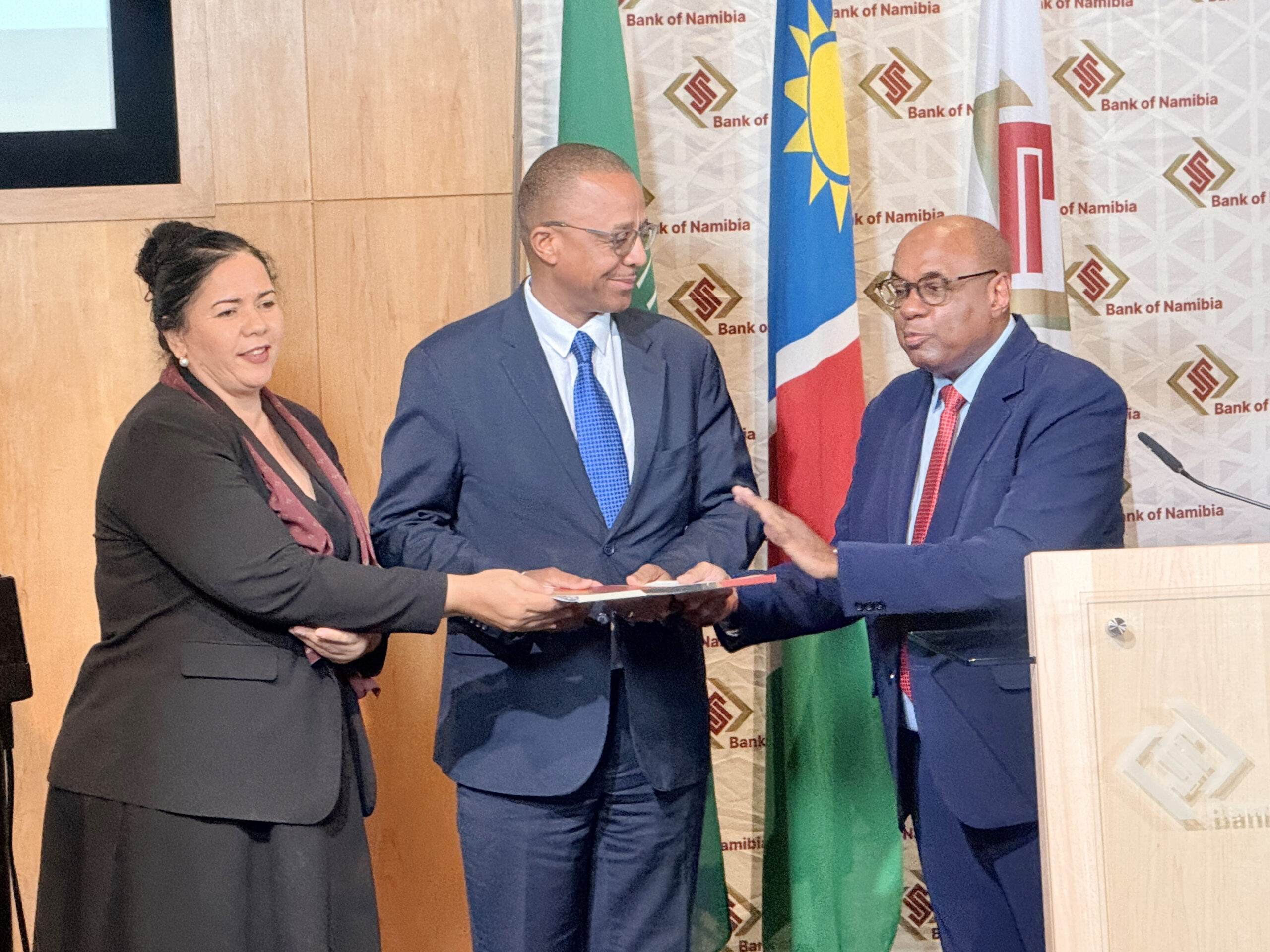

Despite mining still being the greatest contributor to export earnings, domestic economic growth, growth for next year is expected to be driven by agriculture, construction sector, robust electricity generation, and stronger output from the uranium subsector. This is according to Johannes !Gawaxab, the outgoing governor of the Bank of Namibia, who made the remarks at yesterday’s repo rate announcement where the central bank’s Monetary Policy Committee decided to keep the rate unchanged at 6.50%.
Speaking at the briefing the governor said Namibia’s real GDP growth is projected to recover to 3.8% in 2026 and further to 4.3% in 2027.
“The domestic economy grew moderately. Inflation has remained well contained, while growth in Private Sector Credit Extension (PSCE) slowed since the previous MPC meeting. The merchandise trade deficit narrowed, while the stock of international reserves remains sufficient to maintain the currency peg and meet the country’s international financial obligations,” he said.
He added that, while economic activity-maintained growth, the pace of expansion slowed during the first 10 months of 2025 compared to the same period in 2024.
The slowdown was primarily driven by contractions in the manufacturing sector, diamond mining, livestock farming, and transport subsectors. Given the generally subdued economic activity so far in 2025, real GDP growth is now projected to slow from 3.7% in 2024 to 3.0% in 2025, 0.5% point lower than the previous forecast.
“On the external sector, Namibia’s merchandise trade deficit narrowed by 14.5% to N$25.8 billion during the first ten months of 2025, compared to the corresponding period in 2024. The improved trade deficit was largely due to higher export earnings, particularly from uranium and gold, relative to import payments during the period under review,” he said.
He further said, the stock of international reserves stood at N$48.6 billion at the end of October 2025, a decline from N$54.7 billion recorded at the end of September 2025. The reduction in foreign reserves was predominantly due to foreign debt repayments, including the Eurobond redemption, and higher import payments. This level of foreign reserves translates to an estimated import cover of 3.2 months, which remains adequate to sustain the currency peg between the Namibia Dollar and the South African Rand and meet the country’s international financial obligations.
!Gawaxab said, prices of most key commodities have diverged since the previous MPC meeting. The price of gold remained resilient during the period under review, primarily sustained by safe haven demand by both institutional and retail investors. Zinc and copper prices have also trended upward, mainly supported by supply challenges and robust global demand, respectively.
“In contrast, although the uranium spot price has remained firm, it has receded somewhat, reflecting tapering supply concerns alongside an improved supply outlook. Similarly, crude oil prices moderated during the same period, attributable to increased supply. Meanwhile, diamond prices remained under pressure, partly ascribed to competition from lab-grown diamonds,” he said.