


Uakutura Kambaekua
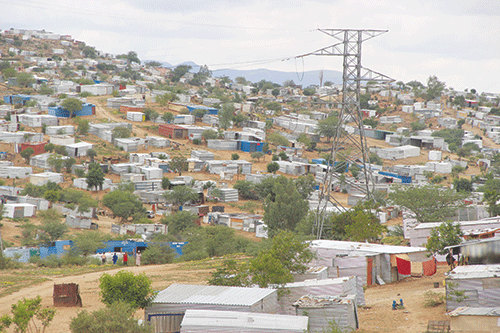
The Namibian government has pledged to reduce the percentage of households living in informal settlements from 28.7% to 14.35%.
Additionally, the government aims to increase the number of serviced plots from 25 111 to 50 000 and to expand the number of houses built from 12 598 to 55 126 by the year 2030.
This was disclosed by Kaire Mbuende, the Director of the National Planning Commission, during his address to the Presidential Task Force on Housing and Land Delivery this week. He reminded them that these ambitious targets can be met if they embrace bold, innovative, and practical solutions.
The task force will tackle one of Namibia’s most pressing social responsibilities by ensuring access to dignified housing and serviced land for families throughout the country, as the country faces a significant housing backlog.
Currently, the estimated housing backlog in the country exceeds 300 000 units, according to data from the Namibia Statistics Agency and the National Housing Enterprise.
Despite this backlog, Mbuende said the country aims to create extensive housing opportunities for residents in both urban and rural areas.
“The constitution of this high-level body signifies the seriousness with which the Government of the Republic of Namibia views the urgent need for land, housing, and sanitation provision as provided in the Sixth National Development Plan. Our country seeks to unlock housing opportunities at scale for both urban and rural residents,” he said.
Mbuende emphasised that the execution of the Flexible Land Tenure Act and the expedited provision of affordable housing have been recognised as transformative factors that can greatly enhance access to secure tenure and varied housing options.
“We understand that traditional methods alone will not suffice to meet the growing demand due to population growth, rising land prices, and swift urbanisation,” he stated, noting that achieving their goals necessitates innovative thinking and the exploration of alternative housing models.
This taskforce will be led by Jacob Nghifindaka as chairperson, with assistance from a team that includes Heinrich Amushila, David Nuyoma, Fanuel Maanda, Barbel Kircher, Rebecca Shilengudwa, Keith Handura, Bruce Stewart, Maureen Dausas, Julius Nyerere Namholo, Erastus Nikodemus, Johannes Niikondo, Amalia Nathaniel, Archie Graham, Kadiva Hamutumwa and Jeckpelins Muundjua.
-Nampa