


Rudolf Gaiseb
President Netumbo Nandi-Ndaitwah’s administration has set the tone, possibly, for the next five years.
As the year ends, the lines have fallen to the youth in pleasant places, as Nandi-Ndaitwah streamlines youth empowerment and transformation.
Maintaining unity in diversity, natural resource beneficiation, and empowering youth for sustainable development; this is the era ushered by the Head of State.
Nandi-Ndaitwah’s directives focus on service delivery, integrity, accountability, unity, and teamwork. A major youth-oriented initiative this year is the subsidised tertiary education model.
“The fees have fallen,” the President declared in parliament during her maiden State of the Nation address on 24 April.
For those qualifying, it will ease the financial burden and bring relief to parents, students, and trainees struggling to fund tertiary education, as described by university leaders.
On 8 December, education minister Sanet Steenkamp explained that only undergraduates at public and private tertiary institutions and technical and vocational trainees qualify for subsidised education.
It will fully cover tuition and registration fees. Postgraduate students will have to wait.
Meanwhile, the youth development agenda continues to advance, including the National Youth Development Fund launched on 20 September 2025. So far, 42 young Namibians have been selected as the Fund’s first beneficiaries.
In retrospect, the government allocated N$257 million for 2025/26. In October, 66 young people secured over N$37 million for entrepreneurship in sectors like renewable energy, horticulture, poultry, veterinary care, recycling, and animal feed.
On 12 December, Nandi-Ndaitwah stated that the National Youth Service (NYS) will be the sole provider of military, police, and correctional services, offering youth training and economic integration.
Bills
On 30 September, agriculture minister Inge Zaamwani-Kamwi introduced a land bill praised for banning foreign ownership, allowing leasing under strict conditions with land reform commission approval. The State has first rights to buy before owners sell, and the Bill is at second reading.
The Public Enterprises Governance Amendment Bill was tabled on 8 October to clarify roles, improve accountability, and give the Prime Minister oversight by transferring powers from ministers. It is also at second reading.
The Regional Councils Amendment Bill, tabled on 2 July, updates definitions for boundary delimitation, staff appointment, and development committees.
Health minister Esperance Luvindao eliminated middlemen in government medicine procurement, saving over N$221 million in phase one, aiming for a more cost-effective, transparent system. She also tabled a new Mental Health Bill on 14 October to protect rights and prevent abuse, which is under review.
The Appropriation Bill was tabled on 27 March and passed on 9 May; amendments were tabled on 21 October and passed on 5 November.
In 2025, AI was a major topic. Information and communication technology minister Emma Theofelus announced Namibia’s plan to develop an Artificial Intelligence Act to regulate the ethical development and use of AI.
Motions
The Namibian parliament recently supported Cuba by adopting a motion by Swapo’s Tobie Aupindi, urging the US to lift the blockade and remove Cuba from its terrorism sponsor list.
Meanwhile, PDM’s Inna Hengari proposed reforms to Namibia’s financial laws to regulate loan sharks, including capping interest rates, strengthening enforcement, expanding oversight of informal lenders, and establishing debt relief for civil servants and low-income households.
The National Assembly also debated lowering the voting age to 16, supported by AR’s Tuhafeni Kalola, who also proposed expanding fertility treatment coverage under PSEMAS to address infertility, involving medical professionals and affected individuals.
Drama
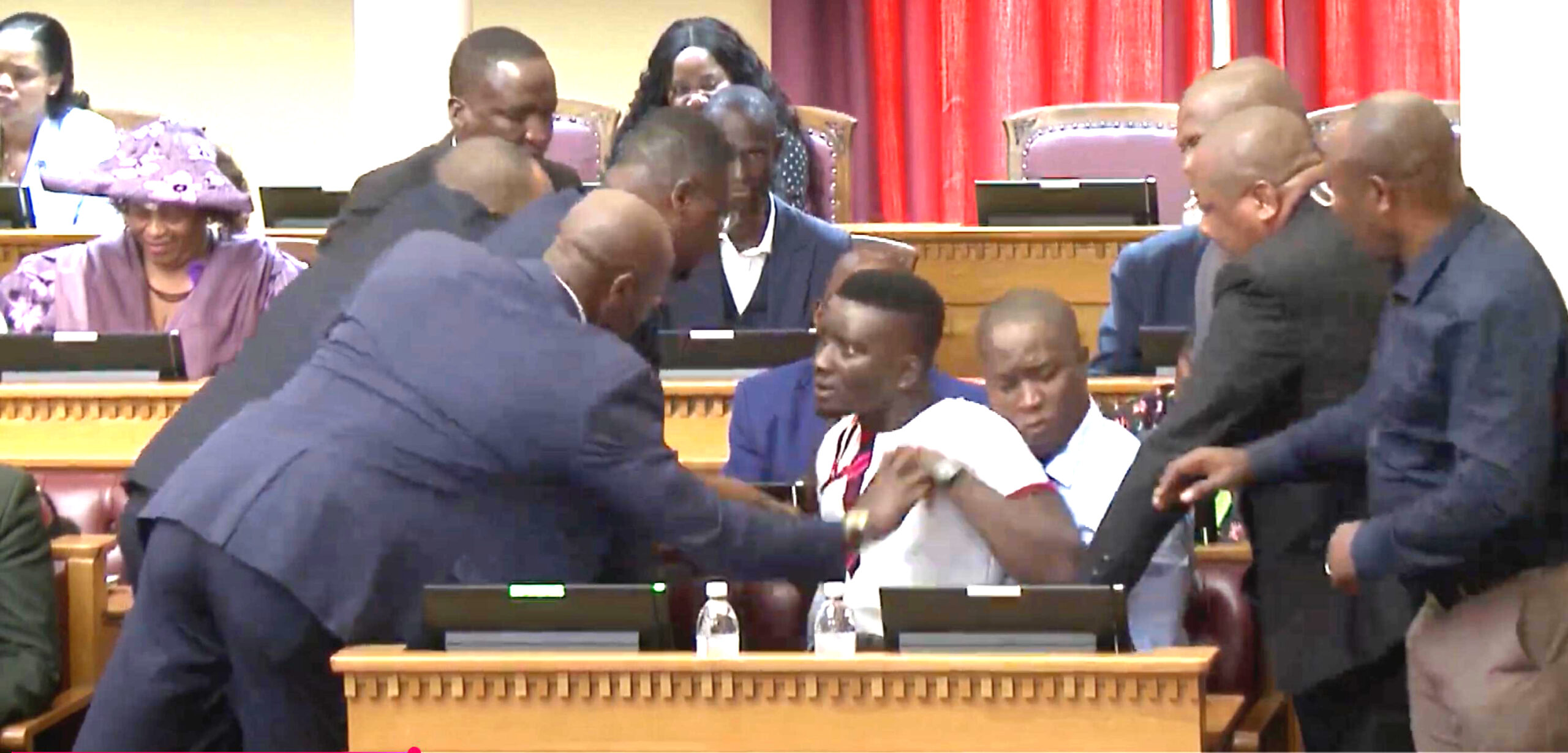
A key highlight in parliamentary drama this year was the incident when AR’s activist-in-chief, Job Amupanda, was dragged out of parliament along with his compatriot, Tuhafeni Kalola.
The event occurred on 11 September, when Kalola wore an unauthorised party cap bearing the party’s logo, and Job wore jeans inside the National Assembly.
The two were denied standing on a point of privilege, but rebellious Kalola refused to take his seat when ordered to do so. He stood up several times, for which the Speaker repeated the ruling each time.
The Speaker then, in accordance with the Standing Rules and Orders, requested that the member leave the Chambers, but Kalola disobeyed.
After repeatedly imploring him to leave, she requested that the sergeants-at-arms escort him out.
Things took a turn, however, as Amupanda joined his subordinate, who was wrestling with the sergeants-at-arms, refusing to leave, turning the parliament into chaos.
Amupanda’s shirt was visibly torn, while Kalola showed up with an arm sling and a band-aid on his left arm at a press briefing the next day.