

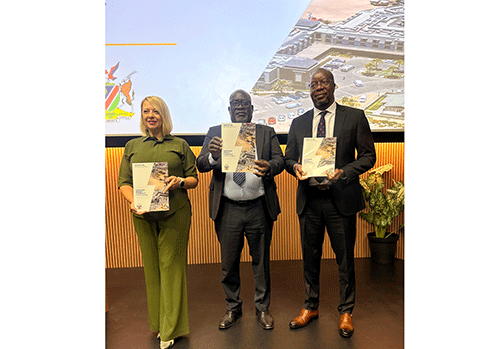

The Ministry of Industries, Mines and Energy yesterday launched Mission 300: Namibia Compact, with support from the African Development Bank and the World Bank.
The mission aims to bring electricity to 300 million Africans by 2030. It will use partnerships with the private sector, energy reforms, and more than US$50 billion in pledged funding. The goal is to support economic growth, improve health services, and expand clean cooking solutions.
According to the Namibia Statistics Agency (NSA), Namibia had 756 339 private households in September 2023. Data from Afrobarometer and the Ministry of Mines and Energy shows that only about 48% of these homes are connected to the national electricity grid.
This means around 300 000 households across the country live without electricity.
For many families, this affects daily life; children struggle to study at night, clinics cannot work properly, and small businesses fail to grow.
The government is working to change this; through the Rural Electrification Programme, more than 2 600 households were connected to electricity over the past two years.
The executive director at the Ministry of Finance Micheal Humavindu said Namibia cannot afford to be left behind as other African countries move forward, hence joining Mission 300.
Energy access is also part of United Nations Sustainable Development Goal 7, which calls for affordable, reliable, sustainable, and modern energy for all.
“Experts say economic growth, industrial development, job creation, and better living standards all depend on enough affordable electricity,” he said.
Humavindu stated that as countries develop, income growth and energy consumption also rise together. Despite Namibia’s small population and low density, the country continues to face challenges of poverty and inequality, which complicate the task of delivering affordable electricity to all.
Nevertheless, notable progress has been achieved. Energy access increased from 42% in 2011 to nearly 60% in 2023, while clean access to clean cooking solutions rose from 40% to about 14% over the same period. Given this achievement, Namibia is well-positioned to accelerate this progress.
“The country is endowed with world-class solar and wind resources alongside significant mineral wealth. These advantages underpin Namibia’s strategy to expand renewable energy, strengthen regional energy trade, and advance an ambitious green industrialisation agenda that supports inclusive social and economic development,” he said.
The Minister of Industries, Mines and Energy Modestus Amutse said Namibia generates only about 40% of its own electricity. The remainder is imported. Howeever, he is not satisfied with that position.
“Energy security is economic security, and we must change this trajectory. This means investing in generation and addressing transmission bottlenecks. Unlocking transmission is not only good for Namibia, but also for the regional projects such as the Angola-
Namibia (ANNA) and ZIZABONA interconnectors which have the potential to strengthen regional power trade and integrate Southern Africa more effectively,” he said.
He added that by joining Mission 300, Namibia is joining a continental movement and the effort to connect 300 million people to electricity by 2030 across Africa.
Under the Sixth National Development Plan (NDP 6), Namibia has committed to connecting 200 000 households within the planned period. The National Energy Compact provides the coordinated framework to deliver on that commitment.
“Under our National Integrated Resource Plan (NIRP) we have set clear ambitions to reach 80% electricity self sufficiency and to achieve 70% renewable energy penetration in our generation mix,” Amutse said.
African Development Bank regional sector manager Farai Kanonda said the bank, stands ready to support the government of Namibia, exposed collaboration, exhausted, whereas, in closing, the loads of this complex, maps emphasise step towards a more resilient energy.
“Namibia’s real industrialization, which is anchorable, manurable energy, low power resources, and innovative technology has the potential to position the country as a global leader in green hydrogen, and clean molecules, critically powerful and decarbonize it,” he said.
He noted that this ‘highway’ promises jobs free empowerment opportunities for women, and hence local manufacturing and increased foreign recipes.
We also observed that original integration is also central to the study and by developing transition, transmission, infrastructure, and serve been as both source and credit for, I can facilitate both south, power flows, strengthen, energy, security, and out there specify the region’s energies,” he said.
Humavindu said more than half of the households still rely on traditional cooking fuels with consequencies for health, gender activity, which have been processed.