

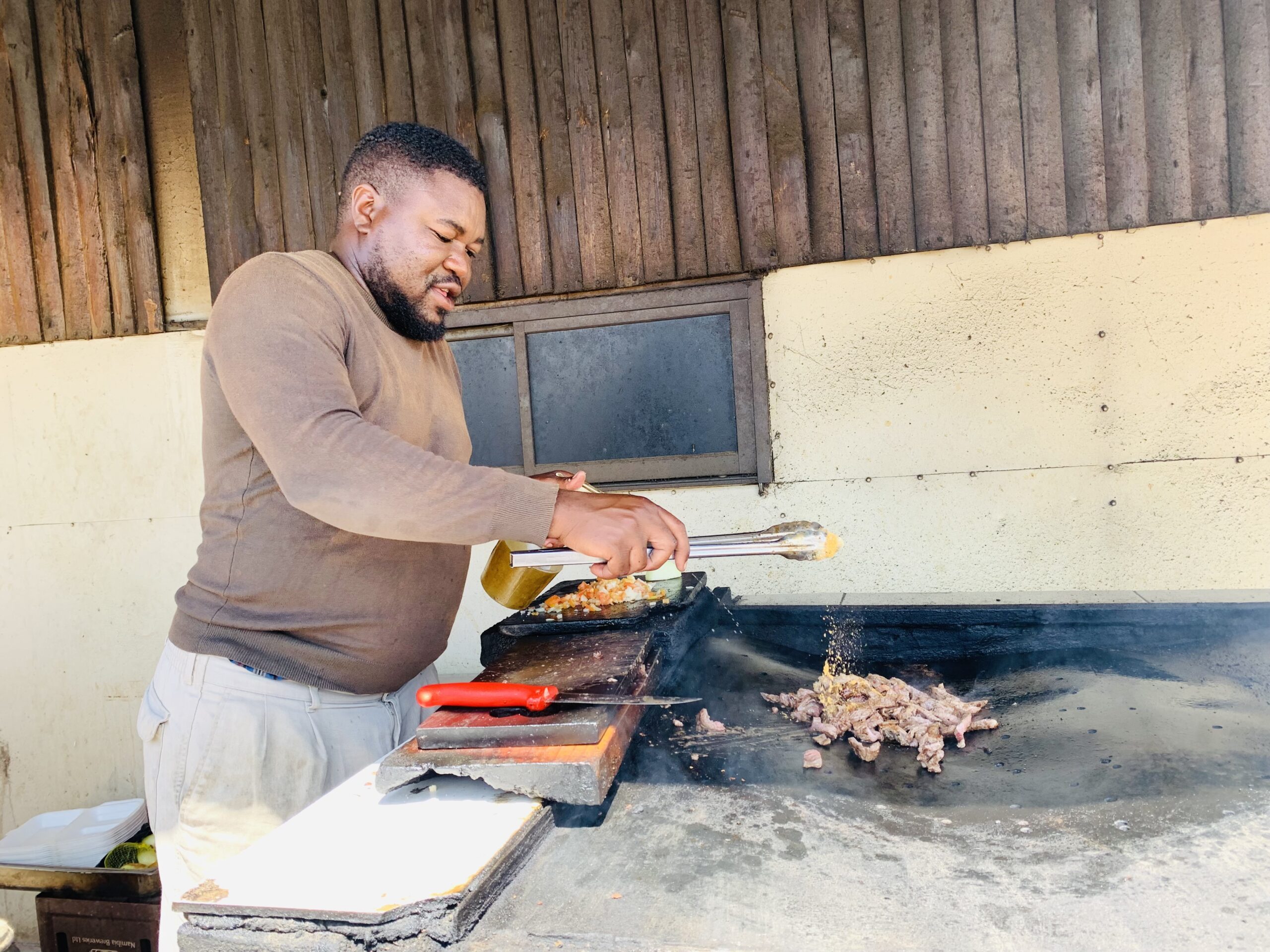

ONGWEDIVA – Every morning at 6am, Petrus Iyambo, better known as Rasta Kapana, rises while the town of Ongwediva is still wrapped in the dawn silence. The streets are nearly empty, punctuated only by the distant hum of cars and the occasional footsteps of early commuters. The air carries a crisp chill, and the faint echo of the waking town lingers across the empty roads.
At his stand near Zola Market, Rasta begins his daily ritual. He lights the coals, each spark catching fire as smoke curls upward, blending with the first rays of sunlight. The crackle of burning wood and the earthy aroma of cooking meat fill the space, announcing the start of another day. This is his time, a quiet prelude before the students, workers, and residents arrive, ready to devour the kapana that has earned him a devoted following.
By sunrise, the grill is roaring, and the Kapana sizzles to perfection. “I wake up early because I want everything ready before the students and workers arrive,” he explains. His kapana is known for being “very sweet, very juicy, and affordable,” attracting loyal customers from IUM, UNAM and the nearby towns of Oshakati and Ondangwa.
Rasta’s journey into Kapana began after a personal setback. He failed Grade 10, a moment that redirected his path. He started selling Kapana in Lüderitz before moving to a location between Ongwediva and Ondangwa, and eventually establishing himself in Shipindo location near Zola Market. Over the past 18 years, he has transformed his humble stand into a thriving business.
The stand is more than just a food stall, it is a community hub. Customers praise it is cleanliness, the speed of service, and the unique flavour of his Kapana. Maria Hamutenya, a long-time supporter, said that, “ever since I came to Ongwediva, I have never tasted any other Kapana apart from Rasta’s. It is very clean, very sweet, and the seller is always friendly.”
Rose Kamati added that, “I feel safe eating Rasta’s Kapana because everything is neat and done in a unique way.” Hilaria Joseph also noted, “Whether it is an online order or a physical visit, everything is delivered on time.”
Rasta employs more than five people. Some work at the Kapana stand, others at his car wash, and a few managing his pub. His business allows him to support his family financially.
“Since I do not have a child of my own, I have managed to pay school fees for my siblings,” he said.
In addition to walk-in customers, Rasta delivers kapana to homes, charging N$13 per order while covering additional del iver y cost s himself. His services extend to high-profile events such as weddings and birthday celebrations, where he braais kapana and ensures guests enjoy freshly prepared meals.
Despite his success, Rasta faces daily challenges. Meat sometimes goes bad, forcing him to refrigerate it until booked. This limits the display of his products, yet he continues to deliver quality kapana with speed, care, and consistency, a devotion that has made him a household name in northern Namibia.
-taimihaihambo2000@gmail. com