

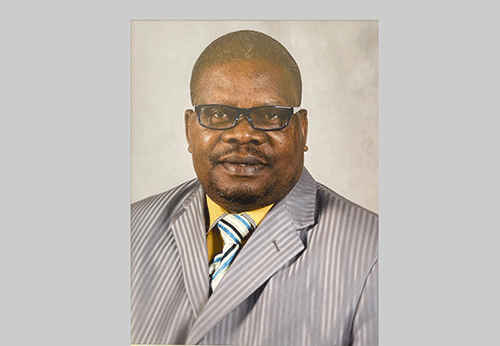

Kazara Ndovazu
OROKAPARE – If a day is a very long time in politics, then five years is eternity.
Between 2020 and 2025, the political career of former journalist and erstwhile Opuwo Urban constituency councillor Weich Mupya appeared all but over following his failure to retain the position.
However, as is the case with all great comebacks, fate had something bigger in store for him.
In this piece, we go down memory lane to where it all began.
Forty years ago, a young boy herding goats in the dusty plains of Ovivero did not know what a schoolbook looked like, let alone an embassy. Today, that boy stands at the pinnacle of Namibia’s diplomatic service.
Appointed by President Netumbo Nandi-Ndaitwah as the ambassador-designate to the Arab Republic of Egypt late last year, Weich Murcle Uapendura Mupya has travelled from the remote margins of the Kunene region to the centre of international diplomacy.
Roots
Mupya was born at Okatjetje, a small traditional settlement on the outskirts of Opuwo. His mother, Utemba Hepute of the Omukuatjivi clan, and his father, Katjiheva Mupya of the Omukueyuva clan, rooted him firmly in the social and cultural lineage of the region.
His upbringing, however, followed a different path. Through the customary practice of okuverwa, Mupya was traditionally adopted by his mother’s younger sister, Vemunongua Kututa, and her husband, Venoori Tjingee. He was raised between Omuhoro and Okaumbamenje, remote villages located some 150 kilometres west of Opuwo.
Growing up far from schools and administrative centres, Mupya spent much of his childhood herding livestock.
“I grew up looking after goats, sheep and cattle,” Mupya recalls. “As far away from all civilisation as I grew up, I did not even dream of going to school one day,” he added.
Hunger
It was hunger, not ambition, that set Mupya on the path to diplomacy.
The year was 1977. A severe drought had forced his adoptive family to move to Otjikunda, near Otjiu West. From there, Mupya was sent to Ovivero, a cattle post about 42 kilometres east of Opuwo, where life was defined by endurance.
When maize meal ran out at the cattle post, hunger troubled the household. It was this basic, desperate need that sent young Weich walking to Otjihama to collect supplies. It was a simple errand, but it would alter the course of his life forever.
There, for the first time, he met his elder brother, Kamanene Michael Mupya, who was working as a clerk at the Bantu Commissioner Ben van Zyl’s office in Opuwo. His brother not only provided the maize meal but also refused to send him back to the cattle post. Instead, he took him to school the following morning.
In March 1977, at the age of 11, Mupya entered Sub A at Opuwo Lower Primary School under teacher and former Member of Parliament Mike Ratoveni Kavekotora during the stewardship of Mannasse Ntananga Hihanguapo. Among his teachers were Lazarus Ueritjinga Ndovazu, Fanie Tjihove and Pieter Kavari, while classmates included Chris Kapitisire Tjijahura, Karutavi Muambo and Kozongombe Kasirua – names he still recalls with precision.
His educational journey continued through Opuwo Junior Secondary School (now Mureti Secondary School), where he completed Standard 7 in 1985, before moving to Augustineum Senior Secondary School in Windhoek. He completed Standard 10 in 1989, the same year Namibia prepared for its first United Nations-supervised elections, under Martti Ahtisaari, which led to independence on 21 March 1990.
Politics
During these formative years, Mupya became active in student politics. In 1988 and 1989, he served as deputy secretary of the Namibia National Students Organisation (Nanso) of the Augustineum branch.
Around the same period, he formally joined Swapo, under the mentorship of the late Uaundjisa Kenatjironga Muharukua and his wife, the late Angelica Kazetjindire Muharukua. Through them, he was introduced to the giants of the struggle, including Daniel Tjongarero, Hidipo Hamutenya, Anton Lubowski, Martin Kapewasha, Ben Ulenga and Katikisa Tjijombo.
Appointment
On 15 October 1990, barely seven months after independence, Mupya was appointed information officer to establish the Ministry of Information and Broadcasting in the Kunene region. Based in Opuwo, with a sub-office in Khorixas, his task unfolded in a politically sensitive environment where Swapo – newly transformed from a liberation movement to a governing party – was still viewed with suspicion in parts of the region.
“Opening a government information office was often seen as the manifestation of Swapo activities rather than development,” Mupya says, recalling harassment, intimidation and violence that lingered from the late 1980s into the early 1990s.
Despite these challenges, the office expanded from a three-person operation into a fully staffed regional institution with eight employees by the time he departed.
Parallel to his government work, Mupya played a pivotal role in labour organising through the Namibia Public Workers Union (Napwu). He helped establish the union’s branch in Opuwo and contributed to the appointment of its first branch coordinator, Uaakuihe Muhuka. His trade union involvement spanned several leadership eras, from Peter Iilonga through to Peter Nevonga, working alongside figures such as Elifas Dingara.
Election
In December 2015, Mupya was elected as the first Swapo councillor for the Opuwo Urban constituency since the establishment of regional councils in 1993. His tenure was tested by service-delivery protests.
“As Swapo councillors in Kunene, you are expected to perform exceptionally,” he notes, pointing to demonstrations in 2016 and 2017 despite efforts to expand water access to communities including Omakange, Okapuindja, Otjerunda, Otjijarua, Orumana, Okahungu and Ohungumure.
Defeat
The 2020 elections, when Swapo lost control of Kunene, did not shake Mupya’s resolve. He describes the defeat as “a learning curve” rather than a disappointment. He remained active at the grassroots level, serving as a branch coordinator within the Opuwo Urban District.
“Loyalty and commitment to a cause does not end with electoral defeat,” he says. “Being a section leader is as important as holding senior office. Swapo should not only be good to you when you become a district coordinator or a regional coordinator”, he added.
Diplomacy
It is this humble journey traversed, Mupya notes, that accompanies him into diplomacy. He was appointed ambassador-designate to Egypt last month.
Mupya framed the role in institutional rather than personal terms.
“Don’t praise me; praise God, President Netumbo Nandi-Ndaitwah as the appointing authority, and minister Selma Ashipala-Musavyi. Credit must go where it is due,” he said.
His mandate, as he understands it, is both historical and forward-looking: sustaining Namibia–Egypt relations.
“I will not disappoint in my responsibility to represent the President and the Namibian nation. My task is to uphold the longstanding cooperation between Namibia and Egypt, which dates to the pre-independence era, while expanding trade between the two countries, as well as increasing the investment,” he said.
For young Namibians, particularly those from Kunene, Mupya offers a simple but firm message: shortcuts rarely lead to lasting success.
“It is very rare for one to get to the top through shortcuts. Loyalty to your cause and meaningful contribution to your country matter,” the soft-spoken politician and now diplomat said.
*Kazara Ndovazu is a communications strategist and youth empowerment advocate from Orokapare, Kunene region. He writes in his personal capacity.