

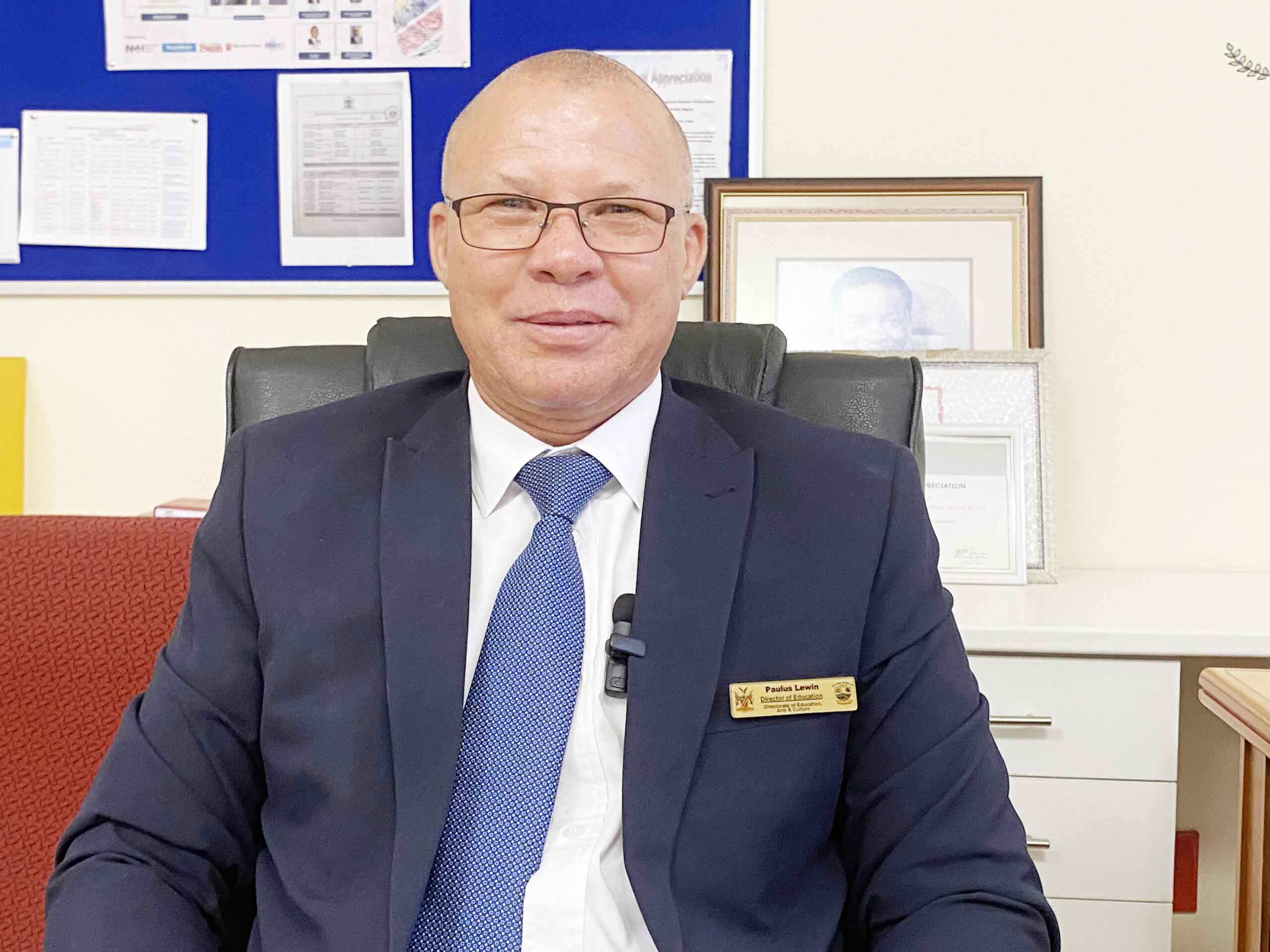

The Hardap region has staged one of the most remarkable education turnarounds in the country, jumping from 12th to second position nationally in Grade 12 results, following the implementation of a bold five-year turnaround strategic plan introduced in 2025.
Hardap education director Paulus Lewin, in an interview with New Era, said the feat was no fluke but the result of deliberate, fast-tracked interventions aimed at addressing long-standing systemic weaknesses across all grades, not just NSSCO and NSSCAS.
“I wouldn’t say this achievement comes as a surprise necessarily. However, it caught us by surprise in one way or another. But it was also a welcoming and remarkable achievement to reward us for all our hard work during 2025,” Lewin said.
When Lewin arrived in Hardap in January last year, the region had fallen sharply from its former status as one of the country’s top performers.
“The Hardap region was actually number one in the country, if not number two or so. But all of a sudden it collapsed down to almost the last places on the national ranking,” he said.
Strategy
In response, the directorate introduced a five-year strategic turnaround plan with 12 objectives, anchored on improving academic performance and service delivery, while shortening the time it takes to implement decisions.
He said the plan places strong emphasis on improving learner outcomes, strengthening service delivery and speeding up implementation, with particular attention given to accountability and staff performance.
One of the key achievements under the plan has been a sharp rise in the number of learners qualifying for AS-level, which increased from 13.8% in 2024 to 25.7% in 2025. The education director says this improvement reflects better teaching practices, closer monitoring of schools and improved learner support.
Development
A key focus was continuous professional development. The educationalist indicated that as part of the strategy, teachers and education officials receive regular training to improve classroom delivery, assessment methods and curriculum coverage.
“You can have this beautiful plan worked out in detail. But if you don’t have people that run with the vision of the region and are committed to it, you will not go far,” he said.
The directorate also strengthened school inspections to ensure compliance and accountability at all levels.
At the same time, the region prioritised staff wellness and morale, recognising that productivity and performance are closely linked to the physical and mental well-being of educators.
To address this, Lewin said the directorate introduced wellness and mental health programmes for staff at the regional and school levels.
“If you have very sick people physically, mentally, and emotionally, you cannot expect productivity from those people,” Lewin said.
With morale restored, the directorate pushed for faster action and stronger accountability.
“My idea was to shorten the turnaround time of activities being implemented in the region,” he said.
Another major intervention focused on improving the physical condition of schools and hostels, many of which were in a dilapidated state.
Implementation
What is more, Lewin stressed that the region’s turnaround plan is focused on implementation rather than rhetoric.
“Otherwise, it doesn’t make sense to have a vision, but nothing is happening in that regard,” Lewin said.
As the five-year strategy moves into its next phase, the directorate is preparing to intensify efforts aimed at strengthening the capacity of teachers, particularly in subject content knowledge, which has been identified as a major weakness in the system.
Lewin noted that incomplete syllabus coverage remains a recurring problem, often linked to limited subject mastery and poor time management.
“Many a time, the teachers are not completing the syllabi or the scheme of work simply because they don’t know, or else they are not good at time management,” he said.
The directorate also scrutinises assessment practices, including how learners are prepared for external examinations at ordinary level, advanced level and the semi-external Grade 9 examinations.
In addition to improving teaching and assessment, the region plans to restructure certain schools and introduce targeted support for high-performing learners who are being held back by socio-economic constraints.
On the downside, despite strong academic ability, many gifted learners in Hardap are unable to access high-performing schools outside the region because their families cannot afford the associated costs, he lamented.
To address this, the directorate is working towards establishing a school of excellence, similar to Rukonga Vision School in the Kavango region, but adapted to Hardap’s specific circumstances.
“At least we will be able to catch these few gifted learners and give them an opportunity in an environment in which they can flourish,” he said.
Complementary interventions such as holiday schools, afternoon classes and weekend lessons will continue to support learners, particularly those preparing for national examinations.
Challenges
However, Lewin acknowledged that high dropout rates and automatic learner transfers continue to undermine performance, as many learners progress without mastering basic competencies.
“The majority of the learners are being transferred without mastering the basic competencies at their current levels,” he said.
This, he said, places learners at a disadvantage in higher grades, often leading to failure or dropout.
As an intervention, the directorate has placed renewed emphasis on foundation-phase teaching, urging junior and senior primary teachers to ensure that literacy and comprehension skills are firmly established.
Despite the scale of the task ahead, Lewin remains confident, pointing to the unity shown across the region in 2025 as proof that progress is possible.
“When we stand together, we can achieve so much more,” he said.
Funding
On the question of funding, Lewin dismissed the notion that limited resources should stall progress.
“If you wait for the money to be enough, it will never be enough,” he said.
He said the region has instead focused on using available resources effectively, an approach that has already attracted donor confidence, including the construction of an N$11.6 million hostel complex in Gochas for marginalised learners.
“Success is a very slow process. But for us to quit will also not make it faster,” Lewin said.
Another major focus area has been school infrastructure. Many schools and hostels in the region were previously in a dilapidated condition, affecting both teaching and learning.
In early 2025, schools were directed to prioritise maintenance, renovation and basic beautification using available resources.
– ljason@nepc.com.na