

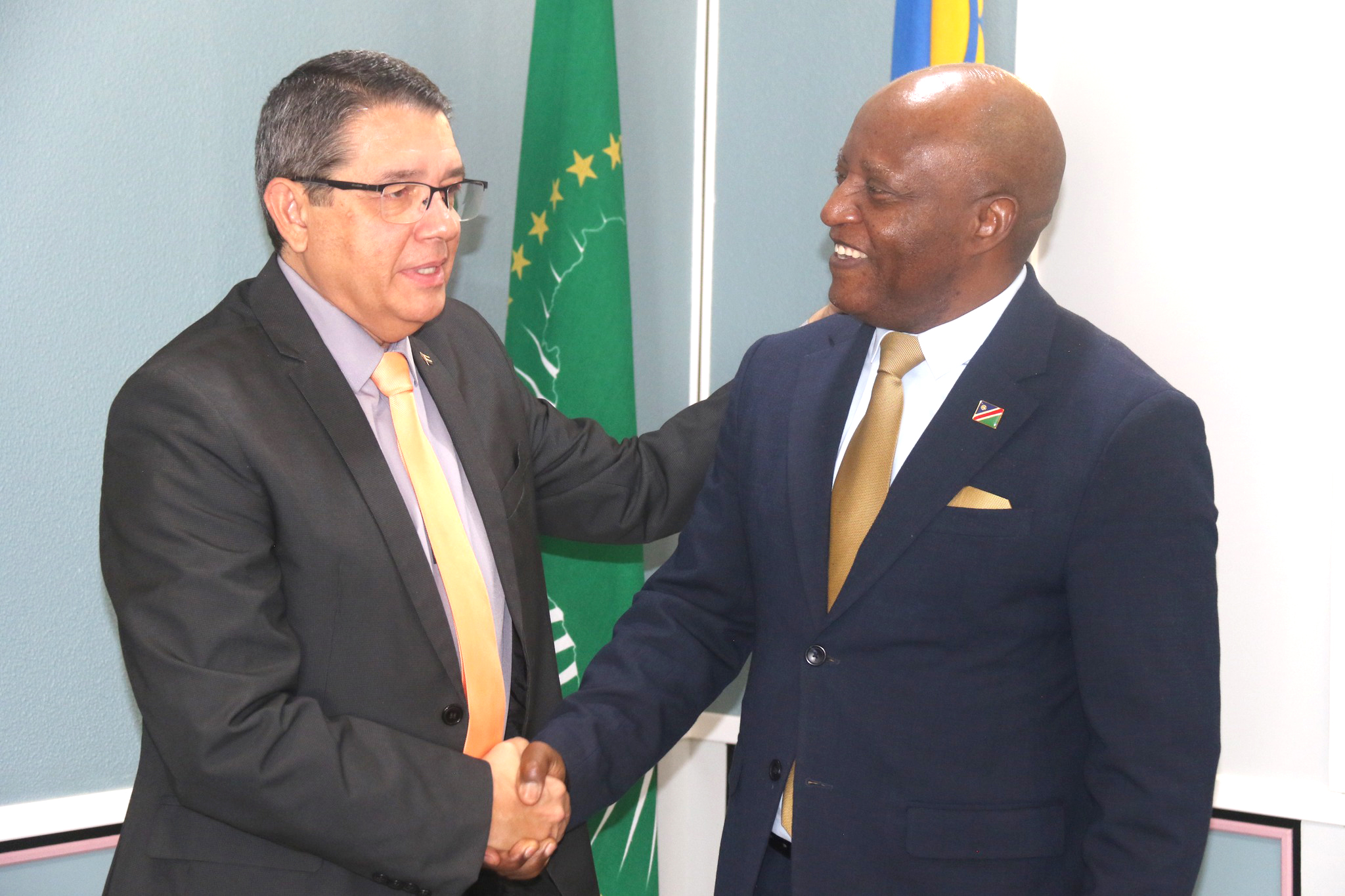

Namibia and Cuba are exploring viable options to establish the long-proposed state-of-the-art pharmaceutical plant in Namibia, which will contribute to the country’s health sector’s self-reliance and security of supply.
Prime Minister Elijah Ngurare and Cuba’s ambassador to Namibia, Sergio Vigoa de la Uz, on Tuesday met for in-depth trade, diplomatic and bilateral talks, and the discussions also touched on the construction of the much-anticipated state-of-the-art pharmaceutical plant, which Namibia and Cuba plan to jointly set up.
Ngurare and De la Uz both agreed to continue the joint work around the proposed pharmaceutical plant, through which Namibia wants to leverage Cuban biotechnology as a potential new area of cooperation.
The project is envisaged to boost economic cooperation between the two countries to enable Namibia to be self-reliant in the supply of pharmaceutical products and potentially export to the Southern African Development Community (SADC) and beyond. The two sides further discussed the possibility of introducing the widely acclaimed Cuban Family Doctor Concept in Namibia, alongside the consideration of cultural and youth exchange programmes as the torchbearers of bilateral relations.
Namibia and Cuba enjoy excellent diplomatic and bilateral relations in the areas of health, education, sports, fisheries, and construction, as well as defence and security, which dates to Namibia’s liberation struggle.
Under the longstanding Namibia-Cuba cooperation agreement, specifically on health, education and medical services, Cuba has for decades provided Namibia with health professionals and offers academic training to Namibians at Cuban institutions of higher learning.
Over the past years, a cohort of 173 Namibian medical students graduated from various universities in Cuba, whereas 49 dentistry students completed their studies in that country in 2022. Another group of 5 Namibian medical students graduated in Cuba in July 2024 and have since returned home to practise their profession.
A total of 93 Cuban health professionals are based in Namibia, extending their service in various public health facilities across the country.
Blueprint
The Cuban Family Doctor concept, which Namibia plans to replicate, was introduced in the early 80s and is based on the model called “the family doctor and nurse”, where the basic unit is the family nucleus, with a clinical, epidemiological and social approach to health problems.
The Cuban health system is anchored around six characteristics and core principles, which are accessibility and free services, prophylactic (preventive) orientation, community and intersectoral participation, international collaboration and adequate application of advances in science and technology.
Since 1959, Cuba has made health a national priority by establishing a public, universal and free system, subordinating economic considerations to the imperative of public health, with an annual investment representing the largest share of the national budget.
Based on prevention and the concept of the “family doctor”, it has enabled the population of the island to enjoy a level of health protection unique to third-world countries, comparable to that of the most developed countries.