

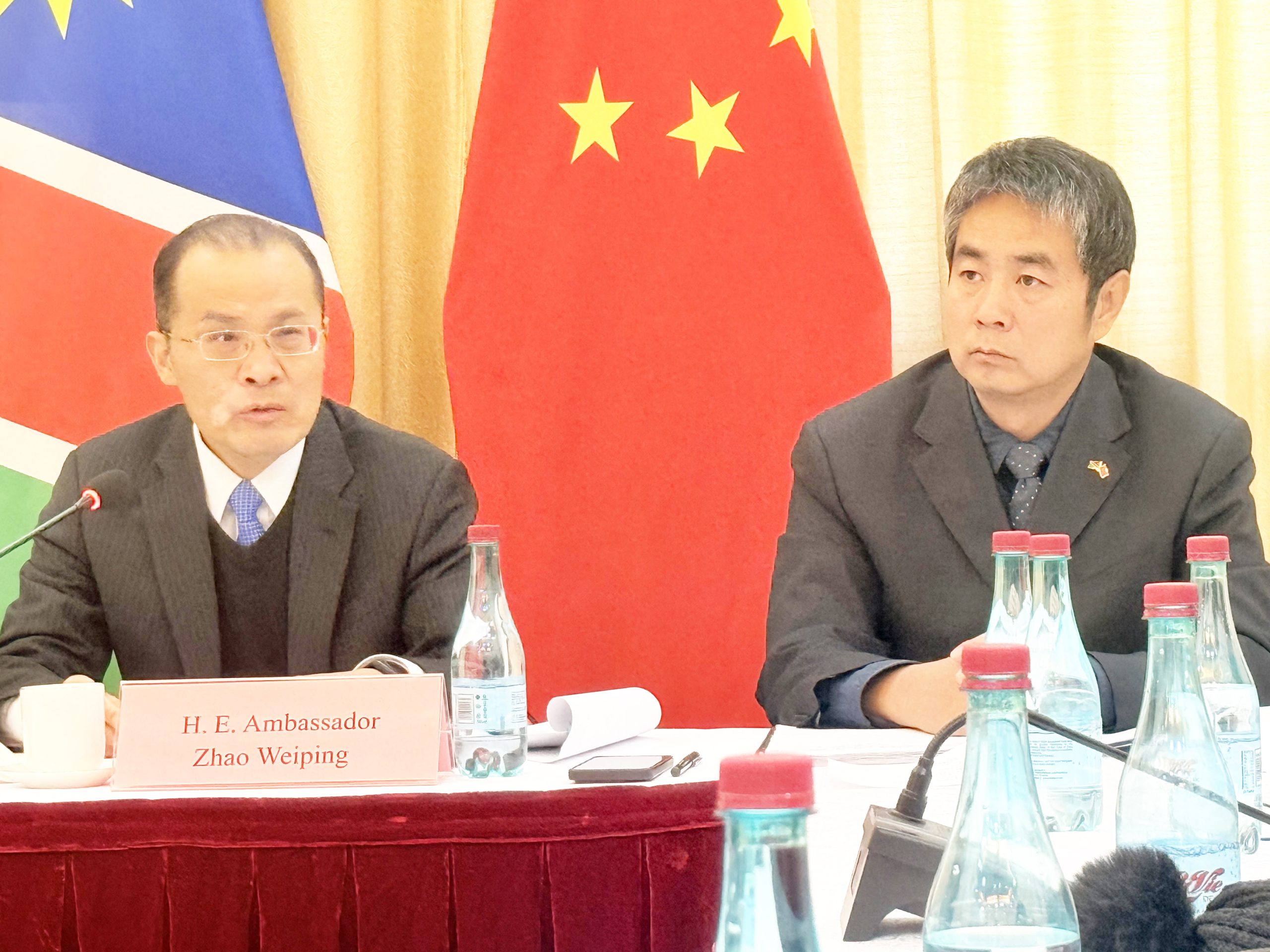

China has urged Namibia to move beyond raw exports and build factories locally, saying the country could double its exports by processing products such as dried beef and dried grapes for the Chinese market.
Speaking during a media briefing on China’s zero tariff policy, Chinese Ambassador Zhao Weiping said Namibia should take advantage of the new trade arrangement by attracting Chinese investors to set up manufacturing and processing plants in the country.
“We should think about setting up factories here. Namibia exports a lot of beef to China, but mostly raw beef. Why not process it here into products for the Chinese market?” he questioned. He said Namibia’s famous biltong could be adapted to suit Chinese consumers, while other products, such as dried grapes, also have strong export potential.
“Chinese people also eat a lot of dried beef and dried grapes. Chinese companies can come here, produce according to Chinese tastes and export back to China. It is workable,” he said.
China officially implemented zero tariffs on products from 53 African countries with diplomatic ties to Beijing on 1 May this year. Namibia is among the beneficiaries.
An import tariff is a tax levied on goods imported from a foreign country. This policy means that African exports to China will no longer be subject to import duties upon entry into the Chinese market.
The move means many Namibian goods entering China will no longer face tariffs ranging from 7% to 25%. China’s Economic and Commercial Counsellor Wei Jinming described the policy as a game changer for Namibia and Africa, saying it opens the door to more exports, investment and industrialisation. He said Namibia has an opportunity to move away from exporting raw materials and start producing finished goods locally.
“A stable expansion of exports to China will attract more foreign investment, including from China, to Namibia,” Wei said.
He said Chinese companies are expected to invest in local processing plants for meat, fish and agricultural products, helping Namibia shift from being only a supplier of raw materials to a producer of value-added goods.
Namibia’s exports to China are currently dominated by uranium, copper, zinc, nickel ore, fish and beef. China accounts for about 18% of Namibia’s total exports, making it one of the country’s biggest trading partners. Economist Joseph Sheeham welcomed the zero-tariff policy, calling it a major opportunity for Africa.
“This is a game changer for Africa and Namibia,” Shiwana said during the briefing. He said the agreement could improve competitiveness, create jobs and support industrialisation across the continent.
“We need modernisation, skills and technology. Africa and Namibia cannot stand alone. We need strong partners,” he said.
Economist Muine Samahiya also welcomed the policy but cautioned that Namibia must ensure local industries benefit through manufacturing and employment creation.
“I think that is where the country should go towards value addition and creating jobs for young people,” he said. China said it would also introduce support measures to facilitate trade, including faster customs clearance, trade exhibitions, and e-commerce platforms to help African products access the Chinese market.
Wei said Namibia could also strengthen its position as a logistics hub for southern Africa by increasing exports through the Port of Walvis Bay. China has remained Africa’s largest trading partner for 16 consecutive years. Trade between China and Africa reached US$348 billion in 2025, according to Chinese officials.
The Chinese government said the zero tariff policy forms part of broader efforts to deepen economic cooperation with Africa amid growing global trade tensions and economic uncertainty.