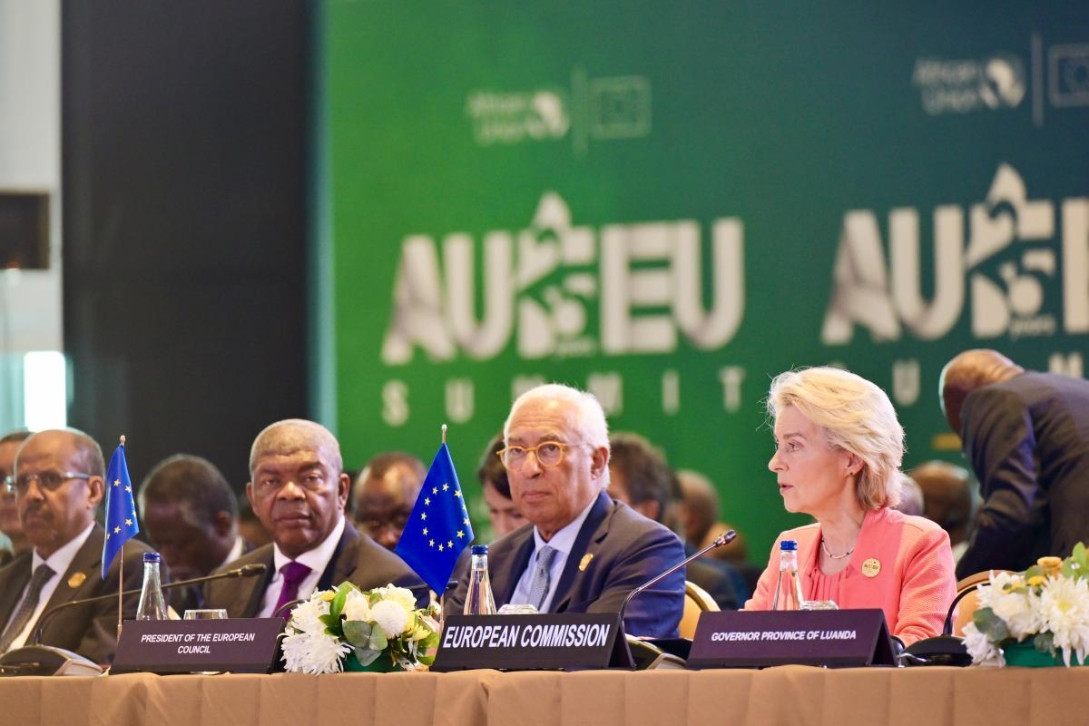

Leaders from across Europe and Africa came together to commemorate a landmark moment: 25 years since the first Africa-Europe Summit in Cairo. Last week, in Luanda, Angola, Heads of State and Government from the European Union (EU) and the African Union (AU) convened for the 7th AU-EU Summit on 24 to 25 November 2025 to renew and deepen a partnership grounded in peace, prosperity, sustainable development and shared opportunity.
President of the European Commission Ursula von der Leyen and European Council president António Costa participated in the Summit, reaffirming the EU’s commitment to advancing this vital intercontinental partnership. Their presence follows the Europe–South Africa Leaders Meeting and the historic G20 Summit hosted for the first time on African soil, together underscoring Africa’s central and growing role on the global stage.
Marking the occasion, president von der Leyen stated that, “Twenty-five years ago at our first Summit in Cairo, Europe and Africa decided to build a common future together. In Luanda today, we celebrate the spirit of Cairo. We are taking the unique partnership between Europe and Africa to the next level. With new projects under Global Gateway, Europe’s investment plan for a better-connected world, we open a new era in trade and cooperation between our two markets. And we will step up our cooperation on clean energy and critical raw materials projects that strengthen value chains and create jobs. This is how Europe builds genuine and enduring partnerships.”
Through Global Gateway, the EU has already mobilised €120 billion for projects all across Africa. Large-scale investments and expertise have been mobilised in strategic sectors such as green energy, transport corridors, digitalisation, health systems and resources.
The EU is well on track to surpass the initial target of €150 billion by 2027.
Looking ahead, leaders committed to take the EU-AU cooperation one step forward through Embracing the digital revolution. The EU will contribute another €122 million to the Finnfund Global Connect programme, of which €32 million to expand subsea cables, fibre networks, data centres and mobile payment systems in Africa.
Leaders committed to advancing peace, security and governance by strengthening AU-led mediation efforts in conflict-affected zones like the Great Lakes and advancing African-led peace operations, such as those in Somalia or against Boko Haram. Both sides will also further deepen cooperation on counterterrorism and the fight against organised crime, as well as enhance collaboration on cyber, maritime and space security.
The European Union remains Africa’s top trading and investment partner, underpinned by a stable and rules-based framework that makes the EU a reliable and trusted counterpart for long-term economic cooperation. Africa is the EU’s fourth-largest trading partner, and over the past decade EU–Africa trade has grown by 30%, while EU investment stocks on the continent have increased by 13%. Today, 44 African countries benefit from duty-free access to the EU market, with 97% of African exports entering the EU without paying any tariffs. Through its extensive network of free trade agreements and generous unilateral preference schemes, the EU continues to provide the broadest and most predictable market access available to African economies, supporting sustainable growth, diversification, and job creation across the continent.
The EU–Namibia partnership stands as a concrete example of the AU-EU relationship in action. They share a strong political partnership grounded in shared values, based on the UN charter. The EU is one of Namibia’s top trading partners, with the SADC–EU Economic Partnership Agreement enabling duty- and quota-free access to the EU market. Namibia will be hosting a new EU–Namibia Business Forum in early 2026 in Windhoek to further drive diversification, value addition and inclusive growth. Through the Strategic Partnership on Green Hydrogen and Critical Raw Materials, the EU is supporting Namibia’s green industrialisation with a 360-degree approach that has already mobilised nearly N$2 billion for pilot projects and future value chains. EU – Namibia Cooperation also strengthens foundational skills and early childhood development, advances good governance and anti-corruption efforts, and supports gender equality and civil-society initiatives addressing gender-based violence.
Together, the AU and EU represent and carry the voices of more than 1.9 billion people. In a time of geopolitical uncertainty, the 7th AU-EU Summit in Luanda, themed ‘Promoting Peace and Prosperity through Effective Multilateralism’, highlighted the strong and solid relationship between Europe and Africa and the shared priorities of both continents. The high-level participation at the Summit underlined that the EU and the AU are advancing on their partnership of equal and mutual interest.
– newsroom@nepc.com.na