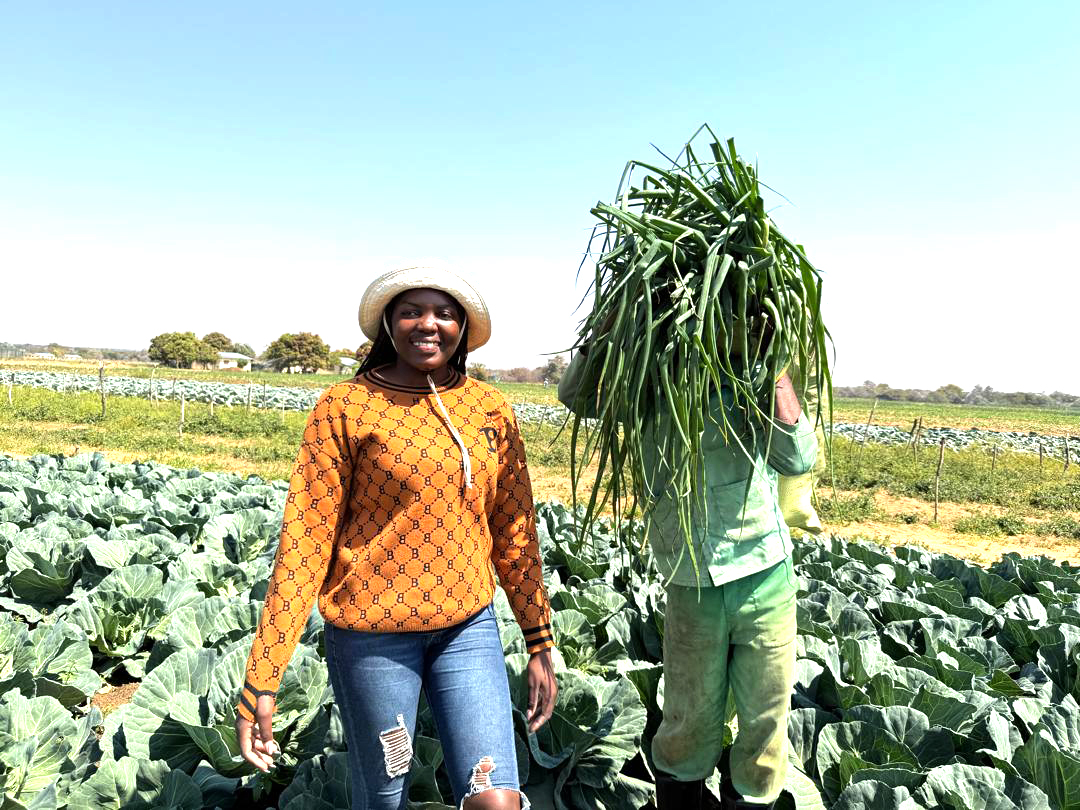

Lahja Nashuuta
At the Etunda Irrigation Project in Namibia’s Omusati region, 33-year-old young farmer Aina Imalwa, popularly known as ‘Aina, the Farmer’, is redefining what it means for young women to succeed in agriculture.
Once a mobile hairdresser, she now manages her own six-hectare farm. Her journey is marked by hard work, vision, and unwavering determination.
Imalwa believes that when women are given the right resources and trusted for their abilities, they transform not only their own lives but also inspire others to take charge of their financial independence.
Speaking to AgriToday, Imalwa said that for her, farming is a business. “I run my farm like a business. Whenever I sell, I reinvest. Many young people make the mistake of spending their earnings on fun instead of putting it back into their projects. I don’t want to remain small-scale; I want to become a commercial farmer,” she asserts.
Imalwa added that success in agriculture also depends on strategy. “For example, cabbage sells well in winter because people need it for soup. It’s all about knowing what to grow when and sometimes taking risks. Farming is about planning, strategy, and courage,” she emphasised.
From hairdressing to horticulture
Farming was never part of Imalwa’s childhood dreams. Born and raised in Omusati, she had hoped to pursue further studies after completing secondary school. But without funds or employment, she turned to hairdressing.
“I started as a mobile hairdresser. I advertised my services on social media, and when a client booked me, I would travel to their home. Every day, I was moving from one house to another,” she recalled.
Her life changed when she saw an advert calling for young people to apply for Agridev funds. She applied, was selected, and later trained at the Mashare Agricultural College in Kavango before being placed at Etunda.
“I was 28 when I started farming. At first, I didn’t know what I was doing. I just wanted an opportunity. But during training, I met other farmers, and I realised farming is a beautiful thing.”
Inspired by young farmers in South Africa and Zambia, she set out to prove that farming could be modern, innovative, and attractive.
“I wanted to show people that farming is not just for uneducated people, and it’s not only for men. Women can do it too and do it well,” added Imalwa.
What she grows
Today, Imalwa produces a variety of seasonal crops, including cabbage, tomatoes, passion fruit, cantaloupe, Chinese cabbage, and even red cabbage, which is rare and costly in Namibia.
“Many people think red cabbage is only for the rich because they can’t afford it in shops. I want to change that by producing it locally and making it more accessible,” she explained.
Her produce is sold at informal markets such as the Oshakati open market, as well as at formal local supermarkets like Spar and Freshco. She also relies heavily on social media to reach customers.
“When I was a hairdresser, I learned how powerful social media is for marketing. I use the same strategy today to advertise my produce.”
Despite the struggles, Imalwa remains optimistic and urges young Namibians to take up farming.
“Farming is beautiful, but you need patience. It’s not quick money and one must be willing to learn and improve every year. I see these past five years as a learning process. Now I can confidently call myself a farmer.”
Imalwa said she uses her income to support her family and employs a growing team.
“I started with one worker, and now I have four permanent employees and hire casuals during peak seasons. I also motivated my brother to start his own business instead of relying on me.”
Challenges on the farm
Like many farmers, Imalwa faces significant hurdles. “The market can sometimes be flooded, which forces us to sell cheaply and not recover our investment. Transport is also another challenge, since I don’t own a vehicle and inputs like fertilizer are very expensive as well,” she shared.
She also pointed out natural disasters and pests as constant threats. “You must be on the ground every day to protect your crops. This year, heavy rains destroyed most of what we planted, and we had to start over.”
Imalwa’s concerns are also shared by another farmer, Maria Ashipala, a seasoned farmer based at Etunda since 1999.
With 25 years’ experience, Ashipala points out that access to markets remains the biggest stumbling block for them.
“It’s one thing to grow crops and another to sell it. We really don’t have a stable market. Those with cars drive to Outapi or Oshakati, but for most of us, we depend on passersby or must look for our own customers,” she said.
In the past, companies such as Choppies bought in bulk, but those arrangements collapsed, leaving farmers to fend for themselves.
“Our appeal is for government to use our produce in schools, hospitals, and public events. We also want big shops like Shoprite and Pick n Pay to buy directly from northern farmers. Institutions should be fed by us, the local farmers,” she maintained.
Once a tailor by profession, Ashipala now employs three permanent workers and up to 30 casual labourers during peak seasons. She expressed gratitude to government for stepping in to subsidise fertiliser for two consecutive years.
“Most farmers were about to give up because fertiliser is very expensive. With that support, many of us managed to return to our fields.”
Ashipala also revealed that getting a tractor on time is a real challenge and the water pipes at the site are ageing. “We need more machinery and continued assistance with fertiliser,” she stressed.
Govt support
Reached for comment, Omusati Governor Immanuel Shikongo spoke about the challenges and opportunities for young people in farming, and the important role of local farmers in keeping the region as one of the food baskets.
“From here to Etunda, you will see farmers turning traditional fields into productive farms, from small backyard gardens to large projects. Our new tomato processing plant will help farmers keep their tomatoes fresh and prevent them from spoiling in town markets. By storing them in a cooler, controlled environment, we ensure their hard work does not go to waste,” he said.
He also emphasised the need to support these farmers, especially with market access and storage.