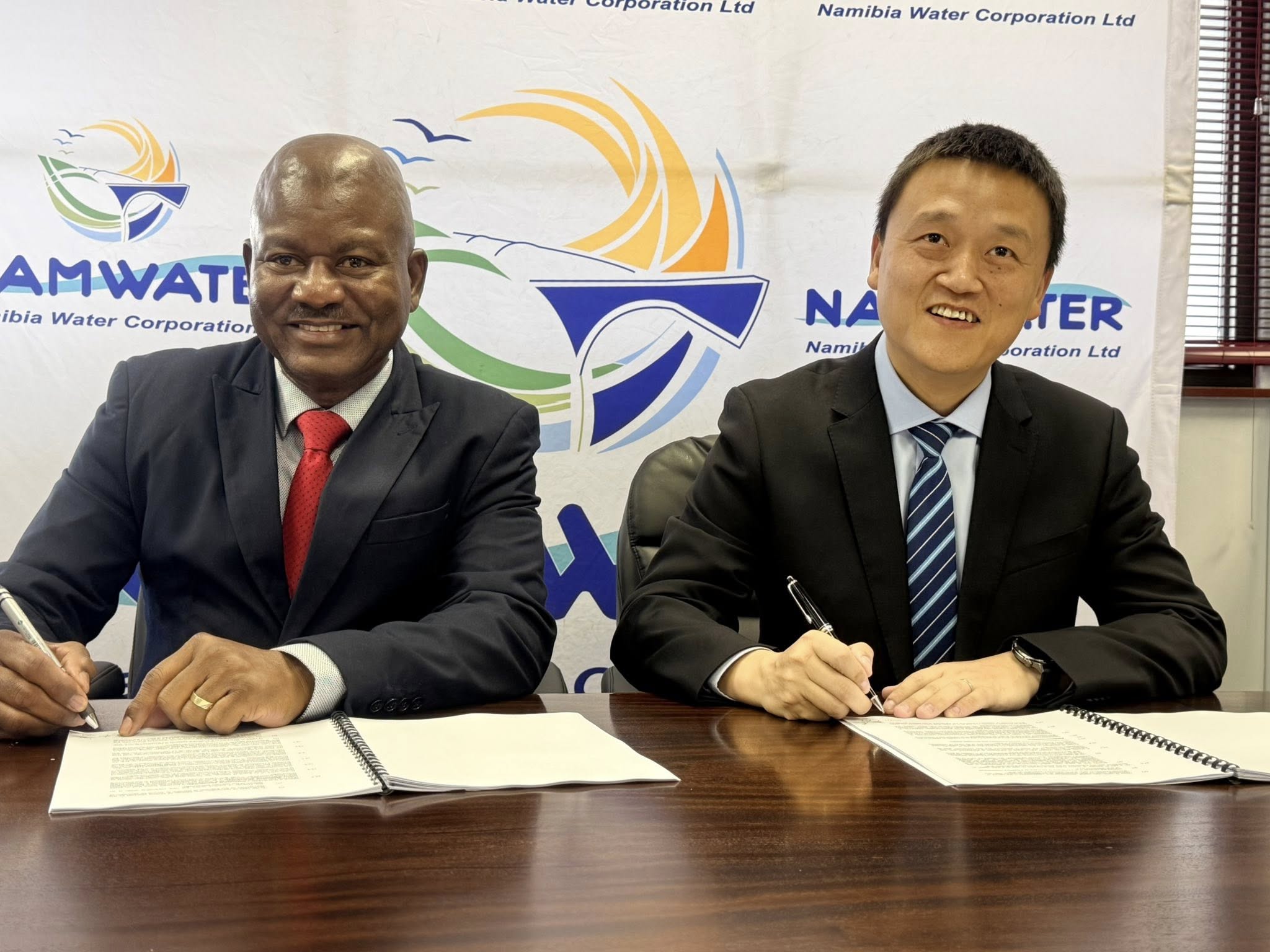

SWAKOPMUND – NamWater and Swakop Uranium have signed an agreement to enter
into a joint venture that will see the construction of a second desalination plant in the Erongo region.
The joint venture, named the Erongo Sunam Desalination Project, is a major step towards securing water for the mining sector and meeting the growing water demand of communities along the coastline.
Erongo continues to be one of Namibia’s most economically active areas, home to thriving mining operations, growing industries, and expanding communities.
However, the region continues to struggle with the availability of water. As a result, the CEO of Namwater, Abraham Nehemia and the CEO of Swakop Uranium, Luo Wei, signed an agreement that has the ability to alleviate water scarcity in the region.
The joint venture will be structured with Swakop Uranium holding a 70% stake, while NamWater will retain 30%. According to a statement released this week by the partners, the structure reflects the respective investment commitments and operational interests of both parties. “While Swakop Uranium contributes significant capital and technical input, NamWater will ensure public-sector oversight, regulatory alignment, and integration with national water infrastructure,” the statement reads.
The construction of the second desalination plant has been in the pipeline since 2016, after the government opted not to buy the Orano desalination plant at Wlotzkasbaken in 2016 due to its high cost.
The plant at that time was offered to the government for N$3 billion by Areva Resources on the basis that such a utility cannot be privately owned.
Currently, some of the mines are receiving water from the Orano desalination plant; however, the plant at times has to be shut down due to sulphur outbreaks in the ocean.
Last year, while proposing the collaboration between NamWater and Swakop Uranium, Executive Vice President Irvinne Simataa said they find themselves having to make decisions around people and industries to the point where the industry must decide to shut down businesses during the sulfuric eruptions. In 2022, they lost 39 days of productive time because of the unavailability of water. He also indicated that Swakop Uranium during that time accounted for 65 % to 70% of the water demand in the region, and that this was a motivation to partner with the government.
“Given the impact we have on business, we have gone to the extent of presenting an unsolicited offer wherein we are saying that we are willing to invest. We would want it fast-tracked to mitigate our business risk,” he said previously.
The cost of the second desalination plant is not yet available, but Simataa earlier hinted that it could cost in excess of N$3.5 billion.
According to the joint statement, the Erongo Sunam Desalination Project will transform water security in Erongo as it will see the construction of a modern seawater desalination plant using energy-efficient and environmentally sound technology. The project also includes upgrades to bulk water conveyance systems, integration with NamWater’s infrastructure, and a long-term operations and maintenance framework. “This project will ensure balanced water distribution to industrial, commercial and domestic users,” the joint statement said.